
Search Market Research Report
Europe Thermal Labels Market Size, Share Global Analysis Report, 2026-2034

Europe Thermal Labels Market Size, Share, Growth Analysis Report By Type (Direct Thermal, Thermal Transfer, and Others), By Application (POS, Tags & Labels, Ticketing, Lottery & Gaming, Medical, and Others), By End-User (Retail, Logistics & Transportation, Healthcare, Manufacturing, Food & Beverage, and Others), and By Region - Industry Insights, Overview, Comprehensive Analysis, Trends, Statistical Research, Market Intelligence, Historical Data and Forecast 2026-2034
Industry Insights
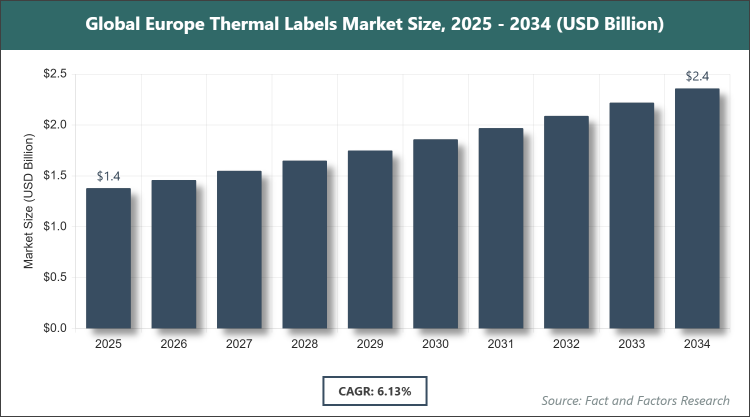
[245+ Pages Report] According to Facts & Factors, the europe thermal labels market size was estimated at USD 1.38 billion in 2025 and is expected to reach USD 2.36 billion by the end of 2034. The europe thermal labels industry is anticipated to grow by a CAGR of 6.13% between 2026 and 2034. The europe thermal labels Market is driven by expanding e-commerce and logistics activities increasing need for efficient inventory management.
 Market Overview
Thermal labels are specialized adhesive-backed materials designed for thermal printing technologies, where heat-sensitive coatings react to produce images without requiring ink, ribbons, or toners. These labels are widely utilized across various industries for applications such as barcode printing, product identification, and shipping documentation, offering advantages like quick printing speeds, durability in certain environments, and cost-effectiveness for high-volume usage. The market encompasses both direct thermal and thermal transfer varieties, catering to diverse needs in retail, logistics, healthcare, and manufacturing sectors within Europe.
Key Insights
- As per the analysis shared by our research analyst, the europe thermal labels market is estimated to grow annually at a CAGR of around 6.13% over the forecast period (2026-2034).
- In terms of revenue, the europe thermal labels market size was valued at around USD 1.38 billion in 2025 and is expected to reach USD 2.36 billion by 2034.
- The market is driven by sustained demand from retail and hospitality sectors, expanding e-commerce and logistics activities, and continued reliance on thermal printing for labels.
- Based on the type, the direct thermal segment dominated the market in 2025 with 55% share due to its cost efficiency, ease of use, and suitability for high-volume applications like logistics labels.
- Based on the application, the tags & labels segment dominated the market in 2025 with 30% share due to the surge in e-commerce activities and the need for efficient inventory management in retail and manufacturing.
- Based on the end-user, the retail segment dominated the market in 2025 with 40% share due to high demand for point-of-sale labeling and compliance with fiscal receipt requirements.
- Based on the region, Germany dominated the market in 2025 with 22.1% share due to its strong fiscal compliance laws, large retail base, and developed logistics sector.
Growth Drivers
- Expansion of E-Commerce and Logistics Networks
The rapid growth of e-commerce platforms across Europe has significantly increased the demand for thermal labels in parcel shipping, warehousing, and supply chain management. With rising online retail activities, efficient tracking and identification systems are essential, driving the adoption of thermal labels for barcode and shipping applications. This trend is further supported by investments in automated warehouses and last-mile delivery solutions, enhancing operational efficiency and traceability.
Additionally, regulatory requirements for product traceability in industries like food and pharmaceuticals bolster the use of thermal labels, ensuring compliance with EU standards on labeling and serialization. Innovations in durable, weather-resistant labels also contribute to market expansion by addressing the needs of cross-border logistics.
Restraints
- Stringent EU Regulations on Chemical Components
EU restrictions on substances like bisphenol A (BPA) in thermal labels pose challenges, increasing production costs as manufacturers reformulate products with safer alternatives. These regulations demand extensive testing and compliance, potentially slowing innovation and raising prices for end-users.
The shift to phenol-free formulations may compromise label durability in harsh environments, limiting applications in certain sectors. Supply chain disruptions from regulatory audits further restrain market growth.
Opportunities
- Development of Eco-Friendly and Recyclable Thermal Labels
The EU's Green Deal and circular economy initiatives create opportunities for sustainable thermal labels made from recyclable materials and eco-friendly coatings. Manufacturers investing in green technologies can capture market share in environmentally conscious sectors like retail and public procurement.
Integration of smart features, such as NFC tags and QR codes, opens new avenues in interactive labeling for consumer engagement and supply chain transparency, aligning with digital transformation trends.
Challenges
- Limited Recycling Infrastructure for Coated Labels
The chemical coatings on thermal labels complicate recycling processes, often excluding them from standard streams and conflicting with EU recycling targets. This environmental concern may lead to increased scrutiny and potential bans on non-recyclable variants.
Volatility in raw material prices, including specialty papers and chemicals, adds financial pressure, impacting profitability and investment in R&D for sustainable alternatives.
Report Scope
Report Attribute |
Details |
Market Size 2025 |
USD 1.38 Billion |
Projected Market Size in 2034 |
USD 2.36 Billion |
CAGR Growth Rate |
6.13% CAGR |
Base Year |
2025 |
Forecast Years |
2026-2034 |
Key Market Players |
Koehler Paper Group, Mitsubishi HiTec Paper, Oji Holdings, Jujo Thermal, Appvion, Ricoh, Hansol Paper, Iconex, Nakagawa Manufacturing, Rotolificio Bergamasco, and Others. |
Key Segment |
By Type, By Application, By End-User, and By Region |
Major Regions Covered |
North America, Europe, Asia Pacific, Latin America, and the Middle East & Africa |
Purchase Options |
Request customized purchase options to meet your research needs. Explore purchase options |
Market Segmentation
The europe thermal labels market is segmented by type, application, end-user, and region.
Based on Type Segment, the europe thermal labels market is divided into direct thermal, thermal transfer, and others. The direct thermal segment is the most dominant, holding a significant market share due to its simplicity, lower operational costs, and suitability for short-term applications like shipping labels. It drives the market by enabling quick, on-demand printing without ribbons, reducing maintenance needs and supporting high-volume operations in logistics and retail. The thermal transfer segment is the second most dominant, favored for its durability and resistance to environmental factors, making it ideal for long-term labeling in manufacturing and healthcare, thus contributing to market growth through enhanced product longevity and compliance with stringent standards.
Based on Application Segment, the europe thermal labels market is divided into POS, tags & labels, ticketing, lottery & gaming, medical, and others. The tags & labels segment is the most dominant, driven by e-commerce growth and inventory management needs, providing efficient tracking and identification that boost supply chain efficiency. The POS segment is the second most dominant, supported by retail transaction volumes and regulatory requirements for receipts, facilitating fast printing and compliance that sustain market demand.
Based on End-User Segment, the europe thermal labels market is divided into retail, logistics & transportation, healthcare, manufacturing, food & beverage, and others. The retail segment is the most dominant, fueled by high demand for barcode and product labeling, enhancing inventory control and customer service efficiency. The logistics & transportation segment is the second most dominant, driven by shipping and tracking requirements, improving operational accuracy and supporting e-commerce expansion.
Recent Developments
- Manufacturers like Mitsubishi HiTec Paper and Oji Holdings commercialized phenol-free thermal label grades compliant with EU regulations.
- Koehler Group enhanced digital capabilities and partnerships with European retailers and logistics firms for supply chain efficiency.
- Oji Holdings expanded R&D collaborations with European partners to improve coating technologies and recyclability.
Regional Analysis
- Germany to dominate the market
Germany leads the europe thermal labels market, driven by its robust manufacturing and logistics infrastructure, which demands high-quality labeling for export-oriented industries. The country's emphasis on automation in warehouses and compliance with EU traceability regulations further accelerates adoption. Strong retail networks and e-commerce penetration, coupled with innovations in sustainable materials, position Germany as a key hub for market advancements.
France exhibits strong growth in the thermal labels market, supported by its vibrant hospitality and retail sectors requiring durable labeling solutions. Regulatory mandates for food safety and pharmaceutical serialization enhance demand, while expanding logistics networks for cross-border trade contribute significantly. Investments in eco-friendly technologies align with national sustainability goals, fostering innovation and market expansion.
The United Kingdom maintains a prominent position in the thermal labels market, bolstered by its advanced e-commerce ecosystem and healthcare labeling needs. High volumes of online retail necessitate efficient shipping labels, while NHS requirements for patient identification drive medical applications. Post-Brexit trade adaptations have increased focus on supply chain transparency, promoting thermal label usage.
Italy's thermal labels market thrives on its tourism-driven economy and small business landscape, where fiscal regulations mandate physical documentation. The manufacturing sector, particularly in fashion and food, relies on precise product labeling for branding and compliance. Growing e-commerce and logistics improvements further support market development in this region.
Spain emerges as a high-growth area in the thermal labels market, propelled by tourism recovery and retail modernization. Expanding logistics infrastructure for international trade demands reliable labeling solutions, while the food industry adheres to EU export standards. Digital integration in supply chains enhances efficiency, driving sustained demand for innovative thermal labels.
Competitive Analysis
The europe thermal labels market is dominated by players:
- Koehler Paper Group
- Mitsubishi HiTec Paper
- Oji Holdings
- Jujo Thermal
- Appvion
- Ricoh
- Hansol Paper
- Iconex
- Nakagawa Manufacturing
- Rotolificio Bergamasco
The europe thermal labels market is segmented as follows:
By Type
- Direct Thermal
- Thermal Transfer
- Others
By Application
- POS
- Tags & Labels
- Ticketing
- Lottery & Gaming
- Medical
- Others
By End-User
- Retail
- Logistics & Transportation
- Healthcare
- Manufacturing
- Food & Beverage
- Others
By Region
- UK
- France
- Spain
- Germany
- Italy
- Russia
- Sweden
- Denmark
- Switzerland
- Netherlands
- Turkey
- Czech Republic
- Rest of Europe
Industry Major Market Players
The europe thermal labels market is dominated by players:
- Koehler Paper Group
- Mitsubishi HiTec Paper
- Oji Holdings
- Jujo Thermal
- Appvion
- Ricoh
- Hansol Paper
- Iconex
- Nakagawa Manufacturing
- Rotolificio Bergamasco
Frequently Asked Questions



Copyright © 2025 - 2026, All Rights Reserved, Facts and Factors