
Search Market Research Report
Erucamide Market Size, Share Global Analysis Report, 2026-2034

Erucamide Market Size, Share, Growth Analysis Report By Product Form (Powder, Beads, and Others), By Function (Slip Agent, Anti-block Agent, Lubricant, Dispersing Agent, and Others), By End-Use Industry (Plastics, Rubber, Food Packaging, Textile, Ink and Coatings, and Others), and By Region - Global Industry Insights, Overview, Comprehensive Analysis, Trends, Statistical Research, Market Intelligence, Historical Data and Forecast 2026-2034
Industry Insights
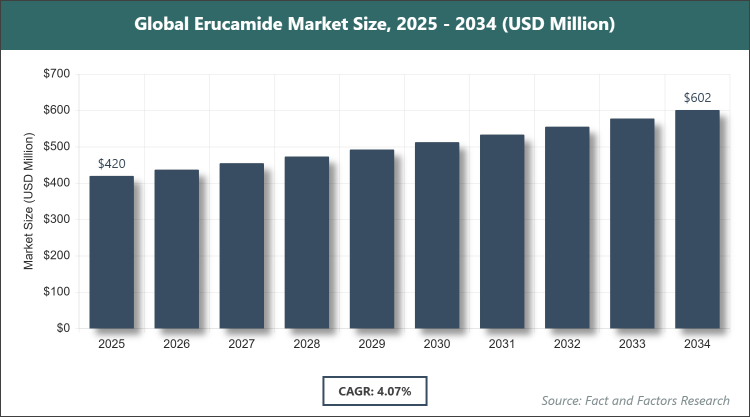
[235+ Pages Report] According to Facts & Factors, the global erucamide market size was estimated at USD 420.06 million in 2025 and is expected to reach USD 601.50 million by the end of 2034. The erucamide industry is anticipated to grow by a CAGR of 4.07% between 2026 and 2034. The erucamide Market is driven by increasing demand in the plastics and packaging industries.
 Market Overview
Erucamide is a long-chain fatty acid amide derived from erucic acid, primarily sourced from rapeseed oil, and serves as a versatile additive in industrial processes. It functions mainly as a slip agent, anti-block agent, and lubricant, enhancing surface properties in materials like polymers, films, and coatings by reducing friction and preventing adhesion. This compound is integral to manufacturing applications where smooth processing and improved product performance are essential, such as in packaging, textiles, and rubber production, without altering the core chemical structure of the base materials.
Key Insights
- As per the analysis shared by our research analyst, the global erucamide market is estimated to grow annually at a CAGR of around 4.07% over the forecast period (2026-2034)
- In terms of revenue, the global erucamide market size was valued at around USD 420.06 million in 2025 and is predicted to grow to around USD 601.50 million by 2034
- The erucamide market is projected to witness significant growth due to the rising demand from the packaging industry
- Based on the product form, the beads segment accounted for the largest market share of 45% in 2025 due to its ease of handling and uniform dispersion in polymer matrices, which improves processing efficiency
- Based on the function, the slip agent segment accounted for the largest market share of 50% in 2025 due to its critical role in reducing surface friction in films and plastics, enabling smoother production and better end-product quality
- Based on the end-use industry, the plastics segment accounted for the largest market share of 40% in 2025 due to the widespread use of erucamide in enhancing the flow and release properties of plastic materials during extrusion and molding
- Based on the region, the Asia Pacific segment accounted for the largest market share of 46% in 2025 due to rapid industrialization and expanding manufacturing sectors in countries like China and India
Growth Drivers
- Increasing Demand in Plastics and Packaging Industries
The surge in global plastic production, driven by the booming e-commerce and food delivery sectors, has heightened the need for additives like erucamide to improve film and packaging quality. Erucamide's ability to act as a slip agent reduces sticking issues in polyethylene and polypropylene films, leading to higher throughput in manufacturing lines and lower defect rates.
This trend is further amplified by the shift toward sustainable packaging solutions, where erucamide helps optimize material usage without compromising performance, supporting environmental goals while meeting consumer demands for durable and efficient products.
Restraints
- Volatility in Raw Material Prices
Fluctuations in the prices of erucic acid, primarily derived from rapeseed oil, pose a significant challenge, as supply chain disruptions from weather events or geopolitical issues can increase production costs. This instability often leads to higher end-product prices, potentially deterring smaller manufacturers from adopting erucamide in cost-sensitive applications.
Additionally, dependency on agricultural sources exposes the market to risks like crop yield variations, which can constrain supply and force companies to seek alternatives, thereby slowing overall market expansion in price-volatile periods.
Opportunities
- Rise of Bio-Based and Sustainable Additives
Growing environmental regulations and consumer preference for eco-friendly materials are opening avenues for bio-based erucamide variants, derived from renewable sources like plant oils. This shift allows manufacturers to align with green chemistry initiatives, potentially accessing new markets in organic packaging and textiles.
Innovation in formulation, such as combining erucamide with other bio-additives, can enhance multifunctional properties, attracting investment from industries aiming for carbon-neutral operations and providing a competitive edge in emerging sustainable product lines.
Challenges
- Stringent Regulatory Compliance
Evolving global standards on chemical additives, particularly in food-contact applications, require rigorous testing and certification for erucamide to ensure safety and non-toxicity. Compliance with bodies like the FDA and EU REACH adds complexity and costs to production, potentially delaying market entry for new formulations.
Moreover, regional differences in regulations can fragment the market, making it difficult for companies to standardize products across borders and increasing the risk of non-compliance penalties that could erode profit margins.
Report Scope
Report Attribute |
Details |
Market Size 2025 |
USD 420.06 Million |
Projected Market Size in 2034 |
USD 601.50 Million |
CAGR Growth Rate |
4.07% CAGR |
Base Year |
2025 |
Forecast Years |
2026-2034 |
Key Market Players |
Croda Sipo, Tianyu Oleochemical, Nipo Fine Chemical, Weike Axunge Chemistry, Alinda Chemical, Zhilian Suhua, BELIKE Chemical, Changsha Hengchang, Huayi Plastics Auxiliary, Haimen Hualong, PCC Chemax, PMC Group, Struktol, Lutianhua, SCM Chemicals Inc., Astra Polymers, Sichuan Nipo Fine Chemical Co., Sichuan Tianyu Oleochemical Co., Hunan Changsha Hengchang Chemical Co., Shanghai Huayi Plastics Auxiliary Cooperation Company, and Others. |
Key Segment |
By Product Form, By Function, By End-Use Industry, and By Region |
Major Regions Covered |
North America, Europe, Asia Pacific, Latin America, and the Middle East & Africa |
Purchase Options |
Request customized purchase options to meet your research needs. Explore purchase options |
Market Segmentation
The erucamide market is segmented by product form, function, end-use industry, and region.
Based on Product Form Segment, the erucamide market is divided into powder, beads, and others. The most dominant segment is beads, which lead due to their superior handling characteristics and consistent dispersion in high-volume manufacturing processes, driving efficiency in plastics and film production by minimizing dust and ensuring uniform additive distribution. The second most dominant is powder, valued for its versatility in custom blending and cost-effectiveness in smaller-scale applications, helping to propel market growth through accessible integration in diverse industrial formulations.
Based on Function Segment, the erucamide market is divided into slip agent, anti-block agent, lubricant, dispersing agent, and others. The most dominant segment is slip agent, excelling in reducing friction on polymer surfaces to facilitate smoother extrusion and molding, which dominates due to its essential role in high-speed packaging lines and contributes to market expansion by enhancing production speeds and product quality. The second most dominant is anti-block agent, crucial for preventing film layers from sticking, driven by demand in food packaging where it ensures easy separation and maintains integrity, thereby supporting overall industry growth through improved material performance.
Based on End-Use Industry Segment, the erucamide market is divided into plastics, rubber, food packaging, textile, ink and coatings, and others. The most dominant segment is plastics, where erucamide optimizes processing and surface properties in resins like polyethylene, leading due to the massive scale of global plastic output and aiding market drive by enabling cost-effective, high-quality outputs. The second most dominant is food packaging, relying on erucamide for non-stick films and wrappers, prominent because of stringent safety needs and rising packaged food consumption, fostering market advancement via compliance and efficiency gains.
Recent Developments
- In March 2025, BASF launched an expanded line of bio-based erucamide products tailored for sustainable food packaging, emphasizing enhanced slip properties and reduced environmental impact to meet growing regulatory demands.
- In August 2024, Croda Sipo announced a capacity expansion at its Asian facilities to boost erucamide production, aiming to address surging demand from the plastics sector amid regional industrial growth.
- In January 2026, PMC Group introduced innovative erucamide formulations with improved thermal stability for high-temperature applications in rubber and textiles, marking a step toward multifunctional additives.
Regional Analysis
- Asia Pacific to dominate the global market
The Asia Pacific region stands out as the leading force in the erucamide market, propelled by its robust manufacturing ecosystem and rapid urbanization that fuels demand across plastics and packaging sectors. China emerges as the dominating country, leveraging its vast polymer production capabilities and export-oriented industries to capture a significant portion of global supply chains. This dominance is supported by cost-effective raw material sourcing and technological advancements in additive integration, enabling seamless scalability. Furthermore, government initiatives promoting industrial efficiency and sustainability enhance adoption rates, positioning the region as a hub for innovation in erucamide applications.
North America exhibits steady progress in the erucamide market, driven by advanced R&D in specialty chemicals and a strong emphasis on high-performance materials in packaging and automotive sectors. The United States leads as the dominating country, benefiting from established infrastructure and a focus on regulatory-compliant, eco-friendly additives that align with consumer preferences. This region's strength lies in its ability to pioneer bio-based alternatives, reducing dependency on volatile imports while fostering collaborations between manufacturers and end-users. The integration of erucamide in sophisticated processing techniques further solidifies its role in enhancing product durability and efficiency across diverse applications.
Europe maintains a prominent position in the erucamide market, characterized by stringent environmental standards and a commitment to circular economy principles that drive demand for sustainable additives. Germany is the dominating country, renowned for its engineering prowess and leadership in chemical innovation, which facilitates the development of high-purity erucamide variants. The region's focus on reducing plastic waste through efficient processing aids like erucamide supports market resilience. Collaborative efforts among EU nations to standardize additive usage enhance cross-border trade, while investments in green chemistry ensure long-term competitiveness in global markets.
Latin America is experiencing emerging growth in the erucamide market, supported by expanding industrial activities and increasing foreign investments in manufacturing. Brazil dominates as the key country, capitalizing on its agricultural resources for raw material supply and growing packaging needs from agribusiness. This region's potential is unlocked through partnerships that introduce advanced technologies, improving local production capabilities. The emphasis on cost-effective solutions in textiles and rubber applications drives adoption, contributing to economic diversification and integration into international supply networks.
The Middle East & Africa region shows promising development in the erucamide market, fueled by diversification efforts beyond oil and rising investments in downstream chemical industries. South Africa leads as the dominating country, utilizing its strategic ports and growing polymer sector to facilitate imports and local processing. The area's focus on infrastructure projects boosts demand in construction-related applications, while initiatives to enhance food security increase packaging requirements. This positions the region for gradual expansion through targeted industrial policies and international collaborations.
Competitive Analysis
The global erucamide market is dominated by players:
- Croda Sipo
- Tianyu Oleochemical
- Nipo Fine Chemical
- Weike Axunge Chemistry
- Alinda Chemical
- Zhilian Suhua
- BELIKE Chemical
- Changsha Hengchang
- Huayi Plastics Auxiliary
- Haimen Hualong
- PCC Chemax
- PMC Group
- Struktol
- Lutianhua
- SCM Chemicals Inc.
- Astra Polymers
- Sichuan Nipo Fine Chemical Co.
- Sichuan Tianyu Oleochemical Co.
- Hunan Changsha Hengchang Chemical Co.
- Shanghai Huayi Plastics Auxiliary Cooperation Company
The global erucamide market is segmented as follows:
By Product Form
- Powder
- Beads
- Others
By Function
- Slip Agent
- Anti-block Agent
- Lubricant
- Dispersing Agent
- Others
By End-Use Industry
- Plastics
- Rubber
- Food Packaging
- Textile
- Ink and Coatings
- Others
By Region
- North America
- The U.S.
- Canada
- Mexico
- Europe
- France
- The UK
- Spain
- Germany
- Italy
- Rest of Europe
- Asia Pacific
- China
- Japan
- India
- Australia
- Southeast Asia
- Rest of Asia Pacific
- The Middle East & Africa
- Saudi Arabia
- UAE
- Egypt
- Kuwait
- South Africa
- Rest of the Middle East & Africa
- Latin America
- Brazil
- Argentina
- Rest of Latin America
Industry Major Market Players
The global erucamide market is dominated by players:
- Croda Sipo
- Tianyu Oleochemical
- Nipo Fine Chemical
- Weike Axunge Chemistry
- Alinda Chemical
- Zhilian Suhua
- BELIKE Chemical
- Changsha Hengchang
- Huayi Plastics Auxiliary
- Haimen Hualong
- PCC Chemax
- PMC Group
- Struktol
- Lutianhua
- SCM Chemicals Inc.
- Astra Polymers
- Sichuan Nipo Fine Chemical Co.
- Sichuan Tianyu Oleochemical Co.
- Hunan Changsha Hengchang Chemical Co.
- Shanghai Huayi Plastics Auxiliary Cooperation Company
Frequently Asked Questions



Copyright © 2025 - 2026, All Rights Reserved, Facts and Factors