
Search Market Research Report
Electrohydraulic Servo Valve (EHSV) Market Size, Share Global Analysis Report, 2026-2034

Electrohydraulic Servo Valve (EHSV) Market Size, Share, Growth Analysis Report By Valve Type (Nozzle Flapper Valve, Jet Pipe Servo Valve, Direct Drive Servo Valve, and Others), By Stage Type (Single-Stage Servo Valve, Two-Stage Servo Valve, Multi-Stage Servo Valve, and Others), By Application (Aerospace, Power Industry, Steel Industry, Chemical Industry, Oil & Gas, Construction Industry, and Others), and By Region - Global Industry Insights, Overview, Comprehensive Analysis, Trends, Statistical Research, Market Intelligence, Historical Data and Forecast 2026-2034
Industry Insights
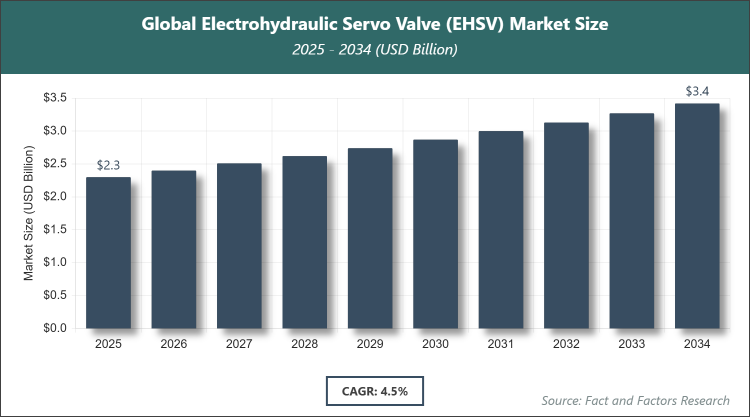
[225+ Pages Report] According to Facts & Factors, the global Electrohydraulic Servo Valve (EHSV) market size was estimated at USD 2.3 billion in 2025 and is expected to reach USD 3.4 billion by the end of 2034. The Electrohydraulic Servo Valve (EHSV) industry is anticipated to grow by a CAGR of 4.5% between 2026 and 2034. The Electrohydraulic Servo Valve (EHSV) Market is driven by increasing demand for precision control in industrial and aerospace applications.
 Market Overview
The Electrohydraulic Servo Valve (EHSV) market encompasses devices that convert electrical signals into hydraulic flow and pressure to control actuators with high precision. These valves are integral components in systems requiring accurate motion control, combining electrical feedback with hydraulic power to achieve responsive and reliable performance in various mechanical operations. EHSVs are essential in applications where fine-tuned adjustments are critical, enabling seamless integration between electronic controls and hydraulic mechanisms.
Key Insights
- As per the analysis shared by our research analyst, the global Electrohydraulic Servo Valve (EHSV) market is estimated to grow annually at a CAGR of around 4.5% over the forecast period (2026-2034).
- In terms of revenue, the global Electrohydraulic Servo Valve (EHSV) market size was valued at around USD 2.3 billion in 2025 and is projected to reach USD 3.4 billion, by 2034.
- The market is driven by rising automation in industries and expanding aerospace applications.
- Based on the valve type, the nozzle flapper valve subsegment dominated with 45% share due to its high reliability and widespread use in precision control systems.
- Based on the stage type, the two-stage servo valve subsegment dominated with 55% share owing to its balance of performance and cost-effectiveness in complex applications.
- Based on the application, the aerospace subsegment dominated with 35% share because of the need for accurate actuation in flight control systems.
- North America dominated with 40% share attributed to strong aerospace and defense sectors along with advanced manufacturing infrastructure.
Growth Drivers
- Increasing Automation Across Industries
The surge in industrial automation is a primary driver for the EHSV market, as industries seek enhanced efficiency and precision in operations. Automation technologies rely on EHSVs for controlling robotic arms, conveyor systems, and other machinery, reducing human error and improving productivity. This trend is particularly evident in manufacturing sectors where real-time adjustments are necessary to maintain quality and speed.
Furthermore, the integration of EHSVs with IoT and AI systems allows for predictive maintenance and optimized performance, further fueling market growth. As companies invest in smart factories, the demand for reliable servo valves that can handle complex tasks increases, driving innovation and adoption in diverse applications.
- Rising Demand in Aerospace and Defense
The aerospace and defense industries heavily depend on EHSVs for critical functions like flight control and landing gear systems. With global defense budgets rising and commercial aviation expanding, the need for high-performance valves that ensure safety and precision is paramount. Technological advancements in aircraft design also contribute to this demand.
In addition, military applications such as missile guidance and unmanned vehicles require robust EHSVs capable of operating under extreme conditions. This sector's focus on reliability and rapid response times continues to propel the market forward, encouraging manufacturers to develop more advanced valve solutions.
Restraints
- High Initial Costs and Maintenance Requirements
The elevated cost of EHSVs, including installation and integration, poses a significant restraint, particularly for small and medium-sized enterprises. These valves involve sophisticated components that increase upfront expenses, limiting adoption in cost-sensitive markets.
Moreover, regular maintenance is essential to prevent failures, adding to operational costs over time. Contamination issues in hydraulic systems can lead to downtime, further deterring potential users who may opt for simpler alternatives despite lower performance.
Opportunities
- Expansion in Emerging Markets
Emerging economies in Asia-Pacific and Latin America present opportunities as industrialization accelerates. Investments in infrastructure and manufacturing create demand for advanced control systems, where EHSVs can play a key role in enhancing efficiency.
Additionally, government initiatives promoting renewable energy and modern agriculture open new avenues. As these regions adopt automation, partnerships with local firms can help established players penetrate these markets effectively.
- Technological Advancements in Valve Design
Innovations such as digital interfaces and energy-efficient designs offer opportunities to capture market share. Developing valves with improved durability and lower power consumption can attract environmentally conscious industries.
Furthermore, integrating sensors for real-time monitoring aligns with Industry 4.0 trends, providing a competitive edge. Research into materials that resist wear can extend valve lifespan, appealing to high-demand sectors.
Challenges
- Stringent Regulatory Standards
Compliance with international standards for safety and environmental impact challenges manufacturers. Regulations in aerospace and oil & gas require rigorous testing, increasing development time and costs.
Adapting to evolving standards across regions complicates global operations. Failure to meet these can result in penalties or market exclusion, necessitating continuous investment in quality assurance.
- Intense Competition from Alternatives
The presence of pneumatic and electric actuators competes with EHSVs in certain applications. These alternatives may offer lower costs or simpler integration, challenging market penetration.
Differentiating through superior performance is essential, but rapid advancements in competing technologies require ongoing innovation to maintain relevance.
Report Scope
Report Attribute |
Details |
Market Size 2025 |
USD 2.3 Billion |
Projected Market Size in 2034 |
USD 3.4 Billion |
CAGR Growth Rate |
4.5% CAGR |
Base Year |
2025 |
Forecast Years |
2026-2034 |
Key Market Players |
Moog Inc., Bosch Rexroth AG, Parker Hannifin Corporation, Eaton Corporation, Honeywell International Inc., Woodward Inc., Voith GmbH & Co. KGaA, Schneider Kreuznach, Atos SE, MTS Systems Corporation, and Others. |
Key Segment |
By Valve Type, By Stage Type, By Application, and By Region |
Major Regions Covered |
North America, Europe, Asia Pacific, Latin America, and the Middle East & Africa |
Purchase Options |
Request customized purchase options to meet your research needs. Explore purchase options |
Market Segmentation
The Electrohydraulic Servo Valve (EHSV) market is segmented by valve type, stage type, application, and region.
Based on Valve Type Segment, the Electrohydraulic Servo Valve (EHSV) market is divided into nozzle flapper valve, jet pipe servo valve, direct drive servo valve, and others. The nozzle flapper valve emerges as the most dominant subsegment, holding a significant market share due to its proven reliability, high response speed, and versatility in precision control applications across industries like aerospace and manufacturing; the jet pipe servo valve follows as the second most dominant, valued for its robustness in high-pressure environments and ability to handle contaminated fluids, which drives market growth by enabling reliable performance in demanding industrial settings and contributing to overall efficiency improvements.
Based on Stage Type Segment, the Electrohydraulic Servo Valve (EHSV) market is divided into single-stage servo valve, two-stage servo valve, multi-stage servo valve, and others. The two-stage servo valve stands out as the most dominant subsegment with its optimal balance of power amplification and control accuracy, making it ideal for complex systems in aerospace and industrial automation where it drives market expansion through enhanced system responsiveness; the multi-stage servo valve is the second most dominant, excelling in applications requiring ultra-high precision and force, such as defense simulations, thereby supporting market growth by addressing needs for advanced motion control in high-stakes environments.
Based on Application Segment, the Electrohydraulic Servo Valve (EHSV) market is divided into aerospace, power industry, steel industry, chemical industry, oil & gas, construction industry, and others. Aerospace dominates as the leading subsegment, driven by the critical need for precise actuation in flight controls and hydraulic systems, which propels market growth through innovations in aircraft design and safety enhancements; the industrial segment, encompassing steel and chemical industries, ranks second, benefiting from EHSVs' role in automating heavy machinery and processes, thus boosting efficiency and reducing operational costs across manufacturing landscapes.
Recent Developments
- In 2025, Moog Inc. announced the launch of a new series of high-performance EHSVs with integrated digital controls, aimed at improving efficiency in aerospace applications and reducing energy consumption by 20%.
- Bosch Rexroth expanded its manufacturing facility in North America in late 2025 to meet growing demand for two-stage servo valves in industrial automation, incorporating advanced AI for predictive maintenance features.
- Parker Hannifin acquired a smaller valve technology firm in 2026 to enhance its portfolio in jet pipe servo valves, focusing on oil & gas sector applications with improved resistance to harsh environments.
Regional Analysis
- North America to dominate the global market
North America leads the EHSV market, primarily driven by the United States as the dominating country with its robust aerospace and defense industries. The region's advanced manufacturing infrastructure supports innovation in valve technologies, while high investments in automation across sectors like oil & gas and construction further solidify its position. Strong regulatory frameworks ensure quality, attracting global players to establish operations here. Additionally, collaborations between universities and industries foster research, leading to cutting-edge developments that enhance market competitiveness.
Europe follows with Germany as the key dominating country, renowned for its engineering prowess in industrial applications. The focus on sustainable manufacturing drives demand for energy-efficient EHSVs in chemical and power industries. EU policies promoting green technologies encourage adoption, while a skilled workforce supports production. The region's emphasis on precision engineering in automotive and aerospace sectors contributes to steady growth, with cross-border trade facilitating market expansion.
Asia-Pacific is the fastest-growing region, led by China as the dominating country due to rapid industrialization and infrastructure projects. Increasing automation in manufacturing and construction boosts EHSV usage, supported by government initiatives for smart factories. The expanding aerospace sector in India and Japan adds momentum, with cost-effective production attracting investments. Technological transfers from Western firms enhance local capabilities, positioning the region for significant future contributions.
Latin America shows potential with Brazil dominating, driven by oil & gas exploration and mining activities requiring reliable control systems. Infrastructure developments in transportation and energy sectors increase demand, though economic fluctuations pose challenges. Partnerships with international companies bring advanced technologies, aiding market penetration. The region's natural resources provide opportunities for specialized applications, gradually integrating EHSVs into local industries.
The Middle East & Africa region is emerging, with the United Arab Emirates leading through investments in oil & gas and diversification into aerospace. Saudi Arabia's Vision 2030 supports industrial growth, incorporating EHSVs in new projects. Challenges like political instability are offset by resource wealth, attracting foreign expertise. Africa's focus on mining and construction in countries like South Africa drives niche demand, with potential for expansion as economies stabilize.
Competitive Analysis
The global Electrohydraulic Servo Valve (EHSV) market is dominated by players:
- Moog Inc.
- Bosch Rexroth AG
- Parker Hannifin Corporation
- Eaton Corporation
- Honeywell International Inc.
- Woodward Inc.
- Voith GmbH & Co. KGaA
- Schneider Kreuznach
- Atos SE
- MTS Systems Corporation
The global Electrohydraulic Servo Valve (EHSV) market is segmented as follows:
By Valve Type
- Nozzle Flapper Valve
- Jet Pipe Servo Valve
- Direct Drive Servo Valve
- Others
By Stage Type
- Single-Stage Servo Valve
- Two-Stage Servo Valve
- Multi-Stage Servo Valve
- Others
By Application
- Aerospace
- Power Industry
- Steel Industry
- Chemical Industry
- Oil & Gas
- Construction Industry
- Others
By Region
- North America
- The U.S.
- Canada
- Mexico
- Europe
- France
- The UK
- Spain
- Germany
- Italy
- Rest of Europe
- Asia Pacific
- China
- Japan
- India
- Australia
- Southeast Asia
- Rest of Asia Pacific
- The Middle East & Africa
- Saudi Arabia
- UAE
- Egypt
- Kuwait
- South Africa
- Rest of the Middle East & Africa
- Latin America
- Brazil
- Argentina
- Rest of Latin America
Industry Major Market Players
The global Electrohydraulic Servo Valve (EHSV) market is dominated by players:
- Moog Inc.
- Bosch Rexroth AG
- Parker Hannifin Corporation
- Eaton Corporation
- Honeywell International Inc.
- Woodward Inc.
- Voith GmbH & Co. KGaA
- Schneider Kreuznach
- Atos SE
- MTS Systems Corporation
Frequently Asked Questions



Copyright © 2025 - 2026, All Rights Reserved, Facts and Factors