
Search Market Research Report
Electric Arc Furnace (EAF) Dust Recycling Market Size, Share Global Analysis Report, 2026-2034

Electric Arc Furnace (EAF) Dust Recycling Market Size, Share, Growth Analysis Report By Process (Pyrometallurgy and Hydrometallurgy), By Application (Zinc Recovery, Iron Recovery, Lead Recovery, and Others), By End-User (Steel Industry, Chemical Industry, Cement Industry, and Others), and By Region - Global Industry Insights, Overview, Comprehensive Analysis, Trends, Statistical Research, Market Intelligence, Historical Data and Forecast 2026-2034
Industry Insights
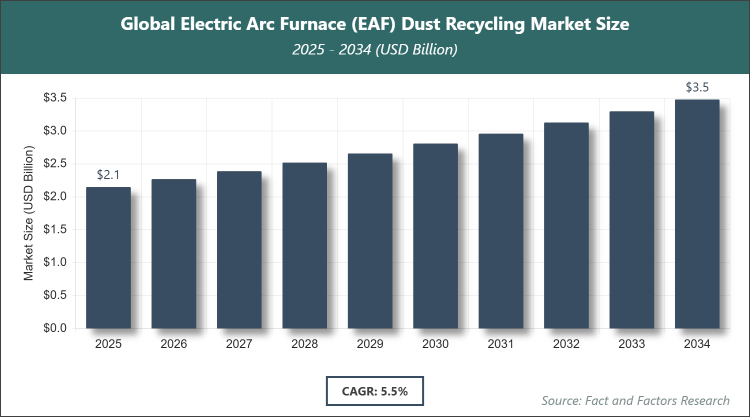
[241 Pages Report] According to Facts & Factors, the global Electric Arc Furnace (EAF) Dust Recycling market size was estimated at USD 2.15 billion in 2025 and is expected to reach USD 3.48 billion by the end of 2034. The Electric Arc Furnace (EAF) Dust Recycling industry is anticipated to grow by a CAGR of 5.5% between 2026 and 2034. The Electric Arc Furnace (EAF) Dust Recycling Market is driven by stringent environmental regulations on hazardous waste disposal and rising demand for recovered zinc and iron from steelmaking byproducts.
 Market Overview
The Electric Arc Furnace (EAF) Dust Recycling market involves the collection, processing, and recovery of valuable metals from the hazardous fine particulate byproduct generated during scrap steel melting in electric arc furnaces. EAF dust contains significant concentrations of zinc, iron, lead, and other metals along with chlorides and fluorides, making it both an environmental liability and a secondary resource. Recycling processes recover zinc oxide for the galvanizing and chemical industries, iron-rich residues for steelmaking or cement production, and other metals, thereby reducing landfill disposal, minimizing raw material extraction, and supporting circular economy principles in the steel sector. This market plays a vital role in sustainable steel production by transforming toxic waste into marketable commodities while helping steel mills comply with strict emission and waste management standards.
Key Insights
- As per the analysis shared by our research analyst, the Electric Arc Furnace (EAF) Dust Recycling market is estimated to grow annually at a CAGR of around 5.5% over the forecast period (2026-2034).
- In terms of revenue, the Electric Arc Furnace (EAF) Dust Recycling market size was valued at around USD 2.15 billion in 2025 and is projected to reach USD 3.48 billion by 2034.
- The Electric Arc Furnace (EAF) Dust Recycling Market is driven by environmental regulations and economic incentives for metal recovery.
- Based on the Process, the Pyrometallurgy segment dominated the market in 2025 with a share of 78% due to its proven scalability through Waelz kiln technology and high zinc recovery efficiency.
- Based on the Application, the Zinc Recovery segment dominated the market in 2025 with a share of 65%, owing to the high economic value of recovered zinc oxide used in galvanizing and chemical sectors.
- Based on the End-User, the Steel Industry segment dominated the market in 2025 with a share of 72% because steel plants generate the dust and directly benefit from on-site or captive recycling to reduce disposal costs.
- Asia Pacific dominated the global Electric Arc Furnace (EAF) Dust Recycling market in 2025, with a share of 45% attributed to massive EAF steel production capacity and growing regulatory pressure on hazardous waste management.
Growth Drivers
- Stringent Environmental Regulations and Circular Economy Policies
Governments worldwide are imposing stricter limits on landfill disposal of hazardous EAF dust, compelling steel producers to adopt recycling solutions that recover metals and minimize environmental impact.
Incentives for circular economy practices and carbon credit mechanisms further encourage investment in advanced recycling technologies, turning waste management into a revenue-generating activity.
Restraints
- High Capital and Operational Costs
Establishing dedicated recycling facilities requires substantial investment in specialized equipment such as Waelz kilns or hydrometallurgical plants, deterring smaller steel mills.
Fluctuating zinc prices and energy-intensive processes can affect profitability, particularly when raw material quality varies across different EAF operations.
Opportunities
- Technological Advancements in Recovery Processes
Emerging hydrometallurgical and hybrid methods offer higher selectivity, lower energy consumption, and better handling of complex dust compositions, creating new revenue streams from previously unrecovered metals.
Integration with steel plant operations for zero-waste goals and partnerships with zinc consumers open long-term supply contracts and regional expansion possibilities.
Challenges
- Variability in Dust Composition and Regulatory Compliance
EAF dust chemistry differs significantly between plants depending on scrap quality and operating conditions, complicating standardized recycling processes and requiring site-specific adaptations.
Evolving hazardous waste classification rules and cross-border transport restrictions add complexity to global supply chains and increase compliance burdens.
Report Scope
Report Attribute |
Details |
Market Size 2025 |
USD 2.15 Billion |
Projected Market Size in 2034 |
USD 3.48 Billion |
CAGR Growth Rate |
5.5% CAGR |
Base Year |
2025 |
Forecast Years |
2026-2034 |
Key Market Players |
Befesa S.A., Enviri Corporation, Recylex S.A., Zinc Nacional S.A., American Zinc Recycling LLC, Global Steel Dust Limited, Marzinc, Steel Dust Recycling LLC, Zochem LLC, Nyrstar, and Others. |
Key Segment |
By Process, By Application, By End-User, and By Region |
Major Regions Covered |
North America, Europe, Asia Pacific, Latin America, and the Middle East & Africa |
Purchase Options |
Request customized purchase options to meet your research needs. Explore purchase options |
Market Segmentation
The Electric Arc Furnace (EAF) Dust Recycling market is segmented by process, application, end-user, and region.
Based on Process Segment, the Electric Arc Furnace (EAF) Dust Recycling market is divided into pyrometallurgy and hydrometallurgy. The most dominant segment is Pyrometallurgy, driven by widespread commercial use of Waelz kiln technology. The second most dominant is Hydrometallurgy, gaining traction for selective metal extraction. Pyrometallurgy dominates due to its proven reliability, high throughput capacity, and ability to handle large volumes of dust while producing marketable zinc oxide and iron-rich slag, helping drive market growth by offering cost-effective solutions for major steel producers seeking regulatory compliance and resource recovery.
Based on Application Segment, the Electric Arc Furnace (EAF) Dust Recycling market is divided into zinc recovery, iron recovery, lead recovery, and others. The most dominant segment is Zinc Recovery, as zinc constitutes the primary economic driver in EAF dust. The second most dominant is Iron Recovery. Zinc Recovery leads because recovered zinc oxide commands premium pricing in galvanizing, rubber, and chemical industries, propelling market expansion through strong demand and attractive returns on investment for recycling operators.
Based on End-User Segment, the Electric Arc Furnace (EAF) Dust Recycling market is divided into the steel industry, chemical industry, cement industry, and others. The most dominant segment is the steel industry, as it both generates and recycles the dust. The second most dominant is the Chemical Industry. The steel industry dominates due to captive recycling models that reduce disposal liabilities and recover valuable metals internally, driving market growth by creating closed-loop systems that enhance sustainability and operational efficiency across global steel production.
Recent Developments
- In March 2025, Befesa expanded its Waelz kiln capacity in the United States to process additional EAF dust from regional steel mills, targeting higher zinc recovery rates.
- In June 2025, ArcelorMittal partnered with a specialized recycler to implement on-site EAF dust treatment at its Luxembourg facility, reducing transport and landfill dependency.
- In September 2025, Zinc Nacional commissioned a new hydrometallurgical pilot plant in Mexico focused on selective zinc and lead extraction from complex EAF dust.
- In November 2025, Enviri Corporation announced successful commercial trials of an enhanced pyrometallurgical process, achieving over 95% zinc recovery with lower energy consumption.
- In January 2026, Global Steel Dust Limited signed long-term supply agreements with major Asian steel producers for sustainable EAF dust recycling services.
Regional Analysis
- Asia Pacific to dominate the global market
Asia Pacific leads the Electric Arc Furnace (EAF) Dust Recycling market due to its dominant share of global EAF steel production, rapid industrialization, and increasing enforcement of environmental standards across China, India, Japan, and South Korea. The region benefits from dense steelmaking clusters that generate large volumes of dust and growing domestic demand for recovered zinc. China dominates within the Asia Pacific, supported by massive steel output, government mandates for circular economy practices, and investments in modern recycling infrastructure that integrates dust treatment directly with steel plants, fostering technological upgrades and export of recovered metals.
Europe maintains a technologically advanced position in the Electric Arc Furnace (EAF) Dust Recycling market, driven by stringent EU waste directives and a focus on resource efficiency. Collaborative projects between steelmakers and recyclers accelerate innovation. Germany leads the region, leveraging its engineering expertise and strong automotive steel sector to pioneer high-efficiency recycling facilities that recover multiple metals while meeting zero-waste targets.
North America exhibits steady growth in the Electric Arc Furnace (EAF) Dust Recycling market, supported by regulatory pressure and rising zinc prices. The United States leads, with established recycling networks and steel industry modernization programs that prioritize on-site dust processing to reduce environmental footprint and enhance supply chain resilience for critical metals.
Latin America is expanding its footprint in the Electric Arc Furnace (EAF) Dust Recycling market, driven by growing steel production and awareness of sustainable practices. Brazil leads, utilizing its large EAF capacity and mining synergies to develop integrated recycling solutions that support both domestic steel needs and regional metal supply.
The Middle East & Africa region shows emerging potential in the Electric Arc Furnace (EAF) Dust Recycling market, linked to new steel capacity additions and diversification efforts. The United Arab Emirates leads through strategic investments in industrial recycling parks that handle EAF dust from local and imported steel operations, aligning with broader sustainability visions.
Competitive Analysis
The global Electric Arc Furnace (EAF) Dust Recycling market is dominated by players:
- Befesa S.A.
- Enviri Corporation
- Recylex S.A.
- Zinc Nacional S.A.
- American Zinc Recycling LLC
- Global Steel Dust Limited
- Marzinc
- Steel Dust Recycling LLC
- Zochem LLC
- Nyrstar
The global Electric Arc Furnace (EAF) Dust Recycling market is segmented as follows:
By Process
- Pyrometallurgy
- Hydrometallurgy
By Application
- Zinc Recovery
- Iron Recovery
- Lead Recovery
- Others
By End-User
- Steel Industry
- Chemical Industry
- Cement Industry
- Others
By Region
- North America
- The U.S.
- Canada
- Mexico
- Europe
- France
- The UK
- Spain
- Germany
- Italy
- Rest of Europe
- Asia Pacific
- China
- Japan
- India
- Australia
- Southeast Asia
- Rest of Asia Pacific
- The Middle East & Africa
- Saudi Arabia
- UAE
- Egypt
- Kuwait
- South Africa
- Rest of the Middle East & Africa
- Latin America
- Brazil
- Argentina
- Rest of Latin America
Industry Major Market Players
- Befesa S.A.
- Enviri Corporation
- Recylex S.A.
- Zinc Nacional S.A.
- American Zinc Recycling LLC
- Global Steel Dust Limited
- Marzinc
- Steel Dust Recycling LLC
- Zochem LLC
- Nyrstar
Frequently Asked Questions



Copyright © 2025 - 2026, All Rights Reserved, Facts and Factors