
Search Market Research Report
Dental Water Jet Market Size, Share Global Analysis Report, 2026-2034

Dental Water Jet Market Size, Share, Growth Analysis Report By Product Type (Cordless Water Flosser, Countertop Water Flosser, and Others), By Application (Home Use, Dentistry Use, Travel Use, and Others), By End-User (Adults and Children), and By Region - Global Industry Insights, Overview, Comprehensive Analysis, Trends, Statistical Research, Market Intelligence, Historical Data and Forecast 2026-2034
Industry Insights
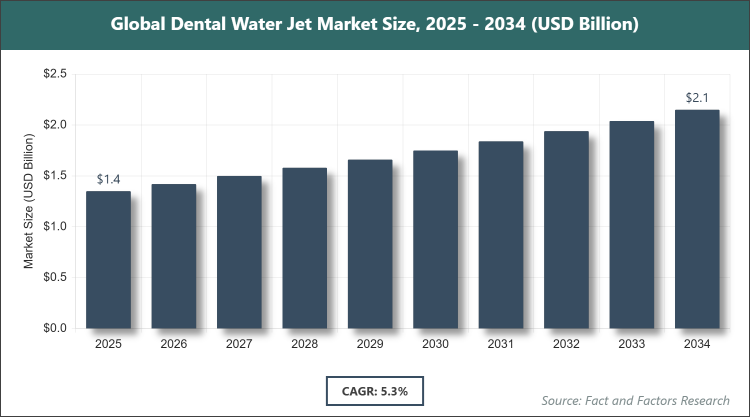
According to Facts & Factors, the global Dental Water Jet market size was estimated at USD 1.35 billion in 2025 and is expected to reach USD 2.23 billion by the end of 2034. The Dental Water Jet industry is anticipated to grow by a CAGR of 5.3% between 2026 and 2034. The Dental Water Jet Market is driven by increasing awareness of oral hygiene and preventive dental care.
 Market Overview
The dental water jet market encompasses devices designed to enhance oral hygiene by using pressurized streams of water to remove food particles, plaque, and bacteria from between teeth and along the gumline. These tools, also known as oral irrigators or water flossers, serve as an effective alternative or complement to traditional flossing methods, particularly for individuals with braces, implants, or sensitive gums. They promote better gum health, reduce the risk of periodontal diseases, and contribute to overall dental wellness without relying on abrasive techniques.
Key Insights
- As per the analysis shared by our research analyst, the global dental water jet market is estimated to grow annually at a CAGR of around 5.3% over the forecast period (2026-2034).
- In terms of revenue, the global dental water jet market size was valued at around USD 1.35 Billion in 2025 and is projected to reach USD 2.23 Billion, by 2034.
- The dental water jet market is driven by rising consumer preference for advanced oral care solutions.
- Based on the product type, the cordless water flosser segment dominated with a 60% share due to its portability and convenience for travel and daily use.
- Based on the application, the home use segment dominated with a 75% share owing to growing at-home dental care routines driven by health awareness.
- Based on the end-user, the adults segment dominated with an 80% share as adults are more prone to periodontal issues and seek effective hygiene tools.
- North America dominated the global market with a 38% share attributed to high oral health awareness and advanced healthcare infrastructure.
Market Dynamics
Growth Drivers
- Rising Prevalence of Dental Disorders
The increasing incidence of dental issues such as gum disease, cavities, and plaque buildup has fueled demand for effective oral care devices. Dental water jets offer a non-invasive solution that aids in preventing these conditions by providing thorough cleaning in hard-to-reach areas.
Technological advancements in device design, including adjustable pressure settings and battery-powered models, have made these products more user-friendly and appealing to a broader audience. This innovation encourages adoption among consumers seeking efficient, pain-free alternatives to string flossing.
Restraints
- High Initial Cost of Devices
The premium pricing of advanced dental water jets can deter price-sensitive consumers, particularly in emerging markets where affordability remains a key concern. This limits market penetration in regions with lower disposable incomes.
Competition from traditional flossing methods and electric toothbrushes poses a challenge, as some users perceive water jets as unnecessary add-ons rather than essential tools, slowing overall market expansion.
Opportunities
- Expansion in Emerging Markets
Growing urbanization and rising disposable incomes in developing regions present opportunities for market players to introduce affordable, entry-level models tailored to local needs. This could significantly boost adoption rates.
Integration of smart features like app connectivity for usage tracking and personalized settings opens avenues for premium product lines, attracting tech-savvy consumers and differentiating brands in a competitive landscape.
Challenges
- Limited Awareness in Rural Areas
In underdeveloped regions, lack of education about advanced oral hygiene tools hinders market growth, as consumers rely on basic methods without recognizing the benefits of water jets.
Regulatory hurdles and varying standards for dental devices across countries can complicate product launches and increase compliance costs for manufacturers.
Report Scope
Report Attribute |
Details |
Market Size 2025 |
USD 1.35 Billion |
Projected Market Size in 2034 |
USD 2.23 Billion |
CAGR Growth Rate |
5.3% CAGR |
Base Year |
2025 |
Forecast Years |
2026-2034 |
Key Market Players |
Waterpik, Philips Sonicare, Oral-B, Panasonic, H2Ofloss, Jetpik, Conair, Hangsun, ToiletTree Products, Aquapick, and Others. |
Key Segment |
By Product Type, By Application, By End-User, and By Region |
Major Regions Covered |
North America, Europe, Asia Pacific, Latin America, and the Middle East & Africa |
Purchase Options |
Request customized purchase options to meet your research needs. Explore purchase options |
Market Segmentation
The Dental Water Jet market is segmented by product type, application, end-user, and region.
Based on Product Type Segment,the Dental Water Jet market is divided into cordless water flosser, countertop water flosser, and others. The cordless water flosser emerges as the most dominant segment, holding approximately 60% market share, primarily due to its portability, rechargeable batteries, and ease of use for on-the-go consumers. This dominance drives the market by catering to busy lifestyles and increasing accessibility, while the countertop water flosser ranks as the second most dominant with around 30% share, favored for its higher water capacity and stability in home settings, contributing to sustained daily usage and overall market stability.
Based on Application Segment, the Dental Water Jet market is divided into home use, dentistry use, travel use, and others. Home use stands out as the most dominant segment with a 75% share, driven by heightened consumer focus on preventive self-care and the convenience of integrating these devices into daily routines, which propels market growth through widespread adoption. The dentistry use segment follows as the second most dominant, capturing about 15% share, as professionals recommend and utilize these tools for patient treatments, enhancing credibility and encouraging consumer purchases.
Based on End-User Segment, the Dental Water Jet market is divided into adults and children. The adults segment is the most dominant, commanding an 80% share, owing to higher rates of dental issues like gingivitis and the need for effective maintenance tools, which fuels market expansion by addressing a large demographic with disposable income. The children segment is the second most dominant with a 20% share, supported by parental emphasis on early oral hygiene habits, aiding market growth through family-oriented product innovations.
Recent Developments
- In February 2023, Fresh Health launched the Proclaim Custom-Jet Oral Irrigator, a 3D-printed device with 60 pressurized jets designed for home use to reduce plaque buildup effectively.
- In August 2022, Oral-B partnered with the International Association of Disability and Oral Health (iADH) to promote inclusive oral care, enhancing accessibility for people with disabilities through adapted water jet technologies.
- In September 2024, Panasonic introduced a new range of oral irrigators featuring ultrasonic technology and cordless designs, aimed at improving cleaning efficiency with multiple pressure levels.
- In 2025, Waterpik announced innovations in smart water flossers with Bluetooth connectivity for app-based tracking, focusing on personalized oral care to meet consumer demands for tech-integrated health solutions.
Regional Analysis
- North America to dominate the global market
North America leads the dental water jet market, driven by robust healthcare systems and widespread emphasis on preventive dentistry. The region's consumers prioritize advanced oral care, supported by high disposable incomes and access to innovative products. The United States stands out as the dominating country, with strong retail presence and endorsements from dental professionals fostering market growth.
Europe follows closely, benefiting from increasing health consciousness and aging populations seeking effective gum care solutions. Germany dominates within the region, thanks to its advanced manufacturing capabilities and focus on quality dental devices, which encourage consumer trust and adoption.
Asia Pacific is experiencing rapid growth due to urbanization and rising awareness of oral hygiene. China emerges as the key dominating country, propelled by a burgeoning middle class and expanding e-commerce channels that make these products more accessible to a vast population.
Latin America shows promising potential with improving economic conditions and greater focus on personal health. Brazil dominates the region, as increasing dental tourism and local manufacturing initiatives drive affordability and availability of water jets.
The Middle East & Africa region is gradually adopting these devices amid growing healthcare investments. South Africa leads as the dominating country, supported by urban health campaigns and partnerships with global brands to promote oral wellness.
Competitive Analysis
The global Dental Water Jet market is dominated by players:
- Waterpik
- Philips Sonicare
- Oral-B
- Panasonic
- H2Ofloss
- Jetpik
- Conair
- Hangsun
- ToiletTree Products
- Aquapick
- and Others.
The global Dental Water Jet market is segmented as follows:
By Product Type
- Cordless Water Flosser
- Countertop Water Flosser
- Others
By Application
- Home Use
- Dentistry Use
- Travel Use
- Others
By End-User
- Adults
- Children
By Regional Segment Analysis
- North America
- The U.S.
- Canada
- Mexico
- Europe
- France
- The UK
- Spain
- Germany
- Italy
- Rest of Europe
- Asia Pacific
- China
- Japan
- India
- Australia
- Southeast Asia
- Rest of Asia Pacific
- The Middle East & Africa
- Saudi Arabia
- UAE
- Egypt
- Kuwait
- South Africa
- Rest of the Middle East & Africa
- Latin America
- Brazil
- Argentina
- Rest of Latin America
Industry Major Market Players
Frequently Asked Questions



Copyright © 2025 - 2026, All Rights Reserved, Facts and Factors