
Search Market Research Report
Concrete Pump Market Size, Share Global Analysis Report, 2026-2034

Concrete Pump Market Size, Share, Growth Analysis Report By Type (Truck-Mounted Concrete Pumps, Stationary Concrete Pumps, Specialized Concrete Pumps), By Application (Commercial, Industrial, Residential), By End-User (Construction Companies, Infrastructure Developers, Rental Service Providers), and By Region - Global Industry Insights, Overview, Comprehensive Analysis, Trends, Statistical Research, Market Intelligence, Historical Data and Forecast 2026-2034
Industry Insights
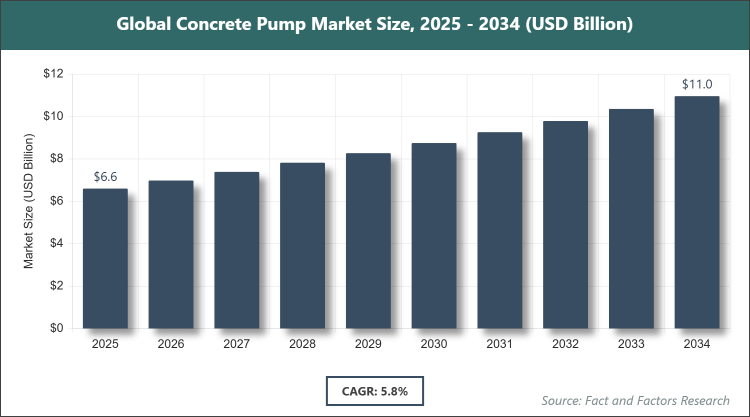
[250+ Pages Report] According to Facts & Factors, the global Concrete Pump market size was estimated at USD 6.6 billion in 2025 and is expected to reach USD 11.0 billion by 2034, growing at a CAGR of 5.8% from 2026 to 2034. The concrete pump market is driven by rapid urbanization and infrastructure development.
 Market Overview
The concrete pump market involves the manufacturing, distribution, and utilization of specialized equipment designed to transport liquid concrete from a mixer to the construction site through a pumping system, enabling efficient placement in hard-to-reach areas such as high-rise buildings, tunnels, or remote locations, and is categorized primarily into truck-mounted, stationary, and specialized types based on mobility and application requirements. This market addresses the need for precise, high-volume concrete delivery that minimizes labor, reduces waste, and accelerates construction timelines, integrating hydraulic or mechanical pumping mechanisms with booms or hoses to handle various concrete viscosities and distances, while emphasizing durability, safety features, and compliance with environmental standards to support diverse projects in commercial, industrial, and residential sectors without the limitations of traditional manual methods.
Key Insights
- The Concrete Pump market was valued at USD 6.6 billion in 2025 and is projected to reach USD 11.0 billion by the end of 2034.
- The market is expected to grow at a CAGR of 5.8% between 2026 and 2034.
- The Concrete Pump market is driven by rapid urbanization and infrastructure development.
- Based on the Type segment, the Truck-Mounted Concrete Pumps subsegment dominated the market in 2025 with a share of 55.0% because of its mobility, extended reach, and suitability for large-scale projects like high-rises and bridges.
- Based on the Application segment, the Commercial subsegment dominated the market in 2025 with a share of 50.0% because of increasing high-rise buildings and urban commercial developments requiring efficient concrete placement.
- Based on the End-User segment, the Construction Companies subsegment dominated the market in 2025 with a share of 60.0% because of direct involvement in large infrastructure projects and need for owned or rented equipment.
- Asia Pacific held the largest market share of 55.0% in 2025 due to rapid industrialization, massive infrastructure investments, and booming construction in countries like China and India.
Growth Drivers
- Rapid Urbanization and Infrastructure Development
The surge in urban populations and government investments in roads, bridges, and high-rises has increased the need for efficient concrete pumping solutions that enable faster construction in densely populated areas. This driver is bolstered by initiatives like smart city projects in emerging economies, where concrete pumps reduce labor costs and enhance precision, supporting sustainable urban growth.
- Technological Advancements in Pump Design
Innovations such as electric and hybrid pumps improve energy efficiency and reduce emissions, appealing to environmentally conscious markets and complying with stringent regulations. These advancements extend equipment lifespan and operational range, driving adoption in remote or eco-sensitive projects, thereby expanding market accessibility.
- Rising Demand for High-Rise Construction
The global trend toward vertical urbanization necessitates pumps with long booms and high-pressure capabilities for tall structures, minimizing manual handling risks. This is amplified by real estate booms in megacities, where truck-mounted pumps facilitate quick setup and high-volume delivery, accelerating project timelines.
Restraints
- High Initial Investment and Maintenance Costs
The capital-intensive nature of concrete pumps, including purchase and upkeep, deters small contractors and limits market entry in developing regions. This restraint affects profitability, as frequent repairs for wear-prone components like hoses increase downtime, impacting overall adoption rates.
- Skilled Labor Shortages
Operating advanced pumps requires trained personnel, and shortages lead to inefficiencies and safety issues, constraining market growth. This challenge necessitates additional training investments, potentially slowing expansion in labor-scarce areas like rural infrastructure projects.
Opportunities
- Adoption of Electric and Sustainable Pumps
Shifting to green technologies offers opportunities amid carbon reduction goals, with electric models reducing fuel costs and emissions. This can be capitalized on through government incentives, unlocking premium segments in urban and green building projects.
- Expansion in Emerging Markets
Infrastructure booms in Asia-Pacific and Latin America provide avenues for affordable, durable pumps tailored to local needs. This enables market penetration via joint ventures, addressing underserved rural and mid-scale constructions.
Challenges
- Regulatory and Safety Compliance
Varying global standards on emissions and operations raise compliance costs, complicating international trade. This demands adaptive designs, potentially delaying innovations in regulated markets like Europe.
- Supply Chain Volatility
Raw material fluctuations and geopolitical disruptions affect component availability, causing delays. This requires diversified sourcing, straining smaller manufacturers' operations.
Report Scope
Report Attribute |
Details |
Market Size in 2025 |
USD 6.6 Billion |
Projected Market Size in 2034 |
USD 11.0 Billion |
CAGR Growth Rate |
5.8% CAGR |
Base Year |
2025 |
Forecast Years |
2026-2034 |
Key Market Players |
Putzmeister Holding GmbH, Schwing Stetter GmbH, Sany Group, Liebherr Group, Zoomlion Heavy Machinery Co., Ltd., Concord Concrete Pumps, Alliance Concrete Pumps Inc., Ajax Fiori Engineering, DY Concrete Pumps, Junjin, and Others. |
Key Segment |
By Type, By Application, By End-User, and By Region |
Major Regions Covered |
North America, Europe, Asia Pacific, Latin America, and the Middle East &, Africa |
Purchase Options |
Request customized purchase options to meet your research needs. Explore purchase options |
Market Segmentation
The Concrete Pump market is segmented by type, application, end-user, and region.
Based on Type Segment, the Concrete Pump market is divided into Truck-Mounted Concrete Pumps, Stationary Concrete Pumps, and Specialized Concrete Pumps. The most dominant segment is Truck-Mounted Concrete Pumps, holding 55.0% share, due to its versatility, mobility, and ability to handle large volumes in urban high-rise projects, driving market growth by enabling efficient concrete placement in challenging sites; the second most dominant is Stationary Concrete Pumps, which supports expansion through cost-effective solutions for fixed-site industrial applications, reducing transportation needs.
Based on Application Segment, the Concrete Pump market is divided into Commercial, Industrial, and Residential. The most dominant segment is Commercial, with 50.0% share, owing to rising office and retail developments requiring precise pumping for complex structures, propelling growth amid urbanization; the second most dominant is Industrial, contributing via heavy-duty use in factories and warehouses for durable foundations.
Based on the End-User Segment, the Concrete Pump market is divided into Construction Companies, Infrastructure Developers, and Rental Service Providers. The most dominant segment is Construction Companies, capturing 60.0% share, because of direct project involvement and need for reliable equipment, fueling growth with large-scale contracts; the second most dominant is Rental Service Providers, aiding flexibility for small projects.
Recent Developments
- In August 2024, Vince & Sons Concrete Pumping launched a new line of electric concrete pumps, focusing on sustainability and reduced emissions for urban construction.
- In April 2025, SCHWING Stetter India partnered with MAX-Truder GmbH to develop advanced tunnel pumping solutions, enhancing efficiency in infrastructure projects.
- In November 2023, Putzmeister introduced a carbon fiber boom pump, lightweight and high-reach for skyscrapers, improving operational speed.
Regional Analysis
- Asia Pacific to dominate the global market
Asia Pacific dominates the Concrete Pump market with a 55.0% share, driven by massive infrastructure investments, urbanization, and industrial growth; China leads the region, with belt and road initiatives in Shanghai fueling demand for truck-mounted pumps in high-speed rail and urban developments, supported by government subsidies for construction efficiency.
North America exhibits steady expansion, emphasizing technology; the United States dominates, with infrastructure bills funding highway upgrades in Texas, where electric pumps gain traction amid emission laws in California.
Europe focuses on sustainability; Germany leads, leveraging EU green deals in Berlin for eco-friendly stationary pumps in renewable energy plants.
Latin America emerges with resource projects; Brazil dominates, using specialized pumps in Amazon dams around Sao Paulo for challenging terrains.
The Middle East and Africa develop with oil and urban plans; the UAE leads in the Middle East, with Dubai's mega-projects demanding high-pressure pumps for skyscrapers.
Competitive Analysis
The global Concrete Pump market is dominated by players:
- Putzmeister Holding GmbH
- Schwing Stetter GmbH
- Sany Group
- Liebherr Group
- Zoomlion Heavy Machinery Co., Ltd.
- Concord Concrete Pumps
- Alliance Concrete Pumps Inc.
- Ajax Fiori Engineering
- DY Concrete Pumps
- Junjin
The global Concrete Pump market is segmented as follows:
By Type
- Truck-Mounted Concrete Pumps
- Stationary Concrete Pumps
- Specialized Concrete Pumps
By Application
- Commercial
- Industrial
- Residential
By End-User
- Construction Companies
- Infrastructure Developers
- Rental Service Providers
By Region
- North America
- The U.S.
- Canada
- Mexico
- Europe
- France
- The UK
- Spain
- Germany
- Italy
- Rest of Europe
- Asia Pacific
- China
- Japan
- India
- Australia
- Southeast Asia
- Rest of Asia Pacific
- The Middle East & Africa
- Saudi Arabia
- UAE
- Egypt
- Kuwait
- South Africa
- Rest of the Middle East & Africa
- Latin America
- Brazil
- Argentina
- Rest of Latin America
Industry Major Market Players
Frequently Asked Questions



Copyright © 2025 - 2026, All Rights Reserved, Facts and Factors