
Search Market Research Report
Casein and Caseinate Market Size, Share Global Analysis Report, 2026-2034

Casein and Caseinate Market Size, Share, Growth Analysis Report By Type (Acid Casein, Rennet Casein, Sodium Caseinate, Calcium Caseinate, Potassium Caseinate, and Others), By Application (Food and Beverages, Pharmaceuticals, Cosmetics and Personal Care, Industrial, and Others), By End-User (Dairy Products, Bakery and Confectionery, Sports Nutrition, Animal Feed, and Others), and By Region - Global Industry Insights, Overview, Comprehensive Analysis, Trends, Statistical Research, Market Intelligence, Historical Data and Forecast 2026-2034
Industry Insights
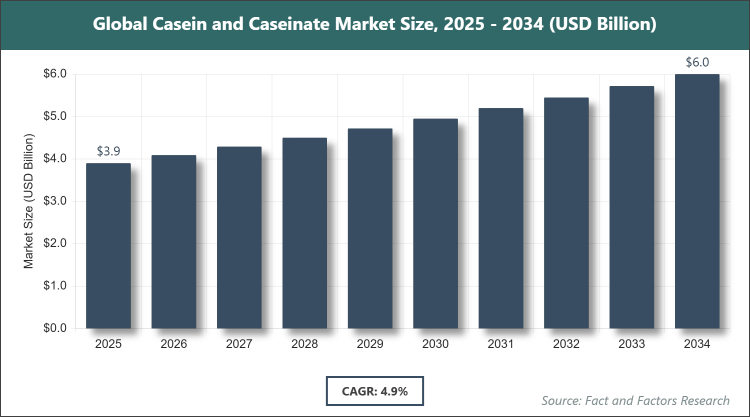
[235+ Pages Report] According to Facts & Factors, the global casein and caseinate market size was estimated at USD 3.90 billion in 2025 and is expected to reach USD 6.21 billion by the end of 2034. The casein and caseinate industry is anticipated to grow by a CAGR of 4.9% between 2026 and 2034. The casein and caseinate Market is driven by increasing demand for protein-rich foods and beverages.
 Market Overview
The casein and caseinate market encompasses milk-derived proteins that are widely utilized for their functional properties such as emulsification, stabilization, and nutritional benefits. Casein is a phosphoprotein found in milk, forming micelles that provide slow-release protein, while caseinates are soluble salts of casein produced by neutralizing acid casein with alkalis, enhancing solubility and usability in various formulations.
Key Insights
- As per the analysis shared by our research analyst, the global casein and caseinate market is estimated to grow annually at a CAGR of around 4.9% over the forecast period (2026-2034).
- In terms of revenue, the global casein and caseinate market size was valued at around USD 3.90 Billion in 2025 and is projected to reach USD 6.21 Billion by 2034.
- The market is driven by increasing demand for protein-rich foods.
- Based on the type, sodium caseinate dominated with 32.8% share due to its excellent emulsifying and stabilizing properties.
- Based on the application, food and beverages dominated with 56.85% share owing to its widespread use in dairy, bakery, and processed foods.
- Based on the end-user, dairy products dominated with 35% share because of its essential role in cheese and yogurt production.
- Based on the region, Europe dominated with 45.9% share due to its strong dairy industry and high consumption of processed foods.
Growth Drivers
- Rising Demand for Protein-Rich Foods and Beverages
The increasing consumer focus on health and wellness has boosted the demand for high-protein diets, where casein and caseinates serve as key ingredients in sports nutrition, dietary supplements, and functional foods. Their slow-digesting properties provide sustained energy release, making them ideal for muscle recovery and weight management products.
This trend is further amplified by the growth of the fitness industry and rising awareness of protein's role in overall nutrition, driving market expansion across developed and emerging economies.
Restraints
- Fluctuating Raw Milk Prices
Volatility in milk supply and prices, influenced by weather conditions, feed costs, and dairy farming regulations, poses a significant challenge to production costs. This instability can lead to higher prices for end products, affecting affordability and market penetration.
Additionally, supply chain disruptions from global events exacerbate these issues, limiting the ability of manufacturers to maintain consistent output and pricing strategies.
Opportunities
- Expansion in Emerging Markets
Rapid urbanization and rising disposable incomes in Asia-Pacific and Latin America are creating new avenues for protein-enriched products. Increasing adoption of Western dietary habits and growing health consciousness present opportunities for market players to introduce innovative casein-based items.
Furthermore, investments in local dairy infrastructure and partnerships with regional suppliers can help tap into these high-growth areas, fostering long-term market development.
Challenges
- Competition from Plant-Based Alternatives
The surge in veganism and preference for plant-derived proteins like pea and soy is eroding market share for dairy-based casein products. Consumers seeking lactose-free and sustainable options are shifting away, pressuring traditional players to innovate.
Regulatory scrutiny on animal welfare and environmental impacts of dairy farming adds to these challenges, requiring the industry to adapt through hybrid products or enhanced sustainability practices.
Report Scope
Report Attribute |
Details |
Market Size 2025 |
USD 3.90 Billion |
Projected Market Size in 2034 |
USD 6.21 Billion |
CAGR Growth Rate |
4.9% CAGR |
Base Year |
2025 |
Forecast Years |
2026-2034 |
Key Market Players |
Fonterra Co-operative Group, Arla Foods, Kerry Group, FrieslandCampina, Lactalis Ingredients, AMCO Proteins, Erie Foods International, Glanbia plc, Idaho Milk Products, Groupe Lactalis, and Others. |
Key Segment |
By Type, By Application, By End-User, and By Region |
Major Regions Covered |
North America, Europe, Asia Pacific, Latin America, and the Middle East & Africa |
Purchase Options |
Request customized purchase options to meet your research needs. Explore purchase options |
Market Segmentation
The casein and caseinate market is segmented by type, application, end-user, and region.
Based on Type Segment, the casein and caseinate market is divided into acid casein, rennet casein, sodium caseinate, calcium caseinate, potassium caseinate, and others. Sodium caseinate is the most dominant subsegment, holding around 32.8% share, due to its superior solubility, emulsifying properties, and versatility in food processing, which enhances texture and stability in products like processed cheeses and beverages. This dominance drives the market by enabling cost-effective formulations and meeting clean-label demands. Calcium caseinate is the second most dominant, valued for its nutritional benefits in sports supplements, providing slow-release protein that supports muscle growth and recovery, thus boosting demand in the health and fitness sector.
Based on Application Segment, the casein and caseinate market is divided into food and beverages, pharmaceuticals, cosmetics and personal care, industrial, and others. Food and beverages is the most dominant subsegment with 56.85% share, as caseinates improve texture, emulsification, and nutritional value in dairy, bakery, and processed foods, driving market growth through increased consumption of convenient, protein-enriched items. Pharmaceuticals is the second most dominant, utilizing casein's binding and controlled-release properties in drug formulations, enhancing bioavailability and supporting the expansion of nutraceuticals and medical nutrition products.
Based on End-User Segment, the casein and caseinate market is divided into dairy products, bakery and confectionery, sports nutrition, animal feed, and others. Dairy products dominate with 35% share, where casein enhances viscosity and stability in cheeses and yogurts, driving market growth by meeting demand for high-quality, functional dairy items. Sports nutrition is the second most dominant, leveraging casein's slow-digesting protein for muscle recovery supplements, fueling expansion amid rising fitness trends and health awareness.
Recent Developments
- In October 2025, Tatua reported record production volumes for its bulk ingredients, including caseinate and whey protein concentrate, boosting supply for global markets.
- In July 2023, Fonterra invested USD 10 million in Pendulum Therapeutics to advance probiotic innovations, potentially enhancing casein-based nutritional products.
- In 2024, Arla Foods expanded its production capacity for micellar casein, targeting the growing sports nutrition sector with high-purity protein isolates.
Regional Analysis
- Europe to dominate the global market
Europe dominates the global casein and caseinate market, driven by its robust dairy industry, advanced processing technologies, and high demand for functional foods. The region's strong focus on innovation in food and beverages, coupled with stringent quality standards, supports premium product development. Germany stands out as the dominating country, with its efficient dairy supply chain and leadership in exporting high-value caseinates to global markets.
North America holds a significant share, fueled by health-conscious consumers and the booming sports nutrition industry. The United States is the dominating country, benefiting from large-scale dairy production and innovative applications in pharmaceuticals and supplements, supported by a mature food processing sector.
Asia-Pacific is experiencing rapid growth due to rising protein consumption and urbanization. China dominates the region, with expanding dairy infrastructure and increasing demand for infant formula and functional beverages, driven by a growing middle class.
Latin America shows steady progress, supported by improving dairy farming practices. Brazil is the leading country, leveraging its vast milk production to supply regional food industries and export casein products.
The Middle East & Africa region is emerging, with growth in packaged foods. South Africa dominates, aided by investments in dairy processing and rising demand for nutritional products amid urbanization.
Competitive Analysis
The global casein and caseinate market is dominated by players:
- Fonterra Co-operative Group
- Arla Foods
- Kerry Group
- FrieslandCampina
- Lactalis Ingredients
- AMCO Proteins
- Erie Foods International
- Glanbia plc
- Idaho Milk Products
- Groupe Lactalis
The global casein and caseinate market is segmented as follows:
By Type
- Acid Casein
- Rennet Casein
- Sodium Caseinate
- Calcium Caseinate
- Potassium Caseinate
- Others
By Application
- Food and Beverages
- Pharmaceuticals
- Cosmetics and Personal Care
- Industrial
- Others
By End-User
- Dairy Products
- Bakery and Confectionery
- Sports Nutrition
- Animal Feed
- Others
By Region
- North America
- The U.S.
- Canada
- Mexico
- Europe
- France
- The UK
- Spain
- Germany
- Italy
- Rest of Europe
- Asia Pacific
- China
- Japan
- India
- Australia
- Southeast Asia
- Rest of Asia Pacific
- The Middle East & Africa
- Saudi Arabia
- UAE
- Egypt
- Kuwait
- South Africa
- Rest of the Middle East & Africa
- Latin America
- Brazil
- Argentina
- Rest of Latin America
Industry Major Market Players
The global casein and caseinate market is dominated by players:
- Fonterra Co-operative Group
- Arla Foods
- Kerry Group
- FrieslandCampina
- Lactalis Ingredients
- AMCO Proteins
- Erie Foods International
- Glanbia plc
- Idaho Milk Products
- Groupe Lactalis
Frequently Asked Questions



Copyright © 2025 - 2026, All Rights Reserved, Facts and Factors