
Search Market Research Report
Candle Market Size, Share Global Analysis Report, 2026-2034

Candle Market Size, Share, Growth Analysis Report By Product Type (Tea Lights, Votive, Pillar, Occasional, Others), By Raw Material (Paraffin Wax, Stearin, Beeswax, Others), By Scent Type (Scented, Unscented), By End-User (Residential, Commercial), By Distribution Channel (Specialty Stores, Supermarkets & Hypermarkets, Online Stores, Others), and By Region - Global Industry Insights, Overview, Comprehensive Analysis, Trends, Statistical Research, Market Intelligence, Historical Data and Forecast 2026-2034
Industry Insights
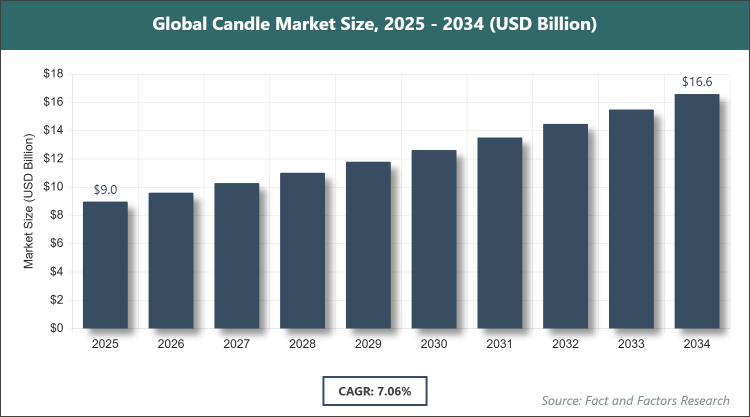
[250+ Pages Report] According to Facts & Factors, the global Candle market size was estimated at USD 8.98 billion in 2025 and is expected to reach USD 16.42 billion by 2034, growing at a CAGR of 7.06% from 2026 to 2034. Candle Market is driven by increasing demand for home decor and aromatherapy products.
 Market Overview
The candle market encompasses the production, distribution, and consumption of wax-based products designed for illumination, fragrance diffusion, decorative purposes, or ritualistic use, crafted from various materials such as paraffin, soy, beeswax, or palm wax, and often infused with scents, colors, and shapes to cater to aesthetic and functional needs in residential, commercial, and hospitality settings. This market includes a diverse array of products ranging from traditional pillars and tapers to modern votives and tea lights, emphasizing sustainability through natural ingredients and eco-friendly packaging, while addressing consumer preferences for ambiance enhancement, wellness benefits via aromatherapy, and seasonal or thematic variations without relying on electrical sources for light or scent.
Key Insights
- The Candle market was valued at USD 8.98 Billion in 2025 and is projected to reach USD 16.42 Billion by the end of 2034.
- The market is expected to grow at a CAGR of 7.06% between 2026 and 2034.
- The Candle market is driven by increasing demand for home decor and aromatherapy products.
- Based on the Product Type segment, the Pillar Candles subsegment dominated the market in 2025 with a share of 30.0% because of its versatility in decor and long burn time appealing to residential users.
- Based on the Raw Material segment, the Paraffin Wax subsegment dominated the market in 2025 with a share of 50.0% because of its low cost and widespread availability in manufacturing.
- Based on the Scent Type segment, the Scented subsegment dominated the market in 2025 with a share of 60.0% because of growing consumer preference for aromatherapy and wellness benefits.
- Based on the End-User segment, the Residential subsegment dominated the market in 2025 with a share of 70.0% because of high home usage for ambiance and relaxation.
- Based on the Distribution Channel segment, the Online Stores subsegment dominated the market in 2025 with a share of 35.0% because of convenience and wide variety offered through e-commerce platforms.
- Europe held the largest market share of 30.0% in 2025 due to strong cultural traditions and high demand for luxury scented candles.
Growth Drivers
- Increasing Demand for Aromatherapy and Wellness Products
The rising consumer focus on mental well-being and stress relief has boosted the use of scented candles infused with essential oils, positioning them as essential home wellness items. This driver is fueled by the global wellness trend, with social media influencing purchases and brands innovating in therapeutic fragrances to capture health-conscious demographics.
- Surge in Home Decor and Gifting Trends
Urbanization and lifestyle changes have elevated candles as decorative elements and popular gifts, especially during holidays and festivals, driving seasonal sales spikes. This is supported by e-commerce growth, enabling personalized and premium options that enhance interior aesthetics and appeal to millennial and Gen Z consumers.
- Shift Toward Eco-Friendly and Sustainable Materials
Consumer preference for natural waxes like soy and beeswax over paraffin has grown due to environmental concerns, prompting manufacturers to adopt green practices. This trend aligns with regulatory pushes for sustainability, encouraging innovation in biodegradable packaging and reducing carbon footprints in production.
Restraints
- Volatility in Raw Material Prices
Fluctuations in wax prices, influenced by agricultural yields and oil markets, increase production costs and affect profitability for manufacturers. This restraint challenges pricing stability, particularly for small producers, potentially leading to higher consumer prices and reduced demand in price-sensitive segments.
- Competition from Alternatives like Diffusers
The rise of electric diffusers and air fresheners offers scent without open flames, diverting consumers concerned about safety and indoor air quality. This competition intensifies in urban areas, requiring candle makers to differentiate through unique designs and safety features to retain market share.
Opportunities
- Expansion in Emerging Markets
Rapid urbanization in Asia-Pacific provides opportunities for affordable, scented candles tailored to local festivals and cultural practices. This can be capitalized on through localized marketing and partnerships, tapping into rising disposable incomes and e-commerce penetration.
- Innovation in Smart and Tech-Integrated Candles
Developing app-controlled or LED-enhanced candles offers premium features like adjustable scents, attracting tech-savvy users. This innovation unlocks high-margin segments, fostering growth in luxury and experiential products.
Challenges
- Regulatory Compliance on Emissions
Stringent standards on VOC emissions and fire safety require reformulations, raising R&D costs. This impacts smaller firms, potentially consolidating the market toward larger players with resources for compliance.
- Supply Chain Disruptions
Geopolitical issues and climate effects on bee populations disrupt beeswax supply, causing shortages. This demands alternative sourcing, increasing costs and affecting production timelines.
Report Scope
Report Attribute |
Details |
Market Size in 2025 |
USD 8.98 Billion |
Projected Market Size in 2034 |
USD 16.42 Billion |
CAGR Growth Rate |
7.06% CAGR |
Base Year |
2025 |
Forecast Years |
2026-2034 |
Key Market Players |
Yankee Candle, Bath & Body Works, Candle-lite Company, WoodWick, Paddywax Candles, Colonial Candle, Bridgewater Candle Company, Voluspa, Diptyque, Jo Malone, and Others. |
Key Segment |
By Product Type, By Raw Material, By Scent Type, By End-User, By Distribution Channel, and By Region |
Major Regions Covered |
North America, Europe, Asia Pacific, Latin America, and the Middle East &, Africa |
Purchase Options |
Request customized purchase options to meet your research needs. Explore purchase options |
Market Segmentation
The Candle market is segmented by type, application, end-user, and region.
Based on Product Type Segment, the Candle market is divided into Tea Lights, Votive, Pillar, Occasional, and Others. The most dominant segment is Pillar, holding 30.0% share, due to its aesthetic appeal and longevity, driving market growth through decor trends; the second most dominant is Votive, contributing via religious and ambiance uses, supporting expansion in commercial spaces.
Based on the Raw Material Segment, the Candle market is divided into Paraffin Wax, Stearin, Beeswax, and Others. The most dominant segment is Paraffin Wax, with 50.0% share, owing to affordability and molding ease, propelling growth in mass production; the second most dominant is Soy Wax, aiding sustainability-driven demand.
Based on the Scent Type Segment, the Candle market is divided into Scented and Unscented. The most dominant segment is Scented, capturing 60.0% share, because of aromatherapy popularity, fueling wellness trends; the second most dominant is Unscented, for sensitive users.
Based on the End-User Segment, the Candle market is divided into Residential and Commercial. The most dominant segment is Residential, with 70.0% share, driven by home use for relaxation, accelerating e-commerce sales; the second most dominant is Commercial, in spas and hotels.
Based on the Distribution Channel Segment, the Candle market is divided into Specialty Stores, Supermarkets & Hypermarkets, Online Stores, and Others. The most dominant segment is Online Stores, holding 35.0% share, due to convenience, boosting digital growth; the second most dominant is Specialty Stores, for premium selections.
Recent Developments
- In February 2026, Yankee Candle launched a new line of eco-friendly soy-based scented candles with biodegradable packaging, targeting sustainability-conscious consumers.
- In January 2026, Bath & Body Works expanded its aromatherapy collection with tech-integrated smart candles featuring app-controlled fragrance release.
Regional Analysis
- Europe to dominate the global market
Europe dominates the Candle market with a 30.0% share, attributed to strong cultural traditions in gifting and decor, plus high demand for luxury items; Germany leads, with festive markets in Munich driving scented candle sales, supported by EU sustainability regulations.
North America exhibits robust growth, fueled by wellness trends; the United States dominates, with holiday seasons in New York boosting e-commerce, emphasizing innovative fragrances.
Asia Pacific is fastest-growing, propelled by urbanization; China leads, with manufacturing in Shanghai supplying global scented demands amid rising middle-class spending.
Latin America shows potential; Brazil dominates, leveraging carnival traditions in Rio for decorative candles.
Middle East and Africa emerge; UAE leads in the Middle East with Dubai's luxury retail for premium scented products.
Competitive Analysis
The global Candle market is dominated by players:
- Yankee Candle
- Bath & Body Works
- Candle-lite Company
- WoodWick
- Paddywax Candles
- Colonial Candle
- Bridgewater Candle Company
- Voluspa
- Diptyque
- Jo Malone
The global Candle market is segmented as follows:
By Product Type
- Tea Lights
- Votive
- Pillar
- Occasional
- Others
By Raw Material
- Paraffin Wax
- Stearin
- Beeswax
- Others
By Scent Type
- Scented
- Unscented
By End-User
- Residential
- Commercial
By Distribution Channel
- Specialty Stores
- Supermarkets & Hypermarkets
- Online Stores
- Others
By Region
- North America
- The U.S.
- Canada
- Mexico
- Europe
- France
- The UK
- Spain
- Germany
- Italy
- Rest of Europe
- Asia Pacific
- China
- Japan
- India
- Australia
- Southeast Asia
- Rest of Asia Pacific
- The Middle East & Africa
- Saudi Arabia
- UAE
- Egypt
- Kuwait
- South Africa
- Rest of the Middle East & Africa
- Latin America
- Brazil
- Argentina
- Rest of Latin America
Industry Major Market Players
Frequently Asked Questions



Copyright © 2025 - 2026, All Rights Reserved, Facts and Factors