
Search Market Research Report
Biomass Briquette Fuel Market Size, Share Global Analysis Report, 2026-2034

Biomass Briquette Fuel Market Size, Share, Growth Analysis Report By Feedstock (Sawdust Biomass Briquette, Biomass Pellet, Biomass Fuel Briquettes, Wood Biomass Briquette, White Coal Briquettes, Agriculture Waste Briquettes, and Others), By Form (Pellets, Blocks, and Others), By Application (Power Generation, Heating Fuel, Cooking Fuel, and Others), and By Region - Global Industry Insights, Overview, Comprehensive Analysis, Trends, Statistical Research, Market Intelligence, Historical Data and Forecast 2026-2034
Industry Insights
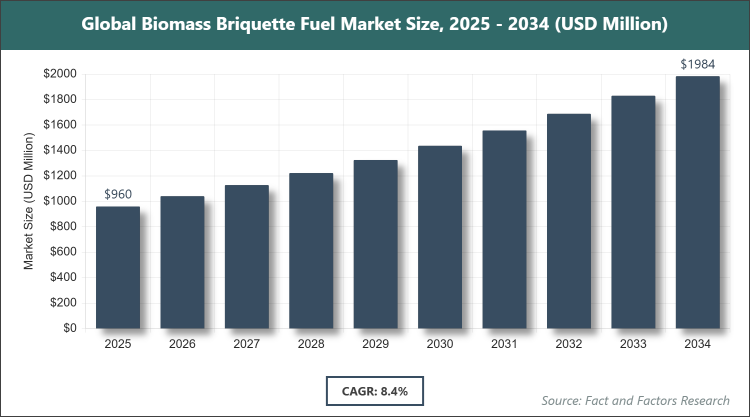
[218 Pages Report] According to Facts & Factors, the global biomass briquette fuel market size was estimated at USD 0.96 billion in 2025 and is expected to reach USD 2.0 billion by the end of 2034. The Biomass Briquette Fuel industry is anticipated to grow by a CAGR of 8.4% between 2026 and 2034. The Biomass Briquette Fuel Market is driven by increasing demand for renewable energy sources and government incentives for bioenergy.
 Market Overview
The biomass briquette fuel market involves the production, distribution, and utilization of compressed blocks or pellets made from organic waste materials such as agricultural residues, wood waste, and other biomass sources, serving as an eco-friendly alternative to traditional fossil fuels for heating, cooking, and power generation, while promoting waste management and reducing carbon emissions through sustainable energy practices in various industrial, residential, and commercial settings. This market encompasses processes from raw material collection to briquetting and end-use applications, focusing on enhancing energy efficiency and environmental sustainability amid global shifts towards cleaner energy solutions.
Key Insights
- As per the analysis shared by our research analyst, the Biomass Briquette Fuel market is expected to grow at a CAGR of 8.4% during the forecast period of 2026-2034.
- In terms of revenue, the Biomass Briquette Fuel market size was valued at about USD 0.96 billion in 2025 and is expected to reach USD 2.0 billion by 2034.
- The Biomass Briquette Fuel market is driven by increasing demand for renewable energy sources and government incentives for bioenergy.
- Based on the feedstock, the agriculture waste briquettes segment dominated the market with a share of 42.5% in 2025 due to the abundant availability of crop residues and cost-effectiveness in production, making it a preferred choice for sustainable fuel.
- Based on the form, the pellets segment dominated the market with a share of 60% in 2025 owing to their uniform size, high energy density, and ease of handling in automated systems.
- Based on the application, the power generation segment dominated the market with a share of 37.2% in 2025 because of its role in large-scale energy production and alignment with renewable energy targets.
- Asia Pacific dominated the market with a share of 40% in 2025 due to high agricultural activity providing ample raw materials and supportive government policies for clean energy adoption.
Growth Drivers
- Rising Demand for Renewable Energy
The global push towards sustainable energy sources is accelerating the adoption of biomass briquettes as a cleaner alternative to coal and oil, driven by international agreements like the Paris Accord that emphasize reducing greenhouse gas emissions, with biomass offering carbon-neutral combustion when sourced responsibly. This driver is bolstered by technological advancements in briquetting machines that improve efficiency and output quality.
Furthermore, corporate sustainability goals and consumer preferences for green products are encouraging investments in biomass infrastructure, expanding market reach into new sectors and regions through subsidies and carbon credits that incentivize transition from fossil fuels.
- Government Incentives and Policies
Supportive regulations, including tax rebates and grants for bioenergy projects, are fostering market growth by lowering entry barriers for producers and encouraging rural entrepreneurship in biomass collection and processing. This is particularly evident in developing nations where energy security is prioritized.
Additionally, integration with national renewable energy targets creates long-term demand stability, promoting R&D in advanced briquette formulations that enhance calorific value and reduce emissions, thereby attracting foreign investments and partnerships.
- Abundant Availability of Raw Materials
The vast supply of agricultural and forestry waste provides a cost-effective feedstock, reducing dependency on imported fuels and supporting local economies through job creation in collection and manufacturing. This driver leverages waste-to-energy concepts to address environmental issues like landfill overflow.
Moreover, seasonal abundance ensures consistent supply chains, with innovations in storage and logistics minimizing losses, enabling scalable production that meets growing industrial demands for reliable, eco-friendly fuel sources.
Restraints
- High Initial Investment Costs
The capital-intensive nature of setting up briquetting plants, including machinery and infrastructure, poses a barrier for small-scale operators, limiting market entry in underdeveloped regions where financing options are scarce. This restraint is amplified by fluctuating raw material prices affecting profitability.
Efforts to mitigate include government loans and public-private partnerships, though adoption remains slow, requiring education on long-term ROI to encourage broader participation.
- Logistical Challenges in Supply Chain
Transportation of bulky raw materials and finished briquettes increases costs, especially in remote areas with poor infrastructure, leading to inefficiencies and higher end-user prices. This is compounded by seasonal availability issues causing supply disruptions.
Strategies like localized production hubs and improved road networks are essential, but implementation varies, necessitating integrated planning to streamline operations.
Opportunities
- Expansion in Emerging Markets
Rapid industrialization in Asia and Africa offers untapped potential for biomass briquettes, with growing energy needs and waste generation creating ideal conditions for market penetration through tailored solutions for local industries. This opportunity aligns with urbanization trends.
Collaborations with NGOs and governments can facilitate awareness campaigns and pilot projects, unlocking funding for scalable initiatives that drive adoption.
- Technological Advancements
Innovations in torrefaction and binding agents enhance briquette quality, opening doors to premium markets and export opportunities. This fosters differentiation in competitive landscapes.
R&D investments can lead to hybrid fuels, expanding applications and attracting tech-savvy investors for sustainable growth.
Challenges
- Competition from Other Renewables
The rise of solar and wind energy alternatives diverts investments away from biomass, as they offer lower maintenance and scalability in certain contexts. This challenge requires highlighting biomass's reliability in off-grid areas.
Advocacy for complementary energy mixes and policy advocacy are crucial to maintain relevance.
- Environmental Concerns Over Sourcing
Unsustainable harvesting of biomass can lead to deforestation critiques, necessitating strict certification to ensure eco-friendly practices. This demands supply chain transparency.
Building trust through audits and community involvement is key to overcoming perceptions and sustaining growth.
Report Scope
Report Attribute |
Details |
Market Size 2025 |
USD 0.96 Billion |
Projected Market Size in 2034 |
USD 2.0 Billion |
CAGR Growth Rate |
8.4% CAGR |
Base Year |
2025 |
Forecast Years |
2026-2034 |
Key Market Players |
Appalachian Wood Pellets, Balcas Energy, Biomass Secure Power Inc., BlueFire Renewables, Drax Biomass, Enviva Partners, Fram Renewable Fuels, Graanul Invest Group, Pfeifer Group, Lignetics, and Others. |
Key Segment |
By Feedstock, By Form, By Application, and By Region |
Major Regions Covered |
North America, Europe, Asia Pacific, Latin America, and the Middle East & Africa |
Purchase Options |
Request customized purchase options to meet your research needs. Explore purchase options |
Market Segmentation
The Biomass Briquette Fuel market is segmented by feedstock, form, application, and region.
Based on Feedstock Segment, the biomass briquette fuel market is divided into sawdust biomass briquette, biomass pellet, biomass fuel briquettes, wood biomass briquette, white coal briquettes, agriculture waste briquettes, and others. The most dominant segment is agriculture waste briquettes, leading the market due to the widespread availability of crop residues like rice husk and sugarcane bagasse in agrarian economies, which reduces production costs and promotes waste utilization, driving overall market growth by addressing environmental concerns and providing affordable fuel options; the second most dominant is wood biomass briquette, which gains prominence for its high calorific value and established supply chains in forested regions, contributing to market expansion through reliable energy output in industrial applications.
Based on Form Segment, the biomass briquette fuel market is divided into pellets, blocks, and others. The most dominant segment is pellets, commanding the largest share owing to their standardized shape facilitating easy storage, transport, and combustion in boilers, thus propelling market growth via efficiency in large-scale uses; the second most dominant is blocks, preferred for their density and longer burn time in household and small industrial settings, aiding market drive by catering to diverse end-user needs.
Based on Application Segment, the biomass briquette fuel market is divided into power generation, heating fuel, cooking fuel, and others. The most dominant segment is power generation, dominating because of its integration into biomass power plants for electricity production, boosted by renewable energy mandates, enhancing market growth through scalable energy solutions; the second most dominant is heating fuel, utilized in industrial processes and residential heating, supporting expansion by offering cost-effective alternatives to fossil fuels.
Recent Developments
- In January 2025, Enviva Partners expanded its production capacity with a new biomass briquette plant in the U.S., focusing on sustainable sourcing to meet growing demand for renewable fuels.
- In June 2024, Drax Biomass announced a partnership with local farmers in Europe to utilize agricultural waste for briquette production, aiming to reduce carbon footprints.
- In March 2023, Graanul Invest Group launched torrefied biomass briquettes, offering higher energy density and water resistance for export markets.
- In October 2022, Pfeifer Group invested in advanced briquetting technology to enhance efficiency and output in their facilities across Asia.
Regional Analysis
- Asia Pacific to dominate the global market
Asia Pacific commands the biomass briquette fuel market, with India as the dominating country, where abundant agricultural residues from crops like paddy and wheat provide ample feedstock, coupled with government initiatives promoting clean cooking and rural energy access through subsidies, while rapid industrialization increases demand for sustainable heating in factories, supported by dense population centers that facilitate efficient distribution and local manufacturing hubs that reduce costs and emissions.
North America exhibits steady growth, dominated by the United States, benefiting from advanced technology in biomass processing and strong policy frameworks encouraging renewable energy adoption in power sectors, with forestry waste serving as key raw material, alongside collaborations between utilities and producers to integrate briquettes into energy mixes for reduced reliance on coal.
Europe shows robust progress, led by Germany, emphasizing stringent environmental regulations that favor biomass over fossil fuels for heating and power, with well-established supply chains from agricultural and wood wastes, driven by EU targets for carbon neutrality that spur investments in efficient briquetting technologies.
Latin America is emerging, with Brazil at the forefront, leveraging sugarcane bagasse and other agro wastes in a tropical climate ideal for biomass growth, supported by biofuel policies and export-oriented production that caters to global demands for sustainable fuels.
The Middle East & Africa region is developing, dominated by South Africa, where agricultural and municipal wastes are converted into briquettes to address energy poverty, with international aid funding projects that enhance local capabilities and promote usage in off-grid communities for cooking and small-scale power.
Competitive Analysis
The global Biomass Briquette Fuel market is dominated by players:
- Appalachian Wood Pellets
- Balcas Energy
- Biomass Secure Power Inc.
- BlueFire Renewables
- Drax Biomass
- Enviva Partners
- Fram Renewable Fuels
- Graanul Invest Group
- Pfeifer Group
- Lignetics
The global Biomass Briquette Fuel market is segmented as follows:
By Feedstock
- Sawdust Biomass Briquette
- Biomass Pellet
- Biomass Fuel Briquettes
- Wood Biomass Briquette
- White Coal Briquettes
- Agriculture Waste Briquettes
- Others
By Form
- Pellets
- Blocks
- Others
By Application
- Power Generation
- Heating Fuel
- Cooking Fuel
- Others
By Region
- North America
- The U.S.
- Canada
- Mexico
- Europe
- France
- The UK
- Spain
- Germany
- Italy
- Rest of Europe
- Asia Pacific
- China
- Japan
- India
- Australia
- Southeast Asia
- Rest of Asia Pacific
- The Middle East & Africa
- Saudi Arabia
- UAE
- Egypt
- Kuwait
- South Africa
- Rest of the Middle East & Africa
- Latin America
- Brazil
- Argentina
- Rest of Latin America
Industry Major Market Players
The global Biomass Briquette Fuel market is dominated by players:
- Appalachian Wood Pellets
- Balcas Energy
- Biomass Secure Power Inc.
- BlueFire Renewables
- Drax Biomass
- Enviva Partners
- Fram Renewable Fuels
- Graanul Invest Group
- Pfeifer Group
- Lignetics
Frequently Asked Questions



Copyright © 2025 - 2026, All Rights Reserved, Facts and Factors