
Search Market Research Report
Battery Storage Inverter Market Size, Share Global Analysis Report, 2026-2034

Battery Storage Inverter Market Size, Share, Growth Analysis Report By Type (Standalone Inverters, Grid-tied Inverters, Micro Inverters, and Others), By Application (Solar PV, Wind, Hybrid Systems, and Others), By End-User (Residential, Commercial, Utility, and Others), and By Region - Global Industry Insights, Overview, Comprehensive Analysis, Trends, Statistical Research, Market Intelligence, Historical Data and Forecast 2026-2034
Industry Insights
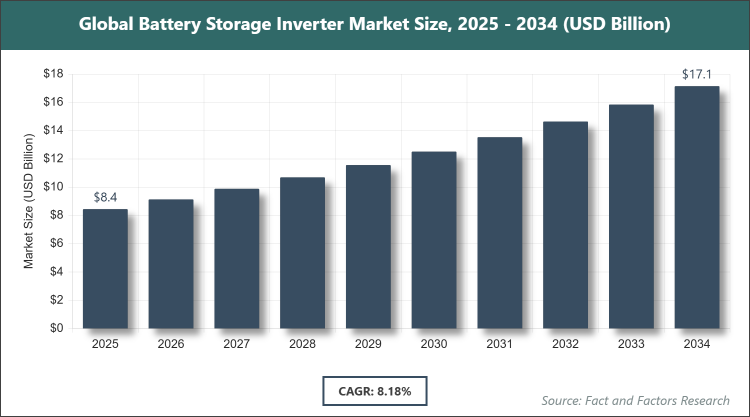
[225 Pages Report] According to Facts & Factors, the global battery storage inverter market size was estimated at USD 8.45 billion in 2025 and is expected to reach USD 17.54 billion by the end of 2034. The Battery Storage Inverter industry is anticipated to grow by a CAGR of 8.18% between 2026 and 2034. The Battery Storage Inverter Market is driven by the rising adoption of renewable energy and supportive government policies.
 Market Overview
The battery storage inverter market encompasses the development, production, and deployment of electronic devices that convert direct current from battery storage systems into alternating current for grid integration or direct use, while also managing energy flow bidirectionally to enable efficient charging and discharging in applications ranging from residential solar setups to large-scale utility grids, focusing on enhancing energy reliability, optimizing renewable integration, and supporting grid stability without specifying quantitative aspects. This market involves an ecosystem of manufacturers, integrators, and end-users committed to advancing power electronics technology to address intermittency challenges in clean energy sources, emphasizing features like high efficiency, scalability, and smart grid compatibility to meet diverse energy management needs across global sectors.
Key Insights
- As per the analysis shared by our research analyst, the Battery Storage Inverter market is expected to grow at a CAGR of 8.18% during the forecast period of 2026-2034.
- In terms of revenue, the Battery Storage Inverter market size was valued at about USD 8.45 billion in 2025 and is expected to reach USD 17.54 billion by 2034.
- The Battery Storage Inverter market is driven by the rising adoption of renewable energy and supportive government policies.
- Based on the type, the grid-tied inverters segment dominated the market with a share of 45% in 2025 due to its essential role in integrating renewable sources with existing power grids for efficient energy management.
- Based on the application, the solar PV segment dominated the market with a share of 60% in 2025, owing to the widespread deployment of solar energy systems requiring inverters for storage and grid compatibility.
- Based on the end-user, the utility segment dominated the market with a share of 55% in 2025 as it supports large-scale energy storage for grid stability and renewable integration.
- Asia Pacific dominated the market with a share of 58% in 2025 due to rapid renewable energy adoption and government incentives in emerging economies.
Growth Drivers
- Rising Adoption of Renewable Energy
The global shift towards solar and wind power is fueling demand for battery storage inverters to manage intermittent energy supply, enabling stable grid integration and reducing reliance on fossil fuels. This driver is bolstered by international commitments to carbon reduction targets, encouraging investments in storage solutions.
Additionally, technological advancements in inverter efficiency are lowering system costs, making them more accessible for widespread adoption and supporting market expansion through enhanced performance in diverse applications.
- Supportive Government Policies
Incentives such as subsidies and tax credits for energy storage systems are accelerating market growth, particularly in regions prioritizing clean energy transitions. These policies stimulate infrastructure development and R&D in advanced inverters.
Furthermore, regulatory frameworks mandating renewable integration are driving utility-scale deployments, fostering collaborations between governments and industry players to achieve energy security goals.
- Increasing Electricity Independence Needs
Growing concerns over power outages and rising electricity costs are prompting residential and commercial users to invest in storage inverters for self-sufficiency. This trend is amplified by urbanization in developing regions with unreliable grids.
Moreover, innovations in hybrid systems allow seamless off-grid operations, expanding market reach into remote areas and supporting long-term growth through diversified applications.
Restraints
- High Initial Costs
Elevated upfront expenses for inverters and associated batteries limit adoption among small-scale users, particularly in cost-sensitive markets. This restraint is compounded by installation and integration complexities with existing infrastructure.
Strategies to mitigate include financing options and economies of scale from mass production, though achieving affordability without compromising quality remains challenging.
- Environmental Impact Concerns
Issues related to battery mining and disposal pose regulatory hurdles, potentially slowing market progress amid growing scrutiny on sustainability. This affects supply chains for key materials like lithium.
Efforts to develop eco-friendly alternatives and recycling programs are essential, yet transitioning requires significant investment and time to align with global environmental standards.
Opportunities
- Grid Modernization Initiatives
Upgrades to smart grids offer avenues for advanced inverters, enabling bidirectional energy flow and real-time management. This opportunity is ripe in regions investing in infrastructure resilience.
Partnerships with utilities can accelerate deployment, driving revenue through integrated solutions that enhance grid efficiency and renewable penetration.
- Innovation in Sustainable Technologies
Development of biodegradable components and efficient hybrid inverters presents growth potential in eco-conscious markets. This aligns with global sustainability trends.
R&D investments can lead to differentiated products, attracting premium segments, and fostering market expansion through green certifications.
Challenges
- Fluctuating Power Inputs
Variability from renewables causes voltage instability, challenging inverter performance, and grid harmony. This requires robust design adaptations.
Ongoing research in AI-driven controls is key to overcoming this, though implementation across diverse systems adds complexity.
- Limited Lifespan and Maintenance
Inverters' finite cycles necessitate regular upkeep, increasing operational costs and deterring long-term investments. This challenge is prominent in harsh environments.
Advancing durable materials and predictive maintenance technologies can address this, but require industry-wide standards for reliability.
Report Scope
Report Attribute |
Details |
Market Size 2025 |
USD 8.45 Billion |
Projected Market Size in 2034 |
USD 17.54 Billion |
CAGR Growth Rate |
8.18% CAGR |
Base Year |
2025 |
Forecast Years |
2026-2034 |
Key Market Players |
SMA Solar Technology AG, KACO New Energy, Sensata Technologies Inc., Poweroneups, GOODWE, Ingeteam, Guangdong Zhicheng Champion Group Co. Ltd., SUNGROW, Eaton, SolaX Power, and Others. |
Key Segment |
By Type, By Application, By End-User, and By Region |
Major Regions Covered |
North America, Europe, Asia Pacific, Latin America, and the Middle East & Africa |
Purchase Options |
Request customized purchase options to meet your research needs. Explore purchase options |
Market Segmentation
The Battery Storage Inverter market is segmented by type, application, end-user, and region.
Based on Type Segment, the battery storage inverter market is divided into standalone inverters, grid-tied inverters, micro inverters, and others. The most dominant segment is grid-tied inverters, commanding the largest share due to their critical function in connecting storage systems to utility grids for seamless energy exchange, driving the market by facilitating renewable integration and peak shaving in large-scale deployments; the second most dominant is standalone inverters, which excels in off-grid applications providing reliable power in remote areas, contributing to market growth through enabling energy access in underserved regions and supporting microgrid developments.
Based on Application Segment, the battery storage inverter market is divided into solar PV, wind, hybrid systems, and others. The most dominant segment is solar PV, leading the market because of the exponential growth in solar installations requiring efficient storage for excess energy, propelling overall expansion via cost reductions and policy support for clean energy; the second most dominant is hybrid systems, gaining traction for combining multiple renewables with storage, aiding market drive by offering versatile solutions for stable power supply in variable conditions.
Based on End-User Segment, the battery storage inverter market is divided into residential, commercial, utility, and others. The most dominant segment is utility, dominating owing to large-scale grid stabilization needs amid rising renewable penetration, boosting market growth through massive projects enhancing energy reliability; the second most dominant is residential, supporting expansion by addressing household energy independence and integrating with home solar setups for cost savings.
Recent Developments
- In September 2023, LG Energy Solution launched Prime+, an energy storage system for residential use with expandable battery modules up to 32 kWh, enhancing home energy management.
- In July 2023, LG Energy Solution introduced hybrid inverters compatible with low and high-voltage configurations, supporting up to 32 kWh capacity for versatile residential applications.
- In June 2022, Natural Battery Technologies unveiled lithium-ion-based inverter batteries for residential and commercial solar storage, promoting grid independence.
- In September 2023, the Indian government initiated a tender for over 4,000 MWh battery energy storage systems to bolster manufacturing and deployment.
Regional Analysis
- Asia Pacific to dominate the global market
Asia Pacific leads the battery storage inverter market with China as the dominating country, where massive investments in solar and wind projects, coupled with carbon neutrality goals drive extensive adoption of inverters for grid integration, supported by government subsidies and manufacturing hubs that lower costs, while rapid urbanization increases demand for reliable power in residential and utility sectors, fostering innovation in hybrid systems.
North America maintains a strong presence led by the United States, which dominates through incentives like the Inflation Reduction Act, promoting residential and utility storage, integrated with advanced grid modernization efforts that enhance inverter efficiency, alongside growing commercial applications for energy resilience in variable weather conditions.
Europe exhibits robust growth with Germany as the key country, emphasizing renewable targets under the EU Green Deal that spur utility-scale deployments, combined with policies encouraging home energy systems for sustainability, creating opportunities for smart inverter technologies in densely populated areas.
Latin America is advancing, dominated by Brazil with its focus on hybrid renewables and storage to address grid instability, aided by natural resources and international investments that support commercial and utility projects for economic diversification.
The Middle East & Africa region is progressing, led by South Africa, where solar integration and off-grid solutions tackle energy access issues, complemented by regional initiatives for sustainable development enhancing inverter use in utility and residential settings.
Competitive Analysis
The global Battery Storage Inverter market is dominated by players:
- SMA Solar Technology AG
- KACO New Energy
- Sensata Technologies Inc.
- Poweroneups
- GOODWE
- Ingeteam
- Guangdong Zhicheng Champion Group Co. Ltd.
- SUNGROW
- Eaton
- SolaX Power
The global Battery Storage Inverter market is segmented as follows:
By Type
- Standalone Inverters
- Grid-tied Inverters
- Micro Inverters
- Others
By Application
- Solar PV
- Wind
- Hybrid Systems
- Others
By End-User
- Residential
- Commercial
- Utility
- Others
By Region
- North America
- The U.S.
- Canada
- Mexico
- Europe
- France
- The UK
- Spain
- Germany
- Italy
- Rest of Europe
- Asia Pacific
- China
- Japan
- India
- Australia
- Southeast Asia
- Rest of Asia Pacific
- The Middle East & Africa
- Saudi Arabia
- UAE
- Egypt
- Kuwait
- South Africa
- Rest of the Middle East & Africa
- Latin America
- Brazil
- Argentina
- Rest of Latin America
Industry Major Market Players
The global Battery Storage Inverter market is dominated by players:
- SMA Solar Technology AG
- KACO New Energy
- Sensata Technologies Inc.
- Poweroneups
- GOODWE
- Ingeteam
- Guangdong Zhicheng Champion Group Co. Ltd.
- SUNGROW
- Eaton
- SolaX Power
Frequently Asked Questions



Copyright © 2025 - 2026, All Rights Reserved, Facts and Factors