
Search Market Research Report
Asset Recovery Services Market Size, Share Global Analysis Report, 2026-2034

Asset Recovery Services Market Size, Share, Growth Analysis Report By Service Type (Remarketing and Value Recovery, Data Destruction/Data Sanitation, Recycling, Reverse Logistics, Others), By Asset Type (IT Assets, Industrial Assets, Consumer Goods, Others), By End-User (BFSI, IT & Telecom, Manufacturing, Healthcare, Government, Others), and By Region - Global Industry Insights, Overview, Comprehensive Analysis, Trends, Statistical Research, Market Intelligence, Historical Data and Forecast 2026-2034
Industry Insights
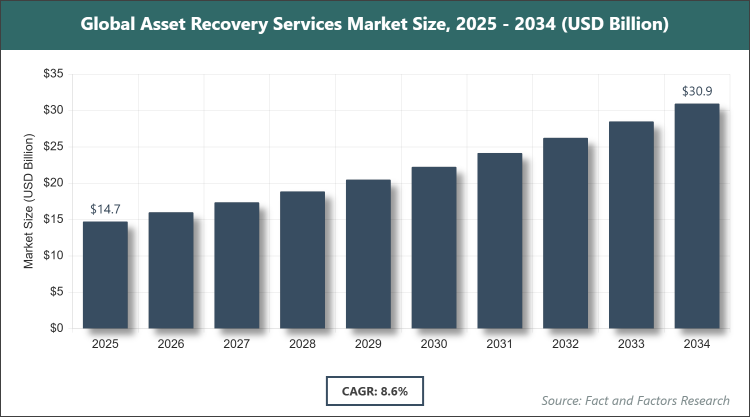
[250+ Pages Report] According to Facts & Factors, the global Asset Recovery Services market size was estimated at USD 14.73 billion in 2025 and is expected to reach USD 30.95 billion by 2034, growing at a CAGR of 8.6% from 2026 to 2034. Asset Recovery Services Market is driven by increasing focus on sustainability and regulatory compliance.
 Market Overview
Asset recovery services encompass a range of professional solutions aimed at identifying, locating, and reclaiming valuable assets that have been lost, stolen, or improperly disposed of, including financial instruments, physical equipment, intellectual property, and digital assets, often involving legal, investigative, and logistical processes to maximize returns for clients such as corporations, financial institutions, and governments. These services facilitate the efficient management of surplus or end-of-life assets by providing options like resale, recycling, or refurbishment, ensuring compliance with environmental regulations and data security standards while minimizing financial losses and promoting circular economy principles without relying on traditional disposal methods that could lead to value erosion or legal liabilities.
Key Insights
- The Asset Recovery Services market was valued at USD 14.73 Billion in 2025 and is projected to reach USD 30.95 Billion by the end of 2034.
- The market is expected to grow at a CAGR of 8.6% between 2026 and 2034.
- The Asset Recovery Services market is driven by increasing focus on sustainability and regulatory compliance.
- Based on the Service Type segment, the Data Destruction/Data Sanitation subsegment dominated the market in 2025 with a share of 40.0% because of rising data security concerns and stringent privacy regulations.
- Based on the Asset Type segment, the IT Assets subsegment dominated the market in 2025 with a share of 60.0% because of rapid technological obsolescence and high volume of electronic waste.
- Based on the End-User segment, the BFSI subsegment dominated the market in 2025 with a share of 30.0% because of high-value financial assets and strict compliance requirements.
- North America held the largest market share of 35.9% in 2025 due to mature financial sectors, advanced technology adoption, and robust regulatory frameworks.
Growth Drivers
- Increasing Regulatory Compliance and Data Security Demands
Stringent regulations such as GDPR and HIPAA compel organizations to securely dispose of assets, driving demand for professional services that ensure compliant data destruction and recovery. This driver is reinforced by rising cyber threats and data breaches, prompting investments in secure asset management to mitigate risks and avoid penalties.
- Focus on Sustainability and Circular Economy Practices
Growing environmental awareness and corporate sustainability goals encourage the reuse, refurbishment, and recycling of assets, reducing e-waste and promoting resource efficiency. This trend is supported by government incentives for green practices, fostering innovation in recovery methods and expanding market applications across industries.
- Rapid Technological Advancements and Asset Obsolescence
The fast pace of innovation leads to frequent asset upgrades, creating opportunities for recovery services to reclaim value from outdated equipment. This accelerates growth by enabling cost savings through resale and refurbishment, particularly in IT-heavy sectors.
Restraints
- High Operational Costs and Complexity
The specialized nature of recovery processes, including legal and logistical challenges, increases costs, limiting accessibility for smaller enterprises. This restraint affects market expansion, as high upfront investments deter adoption in cost-sensitive regions.
- Fragmented Market and Lack of Standardization
Varying practices and regulations across regions create inconsistencies, complicating global operations and trust-building. This challenge requires harmonized standards, potentially slowing international growth.
Opportunities
- Expansion in Emerging Markets
Rising industrialization and digitalization in Asia-Pacific offer opportunities for tailored recovery services addressing local regulatory and economic needs. This can be capitalized on through partnerships, tapping into growing e-waste volumes.
- Integration of AI and Blockchain Technologies
Advanced tech for tracking and verifying assets enhances efficiency and transparency, attracting tech-savvy clients. This innovation unlocks new segments like digital asset recovery, driving premium services.
Challenges
- Supply Chain Disruptions and Geopolitical Issues
Global events affect asset retrieval, increasing risks and delays. This demands resilient strategies, impacting operational stability.
- Evolving Cyber Threats
Sophisticated attacks complicate digital asset recovery, requiring continuous updates. This strains resources, hindering effective service delivery.
Report Scope
Report Attribute |
Details |
Market Size in 2025 |
USD 14.73 Billion |
Projected Market Size in 2034 |
USD 30.95 Billion |
CAGR Growth Rate |
8.6% CAGR |
Base Year |
2025 |
Forecast Years |
2026-2034 |
Key Market Players |
Hilco Global, Iron Mountain, IBM Global Asset Recovery Services, CentricsIT, Dell Technologies Asset Recovery Services, Reclamere, Sims Lifecycle Services, Avnet Integrated, Liquidity Services, Arrow Electronics, and Others. |
Key Segment |
By Service Type, By Asset Type, By End-User, and By Region |
Major Regions Covered |
North America, Europe, Asia Pacific, Latin America, and the Middle East &, Africa |
Purchase Options |
Request customized purchase options to meet your research needs. Explore purchase options |
Market Segmentation
The Asset Recovery Services market is segmented by type, application, end-user, and region.
Based on Service Type Segment, the Asset Recovery Services market is divided into Remarketing and Value Recovery, Data Destruction/Data Sanitation, Recycling, Reverse Logistics, and Others. The most dominant segment is Data Destruction/Data Sanitation, holding 40.0% share, due to escalating data privacy laws and breach risks, driving market growth by ensuring secure disposal and compliance; the second most dominant is Remarketing and Value Recovery, supporting expansion through revenue generation from resale, optimizing asset lifecycles.
Based on Asset Type Segment, the Asset Recovery Services market is divided into IT Assets, Industrial Assets, Consumer Goods, and Others. The most dominant segment is IT Assets, with 60.0% share, owing to short tech cycles and e-waste regulations, propelling growth via high-volume recovery; the second most dominant is Industrial Assets, contributing through heavy machinery repurposing in manufacturing.
Based on End-User Segment, the Asset Recovery Services market is divided into BFSI, IT & Telecom, Manufacturing, Healthcare, Government, and Others. The most dominant segment is BFSI, capturing 30.0% share, because of sensitive financial data and asset values, fueling growth with compliance needs; the second most dominant is IT & Telecom, aiding via rapid equipment turnover.
Recent Developments
- In September 2022, Dell Technologies launched a new Asset Recovery Services wing to help customers responsibly retire IT equipment, contributing to e-waste reduction.
- In September 2023, Broker Compliant Alert (BCA) introduced digital asset recovery services in response to rising digital theft, leveraging networks with legal authorities and banks.
- In September 2023, Coinbase launched an asset recovery tool for unsupported Ethereum-based tokens, enhancing crypto exchange services.
Regional Analysis
- North America to dominate the global market
North America dominates the Asset Recovery Services market with a 35.9% share, driven by advanced infrastructure, stringent regulations, and high technology adoption; the United States leads, with robust financial sectors in New York and California fueling demand for secure IT asset disposal, supported by laws like Sarbanes-Oxley.
Europe exhibits steady growth, emphasizing sustainability; Germany dominates, leveraging EU directives on e-waste in hubs like Frankfurt, promoting circular economy practices.
Asia-Pacific is fastest-growing, propelled by industrialization; China leads, with e-waste management in Shanghai amid rapid tech growth.
Latin America shows potential; Brazil dominates, addressing asset recovery in Sao Paulo through economic reforms.
Middle East and Africa are emerging; UAE leads in the Middle East with Dubai's focus on digital assets.
Competitive Analysis
The global Asset Recovery Services market is dominated by players:
- Hilco Global
- Iron Mountain
- IBM Global Asset Recovery Services
- CentricsIT
- Dell Technologies Asset Recovery Services
- Reclamere
- Sims Lifecycle Services
- Avnet Integrated
- Liquidity Services
- Arrow Electronics
The global Asset Recovery Services market is segmented as follows:
By Service Type
- Remarketing and Value Recovery
- Data Destruction/Data Sanitation
- Recycling
- Reverse Logistics
- Others
By Asset Type
- IT Assets
- Industrial Assets
- Consumer Goods
- Others
By End-User
- BFSI
- IT & Telecom
- Manufacturing
- Healthcare
- Government
- Others
By Region
- North America
- The U.S.
- Canada
- Mexico
- Europe
- France
- The UK
- Spain
- Germany
- Italy
- Rest of Europe
- Asia Pacific
- China
- Japan
- India
- Australia
- Southeast Asia
- Rest of Asia Pacific
- The Middle East & Africa
- Saudi Arabia
- UAE
- Egypt
- Kuwait
- South Africa
- Rest of the Middle East & Africa
- Latin America
- Brazil
- Argentina
- Rest of Latin America
Industry Major Market Players
Frequently Asked Questions



Copyright © 2025 - 2026, All Rights Reserved, Facts and Factors