
Search Market Research Report
Amphibious Excavators Market Size, Share Global Analysis Report, 2026-2034

Amphibious Excavators Market Size, Share, Growth Analysis Report By Type (Small Amphibious Excavators, Medium Amphibious Excavators, and Large Amphibious Excavators), By Application (Dredging, Pipeline Construction, Environmental Remediation, Levee Construction, and Others), By End-User (Construction, Mining, Oil & Gas, and Others), and By Region - Global Industry Insights, Overview, Comprehensive Analysis, Trends, Statistical Research, Market Intelligence, Historical Data and Forecast 2026-2034
Industry Insights
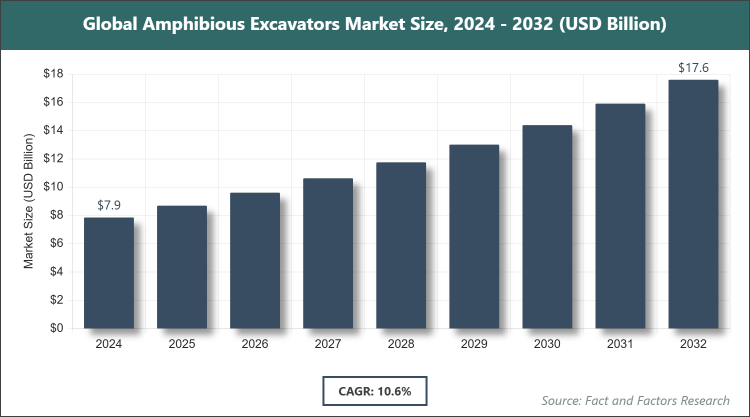
[250+ Pages Report] According to Facts & Factors, the global Amphibious Excavators market size was estimated at USD 8.69 billion in 2025 and is expected to reach USD 21.49 billion by 2034, growing at a CAGR of 10.6% from 2026 to 2034. Amphibious Excavators Market is driven by increasing demand for wetland construction and dredging projects.
 Market Overview
Amphibious excavators are specialized heavy machinery designed to operate effectively in both terrestrial and aquatic environments, featuring buoyant undercarriages or pontoons that allow them to float and maneuver in shallow waters, wetlands, swamps, and soft terrains where traditional excavators cannot function. These machines integrate standard excavator components like booms, arms, and buckets with amphibious adaptations for tasks such as dredging, land reclamation, and environmental restoration, providing versatility in challenging conditions while minimizing ground disturbance and enabling access to remote or flood-prone areas without the need for additional support equipment.
Key Insights
- The Amphibious Excavators market was valued at USD 8.69 Billion in 2025 and is projected to reach USD 21.49 Billion by the end of 2034.
- The market is expected to grow at a CAGR of 10.6% between 2026 and 2034.
- The Amphibious Excavators market is driven by increasing demand for wetland construction and dredging projects.
- Based on the Type segment, the Medium Amphibious Excavators subsegment dominated the market in 2025 with a share of 55.24% because of its versatility in handling a wide range of projects including dredging and infrastructure in medium-depth waters.
- Based on the Application segment, the Dredging subsegment dominated the market in 2025 with a share of 38.81% because of the growing need for waterway maintenance and flood control globally.
- Based on the End-User segment, the Construction subsegment dominated the market in 2025 with a share of 35.75% because of extensive use in infrastructure development in flood-prone and coastal areas.
- Asia Pacific held the largest market share of 46.98% in 2025 due to rapid urbanization, extensive river networks, and significant investments in flood control projects in countries like China and India.
Growth Drivers
- Rising Investments in Infrastructure and Flood Control Projects
Governments and private sectors are increasingly funding projects for flood mitigation, river deepening, and coastal protection, where amphibious excavators provide efficient solutions for working in waterlogged areas without disrupting ecosystems. This driver is bolstered by climate change impacts leading to more frequent flooding, prompting the adoption of versatile equipment that reduces project timelines and costs in challenging terrains.
- Growing Demand for Environmental Restoration and Wetland Management
The emphasis on ecological preservation and restoration of wetlands, mangroves, and waterways has heightened the need for low-impact machinery like amphibious excavators that minimize soil compaction and habitat disturbance. This trend is supported by international environmental regulations and sustainability goals, driving innovation in eco-friendly designs and expanding market applications in conservation efforts.
- Advancements in Equipment Technology and Hybrid Propulsion
Innovations such as electric and hybrid models improve fuel efficiency and reduce emissions, appealing to regions with strict environmental standards and encouraging adoption in urban and sensitive areas. These technological progresses enhance operational capabilities, like extended reach and autonomous features, fostering growth in diverse sectors including mining and oil & gas.
Restraints
- High Initial Costs and Maintenance Requirements
The specialized design and materials used in amphibious excavators result in elevated purchase prices and ongoing maintenance needs, limiting accessibility for small-scale operators and in developing regions. This restraint impacts market penetration, as high capital investment deters entry, particularly where alternative methods like barges are perceived as more cost-effective.
- Limited Skilled Operators and Training Challenges
The complexity of operating in dual environments requires specialized training, and a shortage of skilled personnel can hinder efficient utilization and increase accident risks. This challenge necessitates additional investments in training programs, potentially slowing adoption in emerging markets with limited technical expertise.
Opportunities
- Expansion in Emerging Markets with Urbanization Trends
Rapid urbanization in Asia-Pacific and Latin America creates opportunities for amphibious excavators in new infrastructure projects involving water bodies and soft grounds. This can be leveraged through localized manufacturing and partnerships, addressing regional needs for resilient construction amid rising sea levels.
- Integration of Autonomous and AI Technologies
Developing AI-driven systems for precise operations in hazardous areas offers opportunities to enhance safety and efficiency, attracting investments in high-tech segments. This innovation positions companies to lead in smart construction, unlocking growth in automated dredging and remote-controlled applications.
Challenges
- Regulatory Compliance and Environmental Standards
Varying global regulations on emissions and habitat protection require adaptations, increasing compliance costs and complicating international sales. This demands ongoing R&D to meet diverse standards, potentially delaying product launches and market expansion.
- Supply Chain Disruptions for Specialized Components
Dependence on specific materials like high-strength alloys and pontoons exposes the market to raw material shortages and geopolitical trade issues. This challenge requires diversified sourcing strategies, impacting production stability and costs for manufacturers.
Report Scope
Report Attribute |
Details |
Market Size in 2025 |
USD 8.69 Billion |
Projected Market Size in 2034 |
USD 21.49 Billion |
CAGR Growth Rate |
6.2% CAGR |
Base Year |
2025 |
Forecast Years |
2026-2034 |
Key Market Players |
EIK Engineering, Ultratrex, Caterpillar, Volvo, Hyundai, SUNTON, Hitachi Construction Machinery, Wilco Manufacturing, Wetland Equipment, TSBC Engineering, Sinoway Industrial, Powerplus Group, Marsh Buggies, Normrock Industries, Liebherr Group, Komatsu, Sany Group, JCB, Doosan, Kobelco, and Others. |
Key Segment |
By Type, By Application, By End-User, and By Region |
Major Regions Covered |
North America, Europe, Asia Pacific, Latin America, and the Middle East &, Africa |
Purchase Options |
Request customized purchase options to meet your research needs. Explore purchase options |
Market Segmentation
The Amphibious Excavators market is segmented by type, application, end-user, and region.
Based on Type Segment, The Amphibious Excavators market is divided into Small Amphibious Excavators, Medium Amphibious Excavators, and Large Amphibious Excavators. The most dominant segment is Medium Amphibious Excavators, holding 55.24% share, due to its balanced size offering versatility for medium-scale projects like dredging and infrastructure, driving market growth through efficient performance in varied depths and terrains; the second most dominant is Small Amphibious Excavators, which supports expansion by enabling access to confined spaces in urban restoration and landscaping, enhancing adoption among smaller contractors.
Based on Application Segment, The Amphibious Excavators market is divided into Dredging, Pipeline Construction, Environmental Remediation, Levee Construction, and Others. The most dominant segment is Dredging, with 38.81% share, owing to essential roles in waterway maintenance and flood prevention, propelling market growth amid global climate challenges; the second most dominant is Environmental Remediation, contributing through low-impact operations in wetland restoration, aligning with sustainability trends.
Based on End-User Segment, The Amphibious Excavators market is divided into Construction, Mining, Oil & Gas, and Others. The most dominant segment is Construction, capturing 35.75% share, because of widespread use in infrastructure and coastal projects, fueling expansion with urbanization demands; the second most dominant is Mining, aiding growth via extraction in waterlogged sites.
Recent Developments
- In March 2025, Waterking and Staad Groep introduced the 35-tonne WK 350 NG-E electric amphibious excavator, powered by twin Powerbox 400 batteries, marking a shift toward zero-emission operations in dredging.
- In October 2024, SCO HID Marine Equipment launched a fourth-generation amphibious dredger integrating stranding, digging, grabbing, piling, and weeding functions, enhancing multifunctionality for marine projects.
- In September 2025, the Delhi government announced plans to procure two large amphibious excavators for desilting major city drains, addressing urban flood management needs.
Regional Analysis
- Asia Pacific to dominate the global market
Asia Pacific dominates the Amphibious Excavators market with a 46.98% share, driven by extensive river systems, coastal developments, and flood-prone geographies requiring versatile equipment; China leads the region, with massive investments in infrastructure like the Yangtze River projects and South-to-North Water Diversion, where government policies on ecological protection in hubs like Shanghai boost demand for low-impact excavators.
North America exhibits strong growth, supported by environmental regulations and wetland restoration; the United States dominates, leveraging FEMA funding for flood control in states like Florida and Louisiana, with innovations from companies in Texas enhancing adoption in hurricane-prone areas.
Europe focuses on sustainability and green infrastructure; Germany leads, with EU-funded projects in the Rhine Delta and Baltic regions, emphasizing electric models in urban centers like Rotterdam for compliant waterway management.
Latin America shows potential amid resource extraction; Brazil dominates, utilizing equipment in Amazonian mining and hydroelectric dams around Sao Paulo, addressing environmental concerns through regulated operations.
The Middle East and Africa are emerging with desalination and oil projects; South Africa leads in Africa for mining in wet terrains near Johannesburg, while the UAE drives in the Middle East with coastal expansions in Dubai.
Competitive Analysis
The global Amphibious Excavators market is dominated by players:
- EIK Engineering
- Ultratrex
- Caterpillar
- Volvo
- Hyundai
- SUNTON
- Hitachi Construction Machinery
- Wilco Manufacturing
- Wetland Equipment
- TSBC Engineering
- Sinoway Industrial
- Powerplus Group
- Marsh Buggies
- Normrock Industries
- Liebherr Group
- Komatsu
- Sany Group
- JCB
- Doosan
- Kobelco
The global Amphibious Excavators market is segmented as follows:
By Type
- Small Amphibious Excavators
- Medium Amphibious Excavators
- Large Amphibious Excavators
By Application
- Dredging
- Pipeline Construction
- Environmental Remediation
- Levee Construction
- Others
By End-User
- Construction
- Mining
- Oil & Gas
- Others
By Region
- North America
- The U.S.
- Canada
- Mexico
- Europe
- France
- The UK
- Spain
- Germany
- Italy
- Rest of Europe
- Asia Pacific
- China
- Japan
- India
- Australia
- Southeast Asia
- Rest of Asia Pacific
- The Middle East & Africa
- Saudi Arabia
- UAE
- Egypt
- Kuwait
- South Africa
- Rest of the Middle East & Africa
- Latin America
- Brazil
- Argentina
- Rest of Latin America
Industry Major Market Players
Frequently Asked Questions



Copyright © 2025 - 2026, All Rights Reserved, Facts and Factors