
Search Market Research Report
Steam Sterilizer Market Size, Share Global Analysis Report, 2026-2034

Steam Sterilizer Market Size, Share, Growth Analysis Report By Type (Gravity, SFPP, Pre-Vac, and Others), By Application (Medical & Healthcare, Laboratory, and Others), By End-User (Hospitals & Clinics, Pharmaceutical & Medical Device Manufacturers, and Others), and By Region - Global Industry Insights, Overview, Comprehensive Analysis, Trends, Statistical Research, Market Intelligence, Historical Data and Forecast 2026-2034
Industry Insights
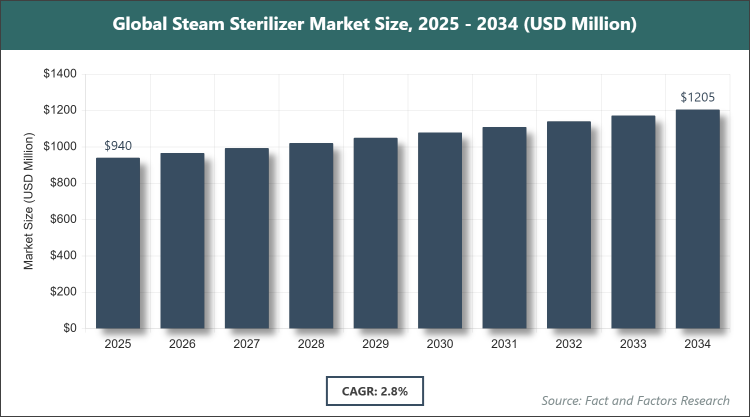
[235+ Pages Report] According to Facts & Factors, the global steam sterilizer market size was estimated at USD 940 million in 2025 and is expected to reach USD 1205.8 million by the end of 2034. The steam sterilizer industry is anticipated to grow by a CAGR of 2.8% between 2026 and 2034. The steam sterilizer Market is driven by escalating demand for infection control in healthcare settings.
 Market Overview
The steam sterilizer market encompasses equipment that utilizes high-pressure steam to eliminate microorganisms, including bacteria, viruses, and spores, from medical instruments, laboratory tools, and other items. These devices are essential in ensuring sterility in healthcare, pharmaceutical, and research environments by penetrating materials effectively and providing reliable decontamination without the use of harmful chemicals.
Key Insights
-
As per the analysis shared by our research analyst, the steam sterilizer market is expected to grow annually at a CAGR of 2.8% during the period 2026-2034.
- In terms of revenue, the steam sterilizer market was valued at USD 940 million in 2025 and is expected to reach USD 1205.8 million by 2034.
- The steam sterilizer market is driven by escalating demand for infection control in healthcare settings.
- Based on the type, SFPP segment dominated with 40% share due to its efficiency in handling porous and lumened items in high-throughput environments.
- Based on the application, Medical & Healthcare segment dominated with 64% share owing to the high volume of surgical procedures and strict sterility requirements in hospitals and clinics.
- Based on the end-user, Hospitals & Clinics segment dominated with around 60% share because of the rising incidence of hospital-acquired infections and increasing surgical volumes.
- Based on the region, North America dominated with 36% share attributed to advanced healthcare infrastructure and stringent regulatory standards.
Growth Drivers
- Increasing Demand for Infection Control in Healthcare
The rising prevalence of hospital-acquired infections (HAIs) globally has heightened the need for effective sterilization solutions. Steam sterilizers play a critical role in decontaminating surgical instruments and medical devices, reducing infection risks during procedures. This demand is further amplified by growing awareness among healthcare providers about patient safety and the implementation of stringent infection prevention protocols in hospitals and clinics.
Additionally, the expansion of healthcare facilities in emerging economies, coupled with investments in modern medical equipment, supports market growth. Technological advancements, such as automated steam sterilizers with faster cycles, enhance operational efficiency, making them indispensable in busy healthcare settings.
Restraints
- High Initial and Maintenance Costs
The substantial upfront investment required for advanced steam sterilizers poses a barrier, particularly for small clinics and facilities in developing regions. Maintenance expenses, including regular validation and repairs, add to the financial burden, leading some users to delay upgrades or opt for less efficient alternatives.
Moreover, operational complexities, such as the need for trained personnel to handle validation protocols and ensure compliance, can hinder adoption. In regions with limited technical support, these factors contribute to slower market penetration and reliance on outdated equipment.
Opportunities
- Innovation in Smart and IoT-Enabled Sterilizers
The integration of IoT and smart technologies offers opportunities for enhanced monitoring, remote validation, and predictive maintenance in steam sterilizers. These features can reduce downtime and improve compliance with regulatory standards, appealing to modern healthcare and laboratory settings.
Furthermore, the growing trend toward eco-friendly models that recycle condensate and reduce energy consumption aligns with sustainability goals. Expansion into outpatient and decentralized healthcare facilities presents additional avenues for compact, portable units tailored to specific needs.
Challenges
- Regulatory Complexity and Validation Burden
Stringent regulatory requirements for sterilization validation and documentation create challenges for manufacturers and users alike. Compliance with multi-stage testing and logging can be resource-intensive, especially for facilities lacking digital infrastructure.
In addition, uneven infrastructure in emerging markets impacts reliable operation, with issues like inconsistent power supply affecting performance. This leads to validation hurdles and potential non-compliance risks, restraining broader adoption.
Report Scope
Report Attribute |
Details |
Market Size 2025 |
USD 940 Million |
Projected Market Size in 2034 |
USD 1205.8 Million |
CAGR Growth Rate |
2.8% CAGR |
Base Year |
2025 |
Forecast Years |
2026-2034 |
Key Market Players |
STERIS, Getinge Group, Shinva, BELIMED, Tuttnauer, Fedegari, Midmark, Thermo Fisher Scientific, Sakura, Yamato Scientific, Steelco, PRIMUS, Consolidated Stills and Sterilizers, MATACHANA, DE LAMA, HP Medizintechnik, Steriflow, Priorclave, Systec, and Others. |
Key Segment |
By Type, By Application, By End-User, and By Region |
Major Regions Covered |
North America, Europe, Asia Pacific, Latin America, and the Middle East & Africa |
Purchase Options |
Request customized purchase options to meet your research needs. Explore purchase options |
Market Segmentation
The steam sterilizer market is segmented by type, application, end-user, and region.
Based on Type Segment, the steam sterilizer market is divided into Gravity, SFPP, Pre-Vac, and others. The SFPP segment emerges as the most dominant, holding a significant market share due to its superior ability to remove air from porous loads and lumened instruments, ensuring thorough sterilization in high-volume settings like hospitals. This dominance drives the market by enabling faster processing times and reducing the risk of wet loads, which enhances overall efficiency and reliability in critical healthcare applications. The Pre-Vac segment follows as the second most dominant, favored for its rapid cycles and effectiveness in modern facilities; it contributes to market growth by supporting quick turnaround in surgical environments, minimizing downtime, and meeting the demands of increasing procedure volumes.
Based on Application Segment, the steam sterilizer market is divided into Medical & Healthcare, Laboratory, and others. The Medical & Healthcare segment is the most dominant, capturing the largest share as it addresses the essential need for sterilizing surgical instruments and devices amid rising global surgeries and infection control priorities. This dominance propels the market forward by ensuring patient safety and regulatory compliance, fostering trust in healthcare systems and encouraging investments in advanced sterilization technology. The Laboratory segment ranks second in dominance, driven by the need for sterile media and glassware in research and biotech; it aids market expansion by supporting innovation in life sciences, where precise decontamination is crucial for accurate results and contamination-free experiments.
Based on End-User Segment, the steam sterilizer market is divided into Hospitals & Clinics, Pharmaceutical & Medical Device Manufacturers, and others. Hospitals & Clinics represent the most dominant end-user segment, with a commanding share fueled by the high incidence of HAIs and the volume of daily sterilization needs for instruments and equipment. This leadership drives the market by prioritizing patient safety and operational efficiency, leading to widespread adoption of reliable steam systems that integrate seamlessly into clinical workflows. Pharmaceutical & Medical Device Manufacturers are the second most dominant, motivated by stringent aseptic processing requirements; this segment boosts market growth by demanding validated, high-capacity sterilizers that ensure product integrity and compliance with global manufacturing standards.
Recent Developments
- In 2023, a leading manufacturer introduced an IoT-enabled pre-vacuum sterilizer capable of storing up to 10,000 cycle records for remote audits, enhancing compliance and efficiency in healthcare facilities.
- In 2024, advancements included a compact SFPP sterilizer that reduces drying time by 25%, catering to high-throughput environments and addressing the need for faster sterilization processes.
- In early 2025, a new model with condensate recycling was launched, achieving 20% energy reduction, aligning with sustainability trends and appealing to eco-conscious laboratories and clinics.
- In 2025, predictive maintenance features were integrated into 35% of new units, minimizing downtime through real-time monitoring and proactive alerts for potential issues.
Regional Analysis
- North America to dominate the global market
North America maintains its position as the leading region in the steam sterilizer market, primarily due to its advanced healthcare infrastructure, high adoption of cutting-edge technologies, and rigorous regulatory frameworks that mandate stringent sterilization practices. The United States stands out as the dominating country, with a vast network of hospitals and outpatient centers emphasizing infection prevention, supported by substantial investments in medical equipment and a skilled workforce for validation and maintenance.
Europe follows closely, benefiting from strong emphasis on energy-efficient and automated sterilization solutions, driven by environmental regulations and modernization efforts in healthcare systems. Germany emerges as the key country here, renowned for its engineering prowess and focus on high-quality manufacturing, which fosters innovation in sterilizer designs and ensures compliance across diverse medical and laboratory applications.
Asia-Pacific is experiencing rapid growth, fueled by expanding healthcare infrastructure and increasing awareness of infection control in densely populated areas. China leads as the dominant country, with massive hospital constructions and local production of cost-effective units, enabling broader access to sterilization technology and supporting the region's burgeoning pharmaceutical and biotech sectors.
Latin America shows steady progress, with improvements in healthcare access and regulatory alignments promoting the uptake of reliable sterilization equipment. Brazil is the frontrunner, leveraging its large healthcare market and investments in public health initiatives to address infection challenges in urban and rural settings alike.
The Middle East & Africa region is emerging, driven by hospital expansions and upgrades in medical facilities to meet international standards. Saudi Arabia dominates, with ambitious healthcare transformation projects that prioritize advanced sterilization for new hospitals, enhancing patient safety and attracting medical tourism.
Competitive Analysis
The global steam sterilizer market is dominated by players:
- STERIS
- Getinge Group
- Shinva
- BELIMED
- Tuttnauer
- Fedegari
- Midmark
- Thermo Fisher Scientific
- Sakura
- Yamato Scientific
- Steelco
- PRIMUS
- Consolidated Stills and Sterilizers
- MATACHANA
- DE LAMA
- HP Medizintechnik
- Steriflow
- Priorclave
- Systec
The global steam sterilizer market is segmented as follows:
By Type
- Gravity
- SFPP
- Pre-Vac
- Others
By Application
- Medical & Healthcare
- Laboratory
- Others
By End-User
- Hospitals & Clinics
- Pharmaceutical & Medical Device Manufacturers
- Others
By Region
- North America
- The U.S.
- Canada
- Mexico
- Europe
- France
- The UK
- Spain
- Germany
- Italy
- Rest of Europe
- Asia Pacific
- China
- Japan
- India
- Australia
- Southeast Asia
- Rest of Asia Pacific
- The Middle East & Africa
- Saudi Arabia
- UAE
- Egypt
- Kuwait
- South Africa
- Rest of the Middle East & Africa
- Latin America
- Brazil
- Argentina
- Rest of Latin America
Industry Major Market Players
The global steam sterilizer market is dominated by players:
- STERIS
- Getinge Group
- Shinva
- BELIMED
- Tuttnauer
- Fedegari
- Midmark
- Thermo Fisher Scientific
- Sakura
- Yamato Scientific
- Steelco
- PRIMUS
- Consolidated Stills and Sterilizers
- MATACHANA
- DE LAMA
- HP Medizintechnik
- Steriflow
- Priorclave
- Systec
Frequently Asked Questions



Copyright © 2025 - 2026, All Rights Reserved, Facts and Factors