
Search Market Research Report
Smart Water Management System Market Size, Share Global Analysis Report, 2026-2034

Smart Water Management System Market Size, Share, Growth Analysis Report By Component (Hardware, Software, Services, and Others), By Solution (Advanced Metering Infrastructure, Leak Detection, Network Management, Smart Irrigation Management, and Others), By End-User (Residential, Commercial, Industrial, and Others), and By Region - Global Industry Insights, Overview, Comprehensive Analysis, Trends, Statistical Research, Market Intelligence, Historical Data and Forecast 2026-2034
Industry Insights
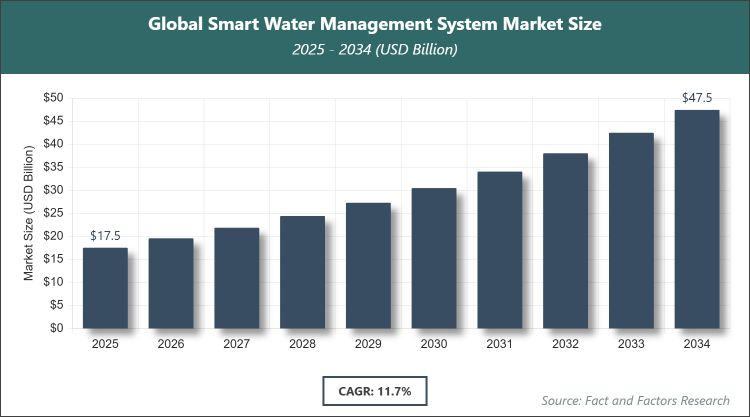
[235 + Pages Report] According to Facts & Factors, the global Smart Water Management System market size was estimated at USD 17.53 billion in 2025 and is expected to reach USD 47.14 billion by the end of 2034. The Smart Water Management System industry is anticipated to grow by a CAGR of 11.7% between 2026 and 2034. The Smart Water Management System Market is driven by increasing water scarcity and the adoption of IoT for efficient distribution.
 Market Overview
The Smart Water Management System market refers to integrated technologies and solutions designed to optimize water usage, distribution, and conservation through real-time monitoring, data analytics, and automation. These systems incorporate sensors, software platforms, and communication networks to detect leaks, manage pressure, and ensure a sustainable water supply across various sectors. They address challenges like resource inefficiency and infrastructure aging by providing actionable insights without relying on manual interventions, ultimately promoting environmental sustainability and operational efficiency in water utilities and related industries.
Key Insights
- As per the analysis shared by our research analyst, the Smart Water Management System market is estimated to grow annually at a CAGR of around 11.7% over the forecast period (2026-2034).
- In terms of revenue, the Smart Water Management System market size was valued at around USD 17.53 billion in 2025 and is expected to reach USD 47.14 billion by 2034.
- The market is driven by rising urbanization, government initiatives for water conservation, and advancements in IoT and AI technologies.
- Based on the Component, the Solutions segment dominated with a 55% share due to its comprehensive data analytics and integration capabilities, enhancing overall system efficiency.
- Based on the Solution, the Advanced Metering Infrastructure segment dominated with a 40% share owing to widespread adoption for real-time consumption tracking and billing accuracy.
- Based on the End-User, the Industrial segment dominated with a 42% share because of high water usage demands and regulatory pressures for sustainable practices.
- North America dominated the global market with a 34% share, attributed to advanced infrastructure, strong regulatory frameworks, and high investment in digital water solutions.
Growth Drivers
- Increasing Water Scarcity and Urbanization
Global water shortages, exacerbated by climate change and population growth, are pushing utilities and industries to adopt smart systems for better resource allocation. These technologies enable precise monitoring and predictive maintenance, reducing wastage and ensuring reliable supply.
Moreover, rapid urban expansion in developing regions demands scalable solutions that integrate with smart city initiatives, fostering demand for automated water networks that support sustainable development goals.
Restraints
- High Implementation Costs and Infrastructure Challenges
The upfront investment required for deploying sensors, software, and connectivity infrastructure poses a barrier, particularly for smaller utilities in emerging markets. This financial hurdle can delay adoption despite long-term savings.
Additionally, integrating new systems with legacy infrastructure often requires significant upgrades, leading to compatibility issues and extended deployment timelines that hinder market penetration.
Opportunities
- Advancements in AI and IoT Integration
Emerging technologies like AI-driven analytics and IoT-enabled devices offer opportunities for enhanced predictive capabilities and remote management. These innovations can open new revenue streams through subscription-based services and data monetization.
Furthermore, government funding and partnerships in smart city projects worldwide provide avenues for expansion, especially in regions prioritizing digital transformation for environmental resilience.
Challenges
- Cybersecurity Threats and Regulatory Variations
As systems become more connected, vulnerability to cyber attacks increases, potentially compromising sensitive data and operational integrity. This risk necessitates robust security measures, adding complexity and cost.
Moreover, differing international standards and regulations on data privacy and water management create compliance challenges, complicating global operations for market players.
Report Scope
Report Attribute |
Details |
Market Size 2025 |
USD 17.53 Billion |
Projected Market Size in 2034 |
USD 47.14 Billion |
CAGR Growth Rate |
11.7% CAGR |
Base Year |
2025 |
Forecast Years |
2026-2034 |
Key Market Players |
Xylem Inc., Siemens AG, ABB Ltd., Schneider Electric SE, IBM Corporation, SUEZ Group, Itron Inc., Honeywell International Inc., Badger Meter Inc., Oracle Corporation, and Others. |
Key Segment |
By Component, By Solution, By End-User, and By Region |
Major Regions Covered |
North America, Europe, Asia Pacific, Latin America, and the Middle East & Africa |
Purchase Options |
Request customized purchase options to meet your research needs. Explore purchase options |
Market Segmentation
The Smart Water Management System market is segmented by component, solution, end-user, and region.
Based on Component Segment, the Smart Water Management System market is divided into hardware, software, services, and others. The most dominant subsegment is Solutions, holding a significant market share due to its role in providing end-to-end management tools. The second most dominant is Hardware, essential for data collection. Solutions drive the market by enabling data-driven decision-making and optimization, reducing non-revenue water losses, while Hardware supports it through reliable sensors and meters that form the foundational layer for accurate monitoring and system integration.
Based on Solution Segment, the Smart Water Management System market is divided into advanced metering infrastructure, leak detection, network management, smart irrigation management, and others. The most dominant subsegment is Advanced Metering Infrastructure, capturing the largest portion because of its critical function in consumption tracking. The second most dominant is Leak Detection, vital for minimizing losses. Advanced Metering Infrastructure drives the market by facilitating smart billing and demand management, promoting efficiency, whereas Leak Detection enhances it by preventing waste and extending infrastructure lifespan through proactive alerts.
Based on End-User Segment, the Smart Water Management System market is divided into residential, commercial, industrial, and others. The most dominant subsegment is Industrial, leading due to intensive water requirements. The second most dominant is Commercial, focusing on cost savings. Industrial applications drive the market by addressing high-volume usage and compliance needs, boosting sustainability, while Commercial sustains it through optimized operations in buildings and facilities.
Recent Developments
- In November 2025, Itron acquired Locusview for USD 525 million, enhancing field-service optimization and integrating it with metering data for comprehensive visibility.
- In May 2025, SUEZ and Schneider Electric expanded their collaboration to incorporate AQUADVANCED into EcoStruxure for improved water and energy management.
- In January 2025, Badger Meter purchased SmartCover Systems for USD 185 million, expanding its offerings into sewer-level monitoring and digital water solutions.
Regional Analysis
- North America to dominate the global market
North America commands the Smart Water Management System market, propelled by cutting-edge technological adoption and rigorous environmental policies. The United States, as the dominating country, excels through substantial investments in upgrading aging water infrastructure and implementing smart city frameworks. This region's emphasis on innovation, with leading companies pioneering AI and IoT integrations, sets global standards. Public-private partnerships further accelerate deployment, addressing urban water challenges effectively. A culture of sustainability and consumer awareness bolsters widespread acceptance of these systems.
Europe maintains strong momentum, particularly in Germany and France, where EU directives on water efficiency drive implementation. Germany's leadership arises from its engineering expertise and focus on industrial applications. The region's commitment to circular economy principles integrates smart systems into wastewater recycling. Collaborative research initiatives enhance technological advancements, while subsidies encourage adoption among municipalities. Emphasis on climate resilience fortifies Europe's position in sustainable water practices.
Asia Pacific surges forward rapidly, dominated by China and India, amid escalating urbanization and water stress. China's preeminence stems from massive government-backed smart city projects and digital infrastructure investments. The region's diverse climates necessitate adaptive technologies for flood and drought management. Rising middle-class demands for reliable supply fuel residential uptake. Local manufacturing lowers costs, enabling broader accessibility and fostering innovation tailored to regional needs.
Latin America exhibits growing potential, led by Brazil, as economic stabilization enables infrastructure enhancements. Brazil's dominance reflects its large urban centers grappling with water inequities. Regional focus on affordable solutions addresses rural-urban divides. International aid supports pilot projects in leak reduction. Increasing awareness of conservation amid climate variability propels gradual adoption across the continent.
The Middle East & Africa progress steadily, with the UAE and South Africa at the helm, leveraging oil revenues for advanced systems. The UAE dominates through visionary smart city developments like Dubai's initiatives. Arid conditions necessitate efficient desalination and distribution technologies. Investments in renewable-powered systems align with sustainability goals. South Africa's urban focus combats water shortages, supported by policy reforms and international collaborations.
Competitive Analysis
The global Smart Water Management System market is dominated by players:
- Xylem Inc.
- Siemens AG
- ABB Ltd.
- Schneider Electric SE
- IBM Corporation
- SUEZ Group
- Itron Inc.
- Honeywell International Inc.
- Badger Meter Inc.
- Oracle Corporation
The global Smart Water Management System market is segmented as follows:
By Component
- Hardware
- Software
- Services
- Others
By Solution
- Advanced Metering Infrastructure
- Leak Detection
- Network Management
- Smart Irrigation Management
- Others
By End-User
- Residential
- Commercial
- Industrial
- Others
By Region
- North America
- The U.S.
- Canada
- Mexico
- Europe
- France
- The UK
- Spain
- Germany
- Italy
- Rest of Europe
- Asia Pacific
- China
- Japan
- India
- Australia
- Southeast Asia
- Rest of Asia Pacific
- The Middle East & Africa
- Saudi Arabia
- UAE
- Egypt
- Kuwait
- South Africa
- Rest of the Middle East & Africa
- Latin America
- Brazil
- Argentina
- Rest of Latin America
Industry Major Market Players
- Xylem Inc.
- Siemens AG
- ABB Ltd.
- Schneider Electric SE
- IBM Corporation
- SUEZ Group
- Itron Inc.
- Honeywell International Inc.
- Badger Meter Inc.
- Oracle Corporation
Frequently Asked Questions
What are the various stages in the value chain of the global Smart Water Management System industry?



Copyright © 2025 - 2026, All Rights Reserved, Facts and Factors