
Search Market Research Report
Site Dumper Market Size, Share Global Analysis Report, 2026-2034

Site Dumper Market Size, Share, Growth Analysis Report By Type (4-Wheeler Site Dumper, 2-Wheeler Site Dumper, Tracked Power Dumpers, and Others), By Capacity (Above 5 Tons, 3 to 5 Tons, 2 to 3 Tons, Under 2 Tons, and Others), By Application (Construction, Mining, Agriculture, Utility Industry, and Others), By Sales Channel (Distributor and Direct Sales), and By Region - Global Industry Insights, Overview, Comprehensive Analysis, Trends, Statistical Research, Market Intelligence, Historical Data and Forecast 2026-2034
Industry Insights
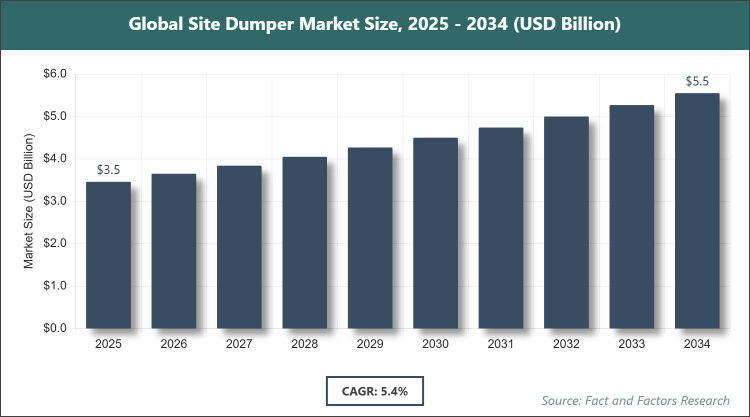
[221 Pages Report] According to Facts & Factors, the global site dumper market size was estimated at USD 3.46 billion in 2025 and is expected to reach USD 5.77 billion by the end of 2034. The Site Dumper industry is anticipated to grow by a CAGR of 5.4% between 2026 and 2034. The Site Dumper Market is driven by increasing infrastructure development and construction activities worldwide.
 Market Overview
Site dumpers are specialized heavy-duty vehicles designed primarily for transporting and dumping loose materials such as gravel, sand, dirt, or demolition waste on construction sites and other industrial environments. These machines feature an open-box bed that can tilt or open to unload contents efficiently, often equipped with hydraulic systems for enhanced functionality. Typically mounted on four wheels for stability and maneuverability, site dumpers excel in navigating rough, uneven terrain where larger trucks may struggle. They serve as essential tools in the initial phases of projects, reducing the need for manual labor by enabling quick and safe material relocation. Originating from Europe, site dumpers have evolved globally, incorporating advanced features to meet diverse industry needs in construction, mining, agriculture, and utilities, emphasizing speed, safety, and operational efficiency.
Key Insights
- As per the analysis shared by our research analyst, the global Site Dumper market is estimated to grow annually at a CAGR of around 5.4% over the forecast period (2026-2034).
- In terms of revenue, the global Site Dumper market size was valued at around USD 3.46 billion in 2025 and is projected to reach USD 5.77 billion by 2034.
- The market is driven by increasing investments in residential and commercial infrastructure development projects.
- Based on the Type, the 4-Wheeler Site Dumper segment dominated with a 50% market share due to its superior stability and load-carrying capacity on varied terrains.
- Based on the Capacity, the Above 5 Tons segment dominated with a 40% market share as it handles heavier loads essential for large-scale projects.
- Based on the Application, the Construction segment dominated with a 55% market share owing to the high demand for material transport in building and infrastructure activities.
- Based on the Sales Channel, the Distributor segment dominated with a 60% market share because of widespread third-party networks providing accessibility and after-sales support.
- Based on the Region, Europe dominated with a 35% market share due to its advanced manufacturing base and high adoption in construction sectors.
Market Dynamics
Growth Drivers
- Increasing investments in residential and commercial infrastructure development projects
The surge in global population has amplified the demand for modern housing solutions, prompting builders to invest in sophisticated residential complexes equipped with amenities like pools, gyms, and recreational areas. This evolution in consumer expectations drives the need for efficient material handling equipment like site dumpers to transport essential construction materials swiftly and safely.
Furthermore, the proliferation of commercial infrastructure projects, including transportation networks, corporate offices, and industrial facilities, particularly in emerging economies, fuels market expansion. Globalization has accelerated these developments, necessitating robust tools for material transport, as seen in major projects worldwide that rely on site dumpers for operational efficiency.
Restraints
- High cost of equipment
Site dumpers represent a significant capital investment, with prices escalating based on advanced features such as hydraulic systems, GPS integration, and safety enhancements. This financial barrier can deter small-scale operators or businesses in economically volatile regions from adopting these machines, limiting market penetration.
Additionally, economic fluctuations can disrupt supply chains, increasing component costs and further elevating prices. The requirement for durable materials to withstand heavy usage adds to the expense, potentially slowing adoption in price-sensitive markets despite the long-term benefits of efficiency and reduced labor needs.
Opportunities
- Growing technological advancements
Manufacturers are continually innovating to offer more efficient site dumpers with enhanced capabilities, such as improved power and specialized features for specific applications. These advancements open new avenues for market growth by addressing diverse industry needs and improving operational productivity.
The shift toward electric site dumpers presents substantial potential, driven by fluctuating fuel prices and a push for sustainable solutions. Government regulations aimed at reducing emissions in key industries like construction and mining further bolster this trend, encouraging the development and adoption of eco-friendly alternatives.
Challenges
- High maintenance requirements
Site dumpers, with their complex technology and heavy-duty components, demand regular maintenance to ensure safety and prevent breakdowns, which can be resource-intensive for operators. Compliance with varying regional regulations adds to the complexity, potentially increasing operational costs.
Moreover, the need for specialized skills and parts for upkeep can pose logistical challenges, especially in remote areas. These factors, combined with the risk of downtime during maintenance, act as barriers to seamless market growth despite the equipment's critical role in industrial applications.
Report Scope
Report Attribute |
Details |
Market Size 2025 |
USD 3.46 Billion |
Projected Market Size in 2034 |
USD 5.77 Billion |
CAGR Growth Rate |
5.4% CAGR |
Base Year |
2025 |
Forecast Years |
2026-2034 |
Key Market Players |
Volvo Construction Equipment, Caterpillar Inc., Thwaites Limited, Terex Corporation, Cormidi S.r.l., Wacker Neuson Group, Kubota Corporation, JCB, Multiquip Inc., Doosan Bobcat, Hitachi Construction Machinery Co. Ltd., Liebherr Group, AUSA Center S.A., Komatsu Ltd., Yanmar Holdings Co. Ltd, and Others. |
Key Segment |
By Type, By Capacity, By Application, By Sales Channel, and By Region |
Major Regions Covered |
North America, Europe, Asia Pacific, Latin America, and the Middle East & Africa |
Purchase Options |
Request customized purchase options to meet your research needs. Explore purchase options |
Market Segmentation
The Site Dumper market is segmented by type, application, end-user, and region.
Based on Type Segment, the Site Dumper market is divided into 4-Wheeler Site Dumper, 2-Wheeler Site Dumper, and others. Tracked Power Dumpers. The most dominant segment is the 4-Wheeler Site Dumper, holding the largest share due to its exceptional stability, higher load capacity, and versatility across rough terrains, which makes it ideal for heavy-duty tasks in construction and mining; the second most dominant is Tracked Power Dumpers, favored for their superior traction in soft or uneven ground, driving market growth by enabling operations in challenging environments where wheeled variants may falter, thus enhancing overall efficiency and project timelines.
Based on Capacity Segment, the Site Dumper market is divided into Above 5 Tons, 3 to 5 Tons, 2 to 3 Tons, Under 2 Tons, and others. The Above 5 Tons segment leads as the most dominant, capturing significant demand for large-scale material handling in major infrastructure projects where high capacity reduces trips and boosts productivity; the 3 to 5 Tons follows as the second dominant, offering a balance of maneuverability and load capability for medium-sized sites, contributing to market expansion by catering to diverse project scales and improving cost-effectiveness in operations.
Based on Application Segment, the Site Dumper market is divided into Construction, Mining, Agriculture, Utility Industry, and others. Construction emerges as the most dominant segment, driven by the extensive use in transporting materials like gravel and waste during building phases, where efficiency directly impacts project speed and costs; Mining ranks second, benefiting from the equipment's robustness in harsh environments for ore and debris movement, propelling market growth through increased mining activities and the need for reliable, high-performance transport solutions.
Based on Sales Channel Segment, the Site Dumper market is divided into Distributor and Direct Sales. The Distributor segment dominates, leveraging extensive networks for broader reach and comprehensive after-sales services, which builds customer trust and facilitates easier access in various regions; Direct Sales is the second dominant, allowing manufacturers to offer customized solutions and competitive pricing, aiding market drive by fostering stronger client relationships and quicker response to specific demands.
Recent Developments
- In September 2023, Ausa launched two new site dumpers, the D201AHG model, featuring a 2-tonne capacity and powered by an 18.5 kW Kubota engine, capable of transporting over 1300 liters of material with a backward folding cab for enhanced operator access.
- In September 2022, Ausa introduced a range of reversible site dumpers with full seat rotation, improving visibility and safety during operations, catering to the demand for more ergonomic and efficient equipment in confined spaces.
- In March 2023, Olectra Greentech Limited launched India's first electric site dumper, a 6*4 electric tipper complying with Central Motor Vehicle rules, with plans to supply 20 vehicles, marking a shift toward sustainable material handling solutions.
- In March 2023, Ausa presented its portfolio at ConExpo in Las Vegas, USA, including its first zero-emission electric site dumper with a 626-liter skip capacity and articulated chassis, highlighting advancements in eco-friendly technology.
- In January 2023, France-based Mecalac launched the TA3SH Power Swivel site dumper designed for small and confined spaces, offering improved maneuverability and efficiency for urban construction applications.
Regional Analysis
- Europe to dominate the global market
Europe stands out as a leading region in the site dumper market, benefiting from its established manufacturing hubs and stringent environmental regulations that promote innovative, low-emission equipment. The region's focus on sustainable construction practices drives demand for advanced dumpers, with countries like Germany and the UK leading through their robust infrastructure projects and technological integrations. Dominating countries such as Germany excel due to their engineering prowess and export capabilities, fostering a competitive landscape that influences global standards. The emphasis on safety and efficiency in European operations further solidifies its position, as local manufacturers continually adapt to meet evolving industry needs.
North America exhibits strong growth potential, supported by extensive mining activities and urban development initiatives that require reliable material transport solutions. The United States, as the dominating country, leads with its vast construction sector and investments in smart infrastructure, integrating advanced features like automation for enhanced productivity. Canada's resource-rich environment complements this, with a focus on durable equipment for harsh terrains. The region's adoption of electric variants aligns with sustainability goals, reducing operational costs over time.
Asia Pacific is rapidly expanding, driven by urbanization and massive infrastructure investments in emerging economies. China dominates as the key country, with its ambitious projects like high-speed rail and urban expansions necessitating efficient dumpers for material handling. India's growing construction boom and mining sector add momentum, emphasizing cost-effective and versatile equipment. The region's diverse terrains demand adaptable solutions, promoting innovation and market penetration.
Latin America shows steady progress, fueled by mining and agricultural applications that rely on site dumpers for bulk material movement. Brazil leads as the dominating country, with its extensive mining operations and infrastructure developments requiring robust, high-capacity vehicles. Mexico's industrial growth supports this, focusing on efficient tools to enhance productivity in challenging environments. The region's emphasis on economic development drives equipment adoption.
The Middle East & Africa region is gaining traction through oil-related infrastructure and mining expansions. Saudi Arabia dominates, with its Vision 2030 initiatives involving large-scale construction projects that utilize site dumpers for efficient operations. South Africa's mining heritage complements this, prioritizing durable equipment for resource extraction. The focus on diversification from oil dependency spurs investments in sustainable transport solutions.
Competitive Analysis
The global Site Dumper market is dominated by players:
- Volvo Construction Equipment
- Caterpillar Inc.
- Thwaites Limited
- Terex Corporation
- Cormidi S.r.l.
- Wacker Neuson Group
- Kubota Corporation
- JCB
- Multiquip Inc.
- Doosan Bobcat
- Hitachi Construction Machinery Co. Ltd.
- Liebherr Group
- AUSA Center S.A.
- Komatsu Ltd.
- Yanmar Holdings Co. Ltd
The global Site Dumper market is segmented as follows:
By Type
- 4-Wheeler Site Dumper
- 2-Wheeler Site Dumper
- Tracked Power Dumpers
By Capacity
- Above 5 Tons
- 3 to 5 Tons
- 2 to 3 Tons
- Under 2 Tons
By Application
- Construction
- Mining
- Agriculture
- Utility Industry
- Others
By Sales Channel
- Distributor
- Direct Sales
By Region
- North America
- The U.S.
- Canada
- Mexico
- Europe
- France
- The UK
- Spain
- Germany
- Italy
- Rest of Europe
- Asia Pacific
- China
- Japan
- India
- Australia
- Southeast Asia
- Rest of Asia Pacific
- The Middle East & Africa
- Saudi Arabia
- UAE
- Egypt
- Kuwait
- South Africa
- Rest of the Middle East & Africa
- Latin America
- Brazil
- Argentina
- Rest of Latin America
Industry Major Market Players
The global Site Dumper market is dominated by players:
Volvo Construction Equipment
Caterpillar Inc.
Thwaites Limited
Terex Corporation
Cormidi S.r.l.
Wacker Neuson Group
Kubota Corporation
JCB
Multiquip Inc.
Doosan Bobcat
Hitachi Construction Machinery Co. Ltd.
Liebherr Group
AUSA Center S.A.
Komatsu Ltd.
Yanmar Holdings Co. Ltd
Frequently Asked Questions



Copyright © 2025 - 2026, All Rights Reserved, Facts and Factors