
Search Market Research Report
Sheet Face Mask Market Size, Share Global Analysis Report, 2026-2034

Sheet Face Mask Market Size, Share, Growth Analysis Report By Product Type (Cotton, Non-Woven, Hydrogel, Bio Cellulose, and Others), By Distribution Channel (Online and Offline), By End-User (Business to Business and Business to Customers), and By Region - Global Industry Insights, Overview, Comprehensive Analysis, Trends, Statistical Research, Market Intelligence, Historical Data and Forecast 2026-2034
Industry Insights
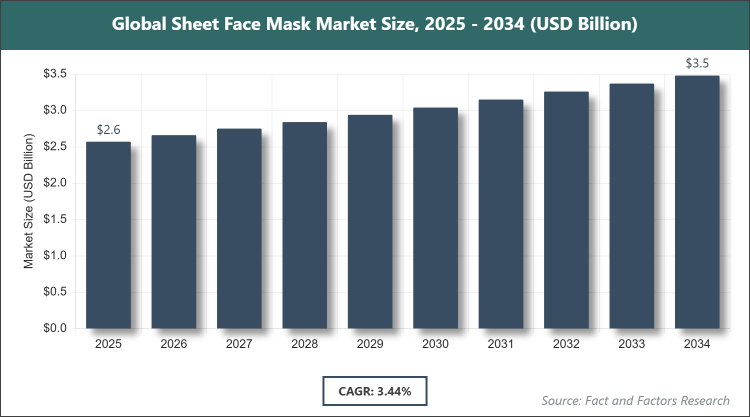
[220+ Pages Report] According to Facts & Factors, the global Sheet Face Mask market size was estimated at USD 2.57 billion in 2025 and is expected to reach USD 3.51 billion by the end of 2034. The Sheet Face Mask industry is anticipated to grow by a CAGR of 3.44% between 2026 and 2034. The Sheet Face Mask Market is driven by increasing demand for innovative skincare products and rising awareness about personal grooming.
 Market Overview
The sheet face mask market refers to the industry involved in the production, distribution, and consumption of facial skincare products consisting of pre-cut sheets infused with serums, essences, or gels designed to deliver targeted benefits to the skin. These masks are typically made from various materials that adhere to the face, allowing active ingredients to penetrate effectively while providing a convenient, at-home spa-like experience. The market caters to diverse consumer needs, focusing on hydration, nourishment, and specific skin concerns without incorporating quantitative data on size or growth.
Key Insights
- As per the analysis shared by our research analyst, the global Sheet Face Mask market is estimated to grow annually at a CAGR of around 3.44% over the forecast period (2026-2034).
- In terms of revenue, the global Sheet Face Mask market size was valued at around USD 2.57 Billion in 2025 and is expected to reach USD 3.51 Billion by 2034.
- The Sheet Face Mask market is driven by increasing skincare awareness and product innovations.
- Based on the Sheet Material Type, the Non-Woven segment dominated with 50.52% share due to its skin-friendliness, comfort, and superior serum absorption capabilities.
- Based on the Functional Benefit, the Hydrating & Moisturizing segment dominated with 33.17% share owing to universal consumer demand for hydration and advancements in ingredients like hyaluronic acid.
- Based on the Ingredient Type, the Natural segment dominated with 39.55% share because of growing preferences for clean, plant-based formulations such as aloe vera and green tea extracts.
- Based on the End-User, the Individual Consumers segment dominated with 48.93% share due to widespread accessibility and rising at-home skincare routines.
- The Asia Pacific region dominated with 58.37% share driven by high demand for innovative skincare formats and expanding salon infrastructure.
Growth Drivers
- Aging Population
The global aging population significantly contributes to the expansion of the sheet face mask market as older consumers seek effective solutions for maintaining youthful skin appearance. With demographic shifts leading to a higher proportion of individuals over 65 in many regions, there is heightened demand for masks that address wrinkles, fine lines, and loss of elasticity through targeted ingredients. This trend encourages manufacturers to innovate with anti-aging formulations, fostering market growth by aligning products with the needs of this expanding consumer base.
Furthermore, the integration of advanced bioactive compounds in sheet masks enhances their appeal to aging demographics, promoting repeat purchases and brand loyalty. As healthcare awareness rises, consumers increasingly view these masks as preventive measures against age-related skin issues, driving sustained investment in research and development to create more efficacious products.
- Skincare Awareness
Rising skincare awareness, amplified by social media platforms and beauty influencers, plays a pivotal role in boosting the sheet face mask market. Consumers are more informed about skin health, leading to greater adoption of specialized masks that offer quick, visible results. This awareness extends to understanding ingredient benefits, encouraging demand for masks tailored to specific concerns like brightness and hydration.
In addition, virtual try-on technologies and online tutorials have democratized access to skincare knowledge, empowering users to incorporate sheet masks into daily routines. This cultural shift towards self-care and wellness further propels market growth, as brands leverage digital marketing to reach a broader audience and highlight product efficacy.
- At-Home Beauty Trends
The surge in at-home beauty treatments has accelerated the sheet face mask market, as consumers prefer convenient, salon-quality experiences without leaving home. This trend is supported by busy lifestyles and a desire for personalized skincare regimens, making single-use masks an ideal choice for quick pampering sessions.
Moreover, the availability of premium, multifunctional masks has elevated at-home routines, attracting consumers who seek professional-level results affordably. As e-commerce platforms expand, easy access to diverse product options reinforces this driver, contributing to overall market dynamism and innovation.
- Product Innovation
Continuous product innovation, including the development of masks with novel ingredients and sustainable materials, drives the sheet face mask market forward. Manufacturers are focusing on eco-friendly options and enhanced formulations to meet evolving consumer preferences for effective yet responsible skincare.
This innovation extends to customizable masks that cater to individual skin types, fostering greater consumer engagement and market penetration. By addressing gaps in traditional skincare, these advancements not only attract new users but also encourage upgrades among existing ones, sustaining long-term growth.
Restraints
- Alternative Skincare Formats
The presence of alternative skincare formats such as creams, gels, and lotions poses a significant restraint to the sheet face mask market by offering similar benefits in more versatile and cost-effective forms. Consumers may opt for these alternatives due to their longer shelf life and ease of application, reducing the perceived necessity for single-use masks.
Additionally, the familiarity and established trust in traditional formats can hinder sheet mask adoption, particularly among price-sensitive segments. This competition necessitates differentiation through unique value propositions to maintain market share.
- Reusable Formats
The growing popularity of reusable skincare products aligns with sustainability concerns, restraining the sheet face mask market which relies heavily on disposable items. Environmentally conscious consumers are shifting towards reusable options like cloth masks or tools that minimize waste, impacting demand for traditional sheet variants.
This trend challenges manufacturers to adapt by developing biodegradable alternatives, but the transition involves higher costs and potential resistance from habitual users. Balancing sustainability with convenience remains a key hurdle.
Opportunities
- Clean Formulations
The demand for clean, chemical-free formulations presents a substantial opportunity in the sheet face mask market, as consumers increasingly seek products with transparent, natural ingredients and sustainable packaging. Brands can capitalize on this by obtaining certifications that assure safety and eco-friendliness, appealing to health-conscious buyers.
Expanding into this niche allows for premium pricing and differentiation, potentially capturing market segments focused on wellness and ethical consumption. Innovation in biodegradable materials further enhances appeal, opening doors to broader global adoption.
- Men’s Skincare
The emerging men’s skincare segment offers growth opportunities for sheet face masks tailored to male-specific needs, such as relief from razor irritation using botanical extracts. As societal norms evolve, more men are embracing grooming routines, creating a new consumer base.
Brands can leverage targeted marketing and product lines to penetrate this underserved market, driving incremental sales and diversifying revenue streams.
- Eco-Friendly Innovations
Eco-friendly innovations, including biodegradable masks infused with natural ingredients, provide opportunities to align with global sustainability goals. This approach attracts environmentally aware consumers and complies with regulatory pressures, enhancing brand reputation.
Such developments can lead to partnerships with green initiatives, expanding market reach and fostering long-term loyalty.
Challenges
- Regulatory Compliance
Evolving regulatory compliance in cosmetics, including ingredient restrictions and labeling standards, challenges the sheet face mask market by complicating international operations and product formulations. Manufacturers must navigate diverse regional requirements, which can delay launches and increase operational complexities.
Adapting to these changes requires ongoing monitoring and adjustments, potentially straining resources for smaller players and affecting overall market agility.
- Certification Costs
High certification costs for product testing and documentation pose challenges, as they demand significant time and financial investment. This barrier can slow innovation and market entry, particularly for new entrants seeking credibility through safety and efficacy certifications.
Overcoming this involves strategic planning and collaborations, but it remains a persistent obstacle in maintaining competitive edges.
Report Scope
Report Attribute |
Details |
Market Size 2025 |
USD 2.57 Billion |
Projected Market Size in 2034 |
USD 3.51 Billion |
CAGR Growth Rate |
3.44% CAGR |
Base Year |
2025 |
Forecast Years |
2026-2034 |
Key Market Players |
L’Oréal S.A. (France), The Estée Lauder Companies Inc. (U.S.), Shiseido Co., Ltd. (Japan), LG Household & Health Care Ltd. (South Korea), Amorepacific Corporation (South Korea), Unilever PLC (U.K.), Procter & Gamble Co. (U.S.), Beiersdorf AG (Germany), Kao Corporation (Japan), Kracie Holdings Ltd. (Japan), and Others. |
Key Segment |
By Sheet Material Type, By Functional Benefit, By Ingredient Type, By End-User, and By Region |
Major Regions Covered |
North America, Europe, Asia Pacific, Latin America, and the Middle East & Africa |
Purchase Options |
Request customized purchase options to meet your research needs. Explore purchase options |
Market Segmentation
The Sheet Face Mask market is segmented by Sheet Material Type, Functional Benefit, Ingredient Type, End-User, and region.
Based on Sheet Material Type Segment, the Sheet Face Mask market is divided into Cotton, Non-Woven, Bio-Cellulose, Hydrogel, and Others. The most dominant subsegment is Non-Woven, holding a significant market presence due to its excellent absorbency, comfort, and affordability, which make it ideal for mass-market products. The second most dominant is Bio-Cellulose, valued for its superior adhesion and natural origin, which appeals to premium consumers seeking enhanced efficacy. Non-Woven drives the market by enabling cost-effective production and wide accessibility, while Bio-Cellulose contributes through innovation in high-end skincare, attracting users focused on advanced hydration and skin repair.
Based on Functional Benefit Segment, the Sheet Face Mask market is divided into Hydrating & Moisturizing, Brightening & Radiance, Anti-Aging & Wrinkle Care, Acne & Oil Control, and Others. The most dominant subsegment is Hydrating & Moisturizing, leading because of its broad appeal across all skin types and the essential role of hydration in daily routines. The second most dominant is Anti-Aging & Wrinkle Care, driven by demographic shifts and demand for preventive skincare. Hydrating & Moisturizing propels market growth by addressing universal needs and integrating easily with other products, whereas Anti-Aging & Wrinkle Care boosts it through targeted solutions that encourage premium purchases and loyalty.
Based on Ingredient Type Segment, the Sheet Face Mask market is divided into Natural, Synthetic, and Hybrid. The most dominant subsegment is Natural, prominent due to rising consumer preferences for clean beauty and avoidance of harsh chemicals. The second most dominant is Hybrid, combining benefits of both for balanced efficacy. Natural ingredients drive the market by aligning with wellness trends and building trust, while Hybrid options enhance growth by offering versatile, high-performance formulations that cater to diverse skin concerns.
Based on End-User Segment, the Sheet Face Mask market is divided into Individual Consumers, Spa & Salons, and Others. The most dominant subsegment is Individual Consumers, leading owing to the convenience of at-home use and e-commerce accessibility. The second most dominant is Spa & Salons, supported by professional treatments and customization. Individual Consumers fuel market expansion through volume sales and repeat usage, whereas Spa & Salons contribute by elevating product perception and driving demand for specialized variants.
Recent Developments
- In June 2025, HYPHEN launched the Ice Dunk Cooling Face Mask, featuring a cooling gel formula aimed at providing instant hydration and reducing puffiness, targeting consumers seeking quick refreshment in warm climates.
- In December 2025, Ringthebell introduced the Resear Kimbap Roll Mask Pack, infused with unique extracts from laver, rice, and vegetables, designed to nourish and revitalize skin with a fun, thematic approach inspired by Korean cuisine.
- In November 2025, RINI released hydrogel facial masks for children, incorporating gentle aloe vera and mushroom extracts to promote safe, mild skincare for younger users, addressing a niche in family-oriented beauty products.
- In February 2025, BioHD Skin unveiled a coconut-based overnight mask enriched with natural botanical extracts, focusing on deep nourishment and repair during sleep for enhanced morning glow.
- In May 2025, Rashel launched the vegan Bio-Collagen Deep Facial Mask in India, emphasizing anti-aging benefits through plant-based collagen alternatives, catering to the growing vegan and ethical skincare demand.
Regional Analysis
- Asia Pacific to dominate the global market
The Asia Pacific region maintains its leading position in the sheet face mask market, primarily driven by robust consumer interest in beauty and grooming innovations. China emerges as the dominating country, where rapid urbanization and a youthful population fuel extensive adoption of skincare routines. The region's cultural emphasis on flawless skin, combined with influential K-beauty trends from South Korea and Japan, encourages widespread use of diverse mask variants. Additionally, expanding e-commerce platforms and affordable product availability enhance accessibility, while local manufacturers continuously introduce region-specific formulations to meet varied climate and skin type needs, solidifying its market dominance.
North America holds a strong position in the sheet face mask market, with the United States as the dominating country due to high disposable incomes and a focus on self-care. The region's consumers prioritize multifunctional products that integrate seamlessly into busy lifestyles, supported by extensive retail networks and digital marketing. Influences from celebrity endorsements and social media amplify demand for premium, ingredient-focused masks. Furthermore, growing awareness of holistic wellness promotes the incorporation of masks into daily regimens, while innovations in clean beauty align with environmental consciousness, contributing to steady regional growth.
Europe demonstrates consistent growth in the sheet face mask market, led by Germany as the dominating country with its emphasis on quality and sustainability. Consumers here favor eco-friendly and dermatologist-approved products, influenced by stringent regulations and a preference for natural ingredients. The region's diverse climates necessitate adaptable skincare solutions, driving demand for targeted masks. Wellness centers and spas play a key role in product promotion, while cross-border e-commerce facilitates access to international brands, enhancing market penetration and consumer choices.
South America is emerging in the sheet face mask market, with Brazil as the dominating country fueled by a vibrant beauty culture and increasing middle-class spending. The region's tropical climate heightens the need for hydrating and protective skincare, leading to higher adoption rates. Local influencers and beauty events boost awareness, while affordable imports and domestic production make products more accessible. This combination supports gradual market expansion, with a focus on inclusive formulations for diverse skin tones.
The Middle East & Africa region shows potential in the sheet face mask market, dominated by the United Arab Emirates with its luxury-oriented consumers and booming retail sector. High temperatures and arid conditions drive demand for intensive hydration masks, while cultural practices emphasize grooming. Expanding beauty shops and tourism influence product diversity, introducing global trends. Despite challenges like varying economic levels, targeted marketing and discounted offerings are key to broader adoption across the region.
Competitive Analysis
The global Sheet Face Mask market is dominated by players:
- L’Oréal S.A. (France)
- The Estée Lauder Companies Inc. (U.S.)
- Shiseido Co., Ltd. (Japan)
- LG Household & Health Care Ltd. (South Korea)
- Amorepacific Corporation (South Korea)
- Unilever PLC (U.K.)
- Procter & Gamble Co. (U.S.)
- Beiersdorf AG (Germany)
- Kao Corporation (Japan)
- Kracie Holdings Ltd. (Japan)
The global Sheet Face Mask market is segmented as follows:
By Sheet Material Type
- Cotton
- Non-Woven
- Bio-Cellulose
- Hydrogel
- Others
By Functional Benefit
- Hydrating & Moisturizing
- Brightening & Radiance
- Anti-Aging & Wrinkle Care
- Acne & Oil Control
- Others
By Ingredient Type
- Natural
- Synthetic
- Hybrid
By End-User
- Individual Consumers
- Spa & Salons
- Others
By Region
- North America
- The U.S.
- Canada
- Mexico
- Europe
- France
- The UK
- Spain
- Germany
- Italy
- Rest of Europe
- Asia Pacific
- China
- Japan
- India
- Australia
- Southeast Asia
- Rest of Asia Pacific
- The Middle East & Africa
- Saudi Arabia
- UAE
- Egypt
- Kuwait
- South Africa
- Rest of the Middle East & Africa
- Latin America
- Brazil
- Argentina
- Rest of Latin America
Industry Major Market Players
The global Sheet Face Mask market is dominated by players:
- L’Oréal S.A. (France)
- The Estée Lauder Companies Inc. (U.S.)
- Shiseido Co., Ltd. (Japan)
- LG Household & Health Care Ltd. (South Korea)
- Amorepacific Corporation (South Korea)
- Unilever PLC (U.K.)
- Procter & Gamble Co. (U.S.)
- Beiersdorf AG (Germany)
- Kao Corporation (Japan)
- Kracie Holdings Ltd. (Japan)
Frequently Asked Questions



Copyright © 2025 - 2026, All Rights Reserved, Facts and Factors