
Search Market Research Report
Sewing Thread Market Size, Share Global Analysis Report, 2026-2034

Sewing Thread Market Size, Share, Growth Analysis Report By Type (Natural, Synthetic), By Application (Apparel, Footwear, Bedding and Mattress, Luggage and Bags, Others), and By Region - Global Industry Insights, Overview, Comprehensive Analysis, Trends, Statistical Research, Market Intelligence, Historical Data and Forecast 2026-2034
Industry Insights
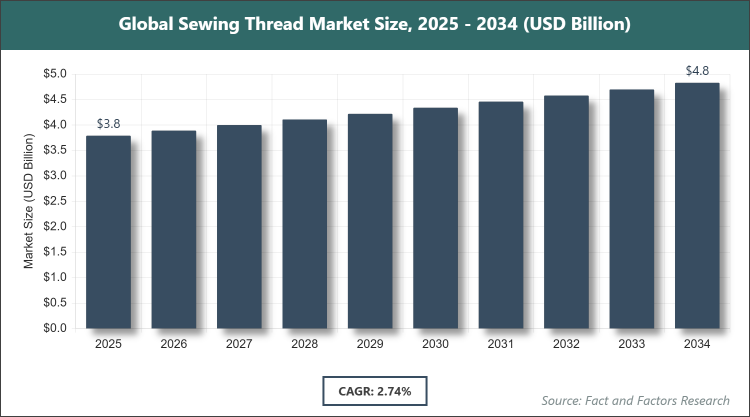
[215+ Pages Report] According to Facts & Factors, the global Sewing Thread market size was estimated at USD 3.79 billion in 2025 and is expected to reach USD 4.84 billion by the end of 2034. The Sewing Thread industry is anticipated to grow by a CAGR of 2.74% between 2026 and 2034. The Sewing Thread Market is driven by increasing demand in the apparel and textile industries.
 Market Overview
The sewing thread market encompasses the production, distribution, and consumption of specialized threads used for stitching fabrics in various applications, including apparel, home textiles, and industrial products. It involves threads made from natural or synthetic fibers designed to provide strength, durability, and aesthetic appeal in sewing processes. This market serves a wide range of industries by ensuring seamless assembly of materials, supporting both manual and automated sewing operations.
Key Insights
- As per the analysis shared by our research analyst, the Sewing Thread market is estimated to grow annually at a CAGR of around 2.74% over the forecast period (2026-2034).
- In terms of revenue, the Sewing Thread market size was valued at around USD 3.79 billion in 2025 and is projected to reach USD 4.84 billion by 2034.
- Due to a variety of driving factors, the market is predicted to rise at a significant rate.
- Based on the Type, the market is dominated by Synthetic segment, which holds a market share of about 80%, due to its superior durability, resistance to environmental factors, and cost-effectiveness compared to natural alternatives.
- Based on the Application, the market is dominated by Apparel segment with 46% share, owing to the expanding fashion industry, rising consumer demand for clothing, and the need for high-quality stitching in garment production.
- Based on region, Asia Pacific is expected to dominate the market with a share of 48%, owing to its robust textile manufacturing infrastructure and low production costs.
Growth Drivers
- Rising Demand in Apparel and Fashion Industries
The global apparel sector's expansion, fueled by fast fashion trends and increasing consumer spending on clothing, significantly boosts the sewing thread market. As urbanization and disposable incomes rise in emerging economies, there is a heightened need for diverse garments, which in turn drives demand for versatile and high-strength threads. Innovations in thread materials, such as enhanced tensile strength and colorfastness, further support this growth by meeting the evolving requirements of modern fashion designers and manufacturers.
Moreover, the integration of sewing threads in automated production lines has improved efficiency, reducing labor costs and enabling mass production. This driver is particularly impactful in regions with strong export-oriented textile industries, where consistent quality and supply chain reliability are paramount for maintaining competitive edges in global trade.
Restraints
- Fluctuating Raw Material Prices
Volatility in the prices of raw materials like polyester and cotton poses a significant challenge, affecting production costs and profit margins for manufacturers. Supply chain disruptions, often caused by geopolitical tensions or climate-related issues, exacerbate this restraint, leading to inconsistent availability and higher procurement expenses.
Additionally, dependency on petroleum-based synthetics makes the market vulnerable to oil price swings, which can deter investment in expansion and innovation. This restraint particularly impacts small-scale producers who lack the bargaining power to negotiate stable contracts, potentially slowing overall market growth.
Opportunities
- Advancements in Sustainable and Eco-Friendly Threads
The shift toward sustainability presents opportunities through the development of bio-based and recycled threads, appealing to environmentally conscious consumers and brands. Regulatory pressures for greener practices encourage innovation in low-impact manufacturing processes, opening new market segments in organic apparel and technical textiles.
Furthermore, partnerships with recycling firms can create closed-loop systems, reducing waste and enhancing brand reputation. This opportunity is ripe in developed markets where eco-certifications drive purchasing decisions, potentially leading to premium pricing and expanded market share for forward-thinking companies.
Challenges
- Intense Competition from Low-Cost Producers
The market faces challenges from low-cost imports, particularly from Asia, which undercut prices and pressure established players to reduce margins. Quality inconsistencies in cheaper alternatives can erode trust, but the price sensitivity of buyers in price-driven segments complicates differentiation efforts.
Moreover, intellectual property issues and counterfeit products add to the challenges, requiring robust enforcement and branding strategies. This dynamic challenges companies to balance cost efficiencies with quality assurance, especially in a globalized supply chain prone to trade barriers and tariffs.
Report Scope
Report Attribute |
Details |
Market Size 2025 |
USD 3.79 Billion |
Projected Market Size in 2034 |
USD 4.84 Billion |
CAGR Growth Rate |
2.74% CAGR |
Base Year |
2025 |
Forecast Years |
2026-2034 |
Key Market Players |
Coats Group PLC, AMANN Group, American & Efird LLC, FUJIX Ltd., Gunze Limited, and Others. |
Key Segment |
By Type, By Application, and By Region |
Major Regions Covered |
North America, Europe, Asia Pacific, Latin America, and the Middle East & Africa |
Purchase Options |
Request customized purchase options to meet your research needs. Explore purchase options |
Market Segmentation
The Sewing Thread market is segmented by type, application, and region.
Based on Type Segment, the Sewing Thread market is divided into Natural and Synthetic. The most dominant segment is Synthetic with 80% share, as it offers superior strength, elasticity, and resistance to abrasion, chemicals, and UV light, making it ideal for high-volume industrial applications and driving market growth through cost savings and performance reliability; the second most dominant is Natural with 20% share, valued for its breathability and eco-friendliness in premium and artisanal products, contributing to niche market expansion by appealing to sustainable fashion trends and enhancing product aesthetics.
Based on Application Segment, the Sewing Thread market is divided into Apparel, Footwear, Bedding and Mattress, Luggage and Bags, and Others. The most dominant segment is Apparel with 46% share, driven by the booming fashion industry and consumer demand for durable clothing, where threads ensure seam integrity and design versatility, propelling overall market revenue through high consumption volumes; the second most dominant is Footwear with 18% share, as specialized threads provide reinforcement in high-stress areas, supporting growth in athletic and casual shoe production by improving product longevity and meeting performance standards.
Recent Developments
- In October 2025, Coats Group introduced its Textile-to-Textile sewing threads, including T2T Epic and T2T Gramax variants made from recycled textile waste via chemical processes, aiming to enhance circularity and increase preferred raw materials usage to 60% by 2026.
- In May 2025, Champion Thread acquired Carolina Sales Thread, accelerating its growth strategy by expanding market share and enhancing its portfolio of industrial sewing solutions in the U.S. market.
- In July 2024, AMANN opened a state-of-the-art production site in India, focusing on sustainable manufacturing to reduce environmental impact and meet growing demand for eco-friendly threads in the region.
- In May 2024, Coloreel partnered with Juki America to introduce on-demand thread dyeing technology, enabling real-time customization and flexibility for sewing applications, marking a shift toward innovative, efficient production methods.
Regional Analysis
- Asia Pacific to dominate the global market
The Asia Pacific region dominates the sewing thread market, primarily driven by its extensive textile manufacturing ecosystem. China stands out as the leading country, benefiting from vast production capacities, skilled labor, and integrated supply chains that enable cost-effective output. The region's growth is supported by strong export demands and domestic consumption in fashion and home textiles. Investments in automation and sustainable practices further strengthen its position, ensuring resilience against global disruptions. Overall, Asia Pacific's dominance fosters innovation and scalability in thread production.
North America's sewing thread market thrives on advanced technological integration and a focus on high-quality, specialized products. The United States leads with robust demand from apparel and automotive sectors, emphasizing durable and eco-friendly threads. The region's emphasis on R&D drives innovations like smart threads, while near-shoring trends reduce dependency on imports. Strong regulatory standards for sustainability enhance market appeal, positioning North America as a hub for premium thread solutions.
Europe's market is characterized by a strong emphasis on sustainability and premium craftsmanship. Germany and Italy dominate, with their heritage in high-end fashion and technical textiles fueling demand for innovative threads. EU regulations promote eco-friendly materials, encouraging recycled and bio-based options. The region's collaborative industry networks support R&D, leading to advanced thread technologies. Europe's focus on quality over quantity sustains steady growth amid global competition.
Latin America's sewing thread market benefits from growing textile exports and local manufacturing. Brazil leads, driven by vibrant apparel and footwear industries that require versatile threads. Low labor costs attract foreign investments, boosting production capacities. Challenges like economic volatility are offset by opportunities in sustainable practices. The region's integration into global supply chains enhances its role in affordable thread provision.
The Middle East & Africa region shows potential in the sewing thread market through emerging textile hubs. Turkey dominates in the Middle East with strong export-oriented production, while South Africa leads in Africa due to its developed manufacturing base. Investments in infrastructure and skills development drive growth, focusing on affordable synthetic threads. Regional trade agreements facilitate expansion, addressing demands in apparel and industrial applications.
Competitive Analysis
The global Sewing Thread market is dominated by players:
- Coats Group PLC
- AMANN Group
- American & Efird LLC
- FUJIX Ltd.
- Gunze Limited
- AURIFIL Srl
- Durak Tekstil San. Ve Tic. A.S.
- Ningbo MH Industry Co., Ltd.
- Threads (India) Private Limited
- Vardhman Yarns & Threads Ltd.
- And Others.
The global Sewing Thread market is segmented as follows:
By Type
- Natural
- Synthetic
By Application
- Apparel
- Footwear
- Bedding and Mattress
- Luggage and Bags
- Others
By Region
- North America
- The U.S.
- Canada
- Mexico
- Europe
- France
- The UK
- Spain
- Germany
- Italy
- Rest of Europe
- Asia Pacific
- China
- Japan
- India
- Australia
- Southeast Asia
- Rest of Asia Pacific
- The Middle East & Africa
- Saudi Arabia
- UAE
- Egypt
- Kuwait
- South Africa
- Rest of the Middle East & Africa
- Latin America
- Brazil
- Argentina
- Rest of Latin America
Industry Major Market Players
The global Sewing Thread market is dominated by players:
- Coats Group PLC
- AMANN Group
- American & Efird LLC
- FUJIX Ltd.
- Gunze Limited
- AURIFIL Srl
- Durak Tekstil San. Ve Tic. A.S.
- Ningbo MH Industry Co., Ltd.
- Threads (India) Private Limited
- Vardhman Yarns & Threads Ltd.
- And Others.
Frequently Asked Questions



Copyright © 2025 - 2026, All Rights Reserved, Facts and Factors