
Search Market Research Report
Residential Security Market Size, Share Global Analysis Report, 2026-2034

Residential Security Market Size, Share, Growth Analysis Report By Systems (Fire Protection Systems, Video Surveillance Systems, Access Control Systems, Entrance Control Systems, and Intruder Alarm Systems), By Services (Security System Integration Services, Remote Monitoring Services, Fire Protection Services, Video Surveillance Services, and Access Control Services), By Security (Professionally-Installed and Monitored, Self-Installed and Professionally Monitored, and Do-It-Yourself), By Residential Type (Independent Homes, and Condominiums/Apartments), and By Region - Global Industry Insights, Overview, Comprehensive Analysis, Trends, Statistical Research, Market Intelligence, Historical Data and Forecast 2026-2034
Industry Insights
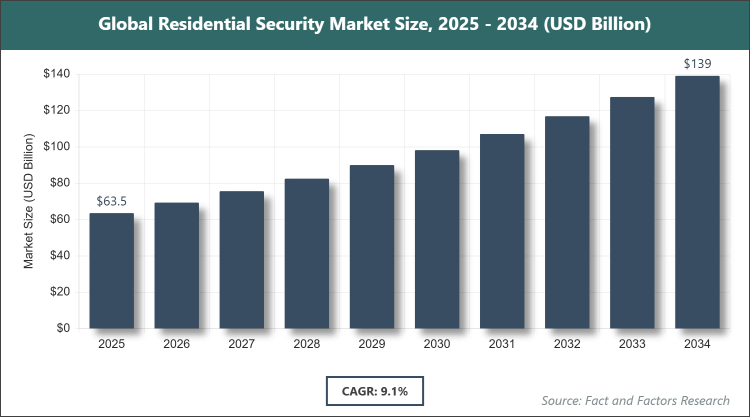
[250+ Pages Report] According to Facts & Factors, the global Residential Security market size was estimated at USD 63.50 billion in 2025 and is expected to reach USD 149.69 billion by 2034, growing at a CAGR of 9.10% from 2026 to 2034. The residential security market is driven by increasing crime rates and technological advancements in smart home integration.
 Market Overview
Residential security encompasses a range of systems, services, and solutions designed to protect homes and apartments from unauthorized access, theft, fire, and other hazards, integrating hardware like alarms, cameras, and locks with software for monitoring and control. This market focuses on safeguarding personal property and ensuring occupant safety through a combination of physical barriers, electronic surveillance, and remote management capabilities, often customizable to fit different living environments such as single-family homes or multi-unit dwellings, emphasizing user-friendly interfaces and seamless integration with everyday lifestyles to provide peace of mind without intrusive measures.
Key Insights
- The Residential Security market was valued at USD 63.50 Billion in 2025 and is projected to reach USD 149.69 Billion by the end of 2034.
- The market is expected to grow at a CAGR of 9.10% between 2026 and 2034.
- The Residential Security market is driven by increasing crime rates and technological advancements in smart home integration.
- Based on the Systems segment, the Video Surveillance Systems subsegment dominated the market in 2025 with a share of 35.0% because of its real-time monitoring capabilities and integration with AI for enhanced threat detection.
- Based on the Services segment, the Remote Monitoring Services subsegment dominated the market in 2025 with a share of 40.0% because of growing demand for professional oversight and quick response times.
- Based on the Security segment, the Professionally-Installed and Monitored subsegment dominated the market in 2025 with a share of 55.0% because of consumer preference for reliable, expert-managed systems.
- Based on the Residential Type segment, the Independent Homes subsegment dominated the market in 2025 with a share of 65.0% because of higher adoption in suburban and rural areas with greater property values.
- North America held the largest market share of 40.0% in 2025 due to high technological adoption, rising crime concerns, and strong presence of key players.
Growth Drivers
- Rising Crime Rates and Safety Concerns
Increasing incidents of burglaries and home invasions globally have heightened homeowner awareness, driving demand for comprehensive security solutions that provide deterrence and rapid alerts. This driver is supported by urban expansion and economic disparities, prompting investments in advanced systems like video surveillance and smart locks to protect families and assets.
- Technological Advancements in Smart Home Integration
Innovations in IoT, AI, and wireless technologies enable seamless connectivity, allowing remote control and automation of security features via smartphones. This fosters growth by offering convenience and customization, appealing to tech-savvy consumers and integrating with broader smart home ecosystems for enhanced functionality.
- Increasing Adoption of DIY and Self-Monitored Systems
The availability of affordable, user-friendly devices has empowered homeowners to install and manage their own security, reducing costs while maintaining effectiveness. This trend is amplified by e-commerce platforms and tutorials, expanding market reach to budget-conscious segments and younger demographics.
Restraints
- High Initial Installation and Maintenance Costs
The expense of professional installation and ongoing subscriptions for monitoring services can deter potential buyers, especially in price-sensitive markets. This restraint limits penetration in developing regions, where economic constraints prioritize basic needs over advanced security investments.
- Privacy and Data Security Concerns
Growing worries about data breaches and unauthorized access to surveillance footage hinder adoption, as consumers fear misuse of personal information. This challenge requires robust encryption and compliance, increasing development costs and potentially slowing innovation in connected devices.
Opportunities
- Expansion in Emerging Markets
Rapid urbanization in Asia-Pacific and Latin America presents opportunities for affordable, scalable security solutions tailored to local needs. This can be leveraged through partnerships with regional providers, tapping into rising middle-class incomes and government safety initiatives.
- Integration with AI and Machine Learning
Advancing AI for predictive analytics and anomaly detection offers opportunities to create proactive systems that anticipate threats. This innovation attracts premium segments, enabling differentiation and higher margins in competitive markets.
Challenges
- Interoperability Issues Among Devices
Compatibility problems between different brands and protocols complicate system integration, frustrating users and increasing support needs. This hinders seamless smart home ecosystems, requiring industry standards to resolve fragmentation.
- Regulatory Compliance and Standards Variations
Differing global regulations on data privacy and installation standards raise compliance costs and entry barriers for international expansion. This challenge demands adaptive strategies, potentially delaying product launches in regulated regions.
Report Scope
Report Attribute |
Details |
Market Size in 2025 |
USD 63.50 Billion |
Projected Market Size in 2034 |
USD 149.69 Billion |
CAGR Growth Rate |
9.10% CAGR |
Base Year |
2025 |
Forecast Years |
2026-2034 |
Key Market Players |
ADT Inc., Honeywell International Inc., Vivint Inc., SimpliSafe Inc., Brinks Home Security, Ring LLC, Frontpoint Security Solutions, Bosch Security Systems, ASSA ABLOY, Johnson Controls, Nortek Security & Control, Protect America, Xfinity Home, Godrej & Boyce, Alarm.com, Allegion Plc, Control4 Corporation, United Technologies Corporation, Tyco International Plc, Robert Bosch GmbH, and Others. |
Key Segment |
By Systems, By Services, By Security, By Residential Type, and By Region |
Major Regions Covered |
North America, Europe, Asia Pacific, Latin America, and the Middle East & Africa |
Purchase Options |
Request customized purchase options to meet your research needs. Explore purchase options |
Market Segmentation
The Residential Security market is segmented by type, application, end-user, and region.
Based on Systems Segment, the Residential Security market is divided into Fire Protection Systems, Video Surveillance Systems, Access Control Systems, Entrance Control Systems, Intruder Alarm Systems. The most dominant segment is Video Surveillance Systems, holding 35.0% share, due to its versatility in providing visual evidence, real-time alerts, and integration with AI for facial recognition, driving market growth by enhancing overall security efficacy and consumer confidence; the second most dominant is Intruder Alarm Systems, which contributes to market expansion through immediate deterrence and notification features, supporting quick response and reducing theft incidents in residential settings.
Based on Services Segment, the Residential Security market is divided into Security System Integration Services, Remote Monitoring Services, Fire Protection Services, Video Surveillance Services, Access Control Services. The most dominant segment is Remote Monitoring Services, with 40.0% share, owing to its provision of 24/7 professional oversight and emergency response, propelling market growth by offering peace of mind and reducing false alarms; the second most dominant is Video Surveillance Services, aiding market dynamics by enabling cloud storage and analytics, facilitating remote access and evidence collection for homeowners.
Based on Security Segment, the Residential Security market is divided into Professionally-Installed and Monitored, Self-Installed and Professionally Monitored, Do-It-Yourself. The most dominant segment is Professionally-Installed and Monitored, capturing 55.0% share, because of its reliability, expert setup, and continuous support, fueling market expansion through trusted protection for high-value properties; the second most dominant is Do-It-Yourself, which boosts the market by providing cost-effective, customizable options that appeal to tech-savvy users and expand accessibility.
Based on Residential Type Segment, The Residential Security market is divided into Independent Homes, Condominiums/Apartments. The most dominant segment is Independent Homes, with 65.0% share, driven by larger property sizes and higher customization needs, accelerating market growth via comprehensive installations; the second most dominant is Condominiums/Apartments, contributing through shared systems and urban demand for compact solutions.
Recent Developments
- In March 2024, ADT Inc. acquired Canopy Growth Corporation's smart home security division to expand its cannabis industry security solutions and strengthen its commercial market presence, enhancing residential offerings with integrated technologies.
- In January 2024, Honeywell International Inc. partnered with Verizon Communications to integrate 5G connectivity into its residential security systems, improving mobile monitoring and real-time data transmission for faster response times.
- In November 2023, Ring LLC launched a comprehensive neighborhood security network program in partnership with local law enforcement, allowing shared video feeds to improve community safety and deter crime.
- In August 2023, ADT Inc. introduced its next-generation AI-powered video analytics platform, reducing false alarms and providing enhanced threat detection for residential customers through advanced machine learning.
- In January 2024, SimpliSafe launched a new wireless outdoor camera system, expanding its product line with weather-resistant, battery-powered units for easy DIY installation.
- In March 2024, ADT formed a strategic partnership with Google to integrate its monitoring services with Google Nest Secure, enhancing smart home compatibility.
Regional Analysis
- North America to dominate the global market
North America dominates the Residential Security market with a 40.0% share, attributed to high crime awareness, advanced infrastructure, and widespread adoption of smart technologies; the United States leads the region, with its large population and tech hubs like Silicon Valley driving innovation in AI-integrated systems, supported by favorable regulations and high disposable incomes in states like California and Texas, where urban crime rates boost demand for professional monitoring.
Europe exhibits steady growth, focused on data privacy and integrated solutions; Germany dominates, leveraging strong manufacturing in cities like Berlin and Munich for high-quality video surveillance, aligned with GDPR compliance and rising burglary concerns in urban areas.
Asia-Pacific is the fastest-growing region, propelled by urbanization and economic development; China leads, with massive investments in smart cities like Shanghai, where government initiatives promote IoT security amid rapid population growth and increasing middle-class affluence.
Latin America shows emerging potential with improving economies; Brazil dominates, addressing high crime in Sao Paulo through affordable DIY systems and partnerships for remote monitoring.
The Middle East and Africa remain developing, emphasizing basic protections; South Africa leads in Africa with Johannesburg's demand for intruder alarms due to security challenges, while the UAE drives in the Middle East via Dubai's luxury residences adopting advanced access controls.
Competitive Analysis
The global Residential Security market is dominated by players:
- ADT Inc.
- Honeywell International Inc.
- Vivint Inc.
- SimpliSafe Inc.
- Brinks Home Security
- Ring LLC
- Frontpoint Security Solutions
- Bosch Security Systems
- ASSA ABLOY
- Johnson Controls
- Nortek Security & Control
- Protect America
- Xfinity Home
- Godrej & Boyce
- Alarm.com
- Allegion Plc
- Control4 Corporation
- United Technologies Corporation
- Tyco International Plc
- Robert Bosch GmbH
The global Residential Security market is segmented as follows:
By Systems
- Fire Protection Systems
- Video Surveillance Systems
- Access Control Systems
- Entrance Control Systems
- Intruder Alarm Systems
By Services
- Security System Integration Services
- Remote Monitoring Services
- Fire Protection Services
- Video Surveillance Services
- Access Control Services
By Security
- Professionally-Installed and Monitored
- Self-Installed and Professionally Monitored
- Do-It-Yourself
By Residential Type
- Independent Homes
- Condominiums/Apartments
By Region
- North America
- The U.S.
- Canada
- Mexico
- Europe
- France
- The UK
- Spain
- Germany
- Italy
- Rest of Europe
- Asia Pacific
- China
- Japan
- India
- Australia
- Southeast Asia
- Rest of Asia Pacific
- The Middle East & Africa
- Saudi Arabia
- UAE
- Egypt
- Kuwait
- South Africa
- Rest of the Middle East & Africa
- Latin America
- Brazil
- Argentina
- Rest of Latin America
Industry Major Market Players
Frequently Asked Questions



Copyright © 2025 - 2026, All Rights Reserved, Facts and Factors