
Search Market Research Report
Mobile Robotics Market Size, Share Global Analysis Report, 2026-2034

Mobile Robotics Market Size, Share, Growth Analysis Report By Product (Unmanned Ground Vehicles (UGVs), Unmanned Aerial Vehicles (UAVs), Autonomous Underwater Vehicles (AUVs)), By Application (Logistics & Warehousing, Military & Defense, Healthcare, Domestic, Entertainment, Agriculture & Forestry, Others), and By Region - Global Industry Insights, Overview, Comprehensive Analysis, Trends, Statistical Research, Market Intelligence, Historical Data and Forecast 2026-2034
Industry Insights
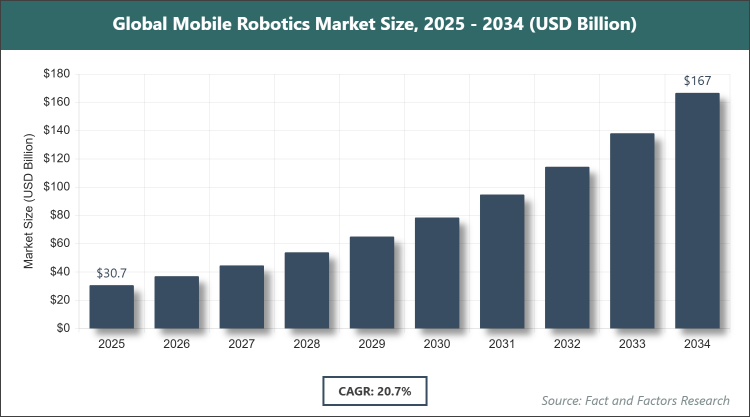
[235 Pages Report] According to Facts & Factors, the global Mobile Robotics market size was estimated at USD 30.67 billion in 2025 and is expected to reach USD 156.3 billion by the end of 2034. The Mobile Robotics industry is anticipated to grow by a CAGR of 20.7% between 2026 and 2034. The Mobile Robotics Market is driven by increasing adoption of automation across various industries.
 Market Overview
The mobile robotics market encompasses the development, production, and deployment of autonomous or semi-autonomous robots capable of moving independently in various environments, including land, air, and water. These robots are designed to perform tasks such as surveillance, material handling, inspection, and delivery without constant human intervention, leveraging technologies like sensors, AI, and navigation systems to interact with their surroundings effectively.
Key Insights
- As per the analysis shared by our research analyst, the global Mobile Robotics market is estimated to grow annually at a CAGR of around 20.7% over the forecast period (2026-2034).
- In terms of revenue, the global Mobile Robotics market size was valued at around USD 30.67 billion in 2025 and is projected to reach USD 156.3 billion by 2034.
- The market is driven by increasing adoption of automation across industries like manufacturing, logistics, and healthcare, fueled by labor shortages and the need for operational efficiency.
- Based on the product, the Unmanned Aerial Vehicles (UAVs) segment dominated the market with a share of 45.4%, as UAVs offer versatile applications in surveillance, delivery, and agriculture, providing real-time data and reducing human risk in hazardous environments.
- Based on the application, the Logistics & Warehousing segment dominated with a share of 32%, due to the surge in e-commerce demanding efficient inventory management and order fulfillment, where mobile robots enhance speed and accuracy.
- Based on the region, Asia Pacific dominated with a share of 35.4%, owing to rapid industrialization, e-commerce growth in countries like China and India, and government support for automation technologies.
Growth Drivers
- Increasing Adoption of Automation Across Industries
The rising demand for automation in sectors such as manufacturing, logistics, and healthcare is a primary driver for the mobile robotics market. Companies are increasingly integrating mobile robots to streamline operations, reduce labor costs, and enhance productivity. For instance, in warehouses, autonomous mobile robots (AMRs) are used for material handling, allowing for faster order processing and minimizing errors. This trend is particularly evident in e-commerce, where the need for efficient supply chain management has surged, prompting investments in robotic solutions that can operate 24/7 without fatigue.
Additionally, advancements in artificial intelligence and machine learning have enabled mobile robots to perform complex tasks autonomously, further accelerating their adoption. As industries face labor shortages and rising wages, the shift toward automation becomes essential for maintaining competitiveness. Governments worldwide are also supporting this transition through incentives and funding for research and development, fostering an environment conducive to market growth.
Restraints
- High Initial Investment Costs
One of the significant restraints in the mobile robotics market is the high upfront costs associated with acquiring and implementing robotic systems. Small and medium-sized enterprises (SMEs) often find it challenging to justify these expenses, particularly when considering the need for infrastructure modifications and employee training. The integration of mobile robots into existing workflows can require substantial capital, which may deter potential adopters in cost-sensitive industries.
Moreover, the return on investment (ROI) may not be immediately apparent, leading to hesitation among businesses. Economic uncertainties and fluctuating market conditions can exacerbate this issue, as companies may prioritize short-term savings over long-term technological investments. As a result, while larger corporations can absorb these costs, smaller players may lag behind, limiting overall market penetration.
Opportunities
- Expansion into Emerging Markets
The mobile robotics market presents significant opportunities in emerging economies, where rapid urbanization and industrialization are creating demand for advanced automation solutions. Countries in Asia Pacific and Latin America are investing heavily in infrastructure and technology, providing a fertile ground for mobile robot adoption. For example, in agriculture, mobile robots can assist in precision farming, optimizing resource use and increasing yields in regions facing labor shortages.
Furthermore, the growing focus on smart cities and sustainable practices opens avenues for mobile robots in areas like waste management and public safety. Collaborations between local governments and technology providers can facilitate the deployment of robotic solutions tailored to specific regional needs, driving market expansion and innovation in these areas.
Challenges
- Regulatory and Safety Concerns
Navigating the complex regulatory landscape poses a challenge for the mobile robotics market. Different countries have varying standards for robotic operations, particularly in safety and data privacy, which can complicate international deployments. Ensuring compliance while maintaining operational efficiency requires significant resources and expertise, potentially slowing down market growth.
Additionally, safety concerns related to human-robot interactions remain a critical issue. As mobile robots operate in shared environments, the risk of accidents necessitates robust safety protocols and technologies. Developing reliable systems that can predict and respond to human behavior is essential, but it adds layers of complexity to design and implementation, hindering widespread adoption.
Report Scope
Report Attribute |
Details |
Market Size 2025 |
USD 30.67 Billion |
Projected Market Size in 2034 |
USD 156.3 Billion |
CAGR Growth Rate |
20.7% CAGR |
Base Year |
2025 |
Forecast Years |
2026-2034 |
Key Market Players |
iRobot Corporation, Northrop Grumman Corporation, Amazon Robotics, KUKA AG, Honda Motor Co. Ltd., SoftBank Robotics Group, Kongsberg Maritime, Boston Dynamics, Lockheed Martin Corporation, UBTECH Robotics Corp Ltd., and Others. |
Key Segment |
By Product, By Application, and By Region |
Major Regions Covered |
North America, Europe, Asia Pacific, Latin America, and the Middle East & Africa |
Purchase Options |
Request customized purchase options to meet your research needs. Explore purchase options |
Market Segmentation
The Mobile Robotics market is segmented by product, application, and region.
Based on Product Segment, the Mobile Robotics market is divided into Unmanned Ground Vehicles (UGVs), Unmanned Aerial Vehicles (UAVs), Autonomous Underwater Vehicles (AUVs), and others.
The most dominant segment is Unmanned Aerial Vehicles (UAVs), which holds the largest share due to their versatility in applications such as surveillance, delivery, and agricultural monitoring, enabling efficient data collection and reducing operational risks in challenging environments. The second most dominant is Unmanned Ground Vehicles (UGVs), favored for their effectiveness in logistics and military operations, where they provide reliable material handling and reconnaissance capabilities that enhance productivity and safety.
Based on Application Segment, the Mobile Robotics market is divided into Logistics & Warehousing, Military & Defense, Healthcare, Domestic, Entertainment, Agriculture & Forestry, and others.
The most dominant segment is Logistics & Warehousing, driven by the e-commerce boom requiring efficient inventory management and order fulfillment, where mobile robots optimize workflows and minimize errors. The second most dominant is Military & Defense, as these robots are crucial for reconnaissance and bomb disposal, offering enhanced safety for personnel in high-risk scenarios while improving mission effectiveness.
Recent Developments
- In October 2024, Amazon unveiled its advanced fulfillment center in Shreveport, Louisiana, integrating robotics and AI to enhance logistics efficiency.
- In May 2025, Teradyne Robotics partnered with Honeywell to provide intelligent automation solutions for logistics and warehousing in the Americas and Europe.
- In March 2025, Boston Dynamics expanded its collaboration with NVIDIA to boost AI capabilities in its humanoid robot, Atlas.
- In October 2023, Boston Dynamics launched Stretch, a commercial product for autonomous warehouse operations.
Regional Analysis
- Asia Pacific to dominate the global market
The Asia Pacific region dominates the mobile robotics market, primarily driven by rapid industrialization and e-commerce growth in countries like China and India. China leads as the dominating country, with extensive adoption of mobile robots in manufacturing and logistics, supported by government initiatives promoting automation and technological advancements that enhance operational efficiency and address labor shortages.
North America follows closely, with the United States as the dominating country, where strong investments in robotics for healthcare and defense applications are prevalent, fueled by a robust tech ecosystem and a focus on innovation that drives the integration of advanced robotic solutions into various industries.
Europe exhibits steady growth, led by Germany, which excels in industrial automation and precision engineering, utilizing mobile robots in automotive and warehousing sectors to improve productivity and maintain competitive advantages in manufacturing processes.
Latin America is emerging in the market, with Brazil as the dominating country, where increasing adoption in agriculture and mining sectors leverages mobile robots for enhanced monitoring and resource management, addressing challenges in labor availability and operational safety.
The Middle East & Africa region shows potential, dominated by the United Arab Emirates, which invests in smart city initiatives and logistics automation, employing mobile robots to support economic diversification and improve efficiency in transportation and public services.
Competitive Analysis
The global Mobile Robotics market is dominated by players:
- iRobot Corporation
- Northrop Grumman Corporation
- Amazon Robotics
- KUKA AG
- Honda Motor Co. Ltd.
- SoftBank Robotics Group
- Kongsberg Maritime
- Boston Dynamics
- Lockheed Martin Corporation
- UBTECH Robotics Corp Ltd.
The global Mobile Robotics market is segmented as follows:
By Product
- Unmanned Ground Vehicles (UGVs)
- Unmanned Aerial Vehicles (UAVs)
- Autonomous Underwater Vehicles (AUVs)
By Application
- Logistics & Warehousing
- Military & Defense
- Healthcare
- Domestic
- Entertainment
- Agriculture & Forestry
- Others
By Region
- North America
- The U.S.
- Canada
- Mexico
- Europe
- France
- The UK
- Spain
- Germany
- Italy
- Rest of Europe
- Asia Pacific
- China
- Japan
- India
- Australia
- Southeast Asia
- Rest of Asia Pacific
- The Middle East & Africa
- Saudi Arabia
- UAE
- Egypt
- Kuwait
- South Africa
- Rest of the Middle East & Africa
- Latin America
- Brazil
- Argentina
- Rest of Latin America
Industry Major Market Players
The global Mobile Robotics market is dominated by players:
- iRobot Corporation
- Northrop Grumman Corporation
- Amazon Robotics
- KUKA AG
- Honda Motor Co. Ltd.
- SoftBank Robotics Group
- Kongsberg Maritime
- Boston Dynamics
- Lockheed Martin Corporation
- UBTECH Robotics Corp Ltd.
Frequently Asked Questions



Copyright © 2025 - 2026, All Rights Reserved, Facts and Factors