
Search Market Research Report
Lift Chair Market Size, Share Global Analysis Report, 2026-2034

Lift Chair Market Size, Share, Growth Analysis Report By Type (2-Position Lift Chairs, 3-Position Lift Chairs, Infinite Position Lift Chairs, Zero Gravity Lift Chairs, and Others), By End-User (Hospitals, Households, and Others), and By Region - Global Industry Insights, Overview, Comprehensive Analysis, Trends, Statistical Research, Market Intelligence, Historical Data and Forecast 2026-2034
Industry Insights
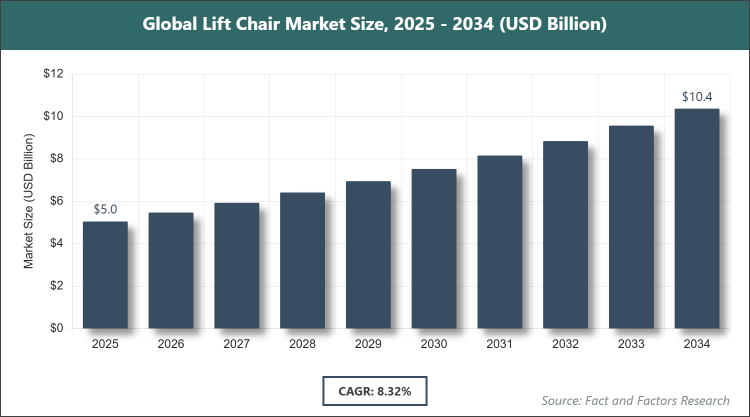
According to Facts & Factors, the global Lift Chair market size was estimated at USD 5.05 billion in 2025 and is expected to reach USD 10.36 billion by the end of 2034. The Lift Chair industry is anticipated to grow by a CAGR of 8.32% between 2026 and 2034. The Lift Chair Market is driven by the increasing aging population and rising demand for mobility assistance devices.
 Market Overview
Lift chairs are specialized reclining seats equipped with a motorized lifting mechanism designed to assist individuals with limited mobility in transitioning from a seated to a standing position. These chairs combine comfort features of traditional recliners with assistive technology, making them essential for elderly users, those recovering from surgery, or individuals with chronic conditions affecting movement. They typically offer multiple reclining positions and are customizable to fit various body types and home environments, promoting independence and reducing the risk of falls or strains during daily activities.
Key Insights
- As per the analysis shared by our research analyst, the global Lift Chair market is estimated to grow annually at a CAGR of around 8.32% over the forecast period (2026-2034).
- In terms of revenue, the global Lift Chair market size was valued at around USD 5.05 billion in 2025 and is projected to reach USD 10.36 billion by 2034.
- The market is driven by the growing geriatric population, increasing prevalence of mobility-related disorders, and advancements in ergonomic design and smart features.
- Based on the type, the 3-Position Lift Chair segment dominated the market with a revenue share of 35% in 2025 due to its versatility, affordability, and ability to offer multiple reclining options suitable for everyday use.
- Based on the end-user, the Households segment dominated the market with a revenue share of 65% in 2025 owing to rising home healthcare trends and the preference for independent living among seniors.
- North America dominated the global Lift Chair market with a revenue share of 42% in 2025, primarily driven by a well-established healthcare infrastructure, high awareness of assistive devices, and a large aging demographic supported by favorable reimbursement policies.
Growth Drivers
- Increasing Geriatric Population and Mobility Challenges
The global rise in the elderly population is a primary catalyst for the lift chair market, as aging often leads to reduced mobility, joint issues, and balance problems that necessitate assistive furniture. This demographic shift, particularly in developed nations, has heightened the demand for products that enable safe and independent living, reducing reliance on caregivers and minimizing injury risks. Innovations in chair designs, such as enhanced cushioning and user-friendly controls, further appeal to this group by addressing specific health needs like arthritis or post-operative recovery.
Additionally, the integration of technology, including remote controls and adjustable features, has made lift chairs more accessible and customizable, encouraging adoption among tech-savvy seniors. Government initiatives promoting age-friendly homes and healthcare subsidies also play a role in expanding market reach, ensuring that these devices become a staple in elderly care strategies worldwide.
Restraints
- High Initial Costs and Limited Reimbursement Coverage
The elevated price point of lift chairs, often due to advanced motors and durable materials, acts as a significant barrier, particularly for low-income households or regions with underdeveloped healthcare systems. This cost factor can deter potential buyers who view them as luxury items rather than necessities, limiting market penetration in price-sensitive segments. Moreover, inconsistent insurance coverage for such devices adds to the financial burden, as many policies classify lift chairs as non-essential, leading to out-of-pocket expenses.
Beyond pricing, supply chain disruptions and material shortages can inflate costs further, affecting availability and affordability. These restraints highlight the need for manufacturers to explore cost-effective production methods and advocate for broader reimbursement policies to mitigate economic hurdles and foster inclusive growth.
Opportunities
- Technological Advancements and Smart Integration
Emerging technologies like IoT-enabled chairs that monitor user health metrics or integrate with smart home systems present substantial opportunities for market expansion. These innovations can attract younger demographics caring for elders, as well as healthcare facilities seeking efficient patient management tools. The potential for customization, such as voice-activated controls or app connectivity, opens new avenues for differentiation and premium pricing in a competitive landscape.
Furthermore, partnerships with e-commerce platforms and telemedicine providers could enhance distribution channels, reaching underserved rural areas and global markets. As consumer awareness grows through digital marketing, opportunities arise to tap into emerging economies where aging populations are rapidly increasing, positioning lift chairs as integral to modern healthcare solutions.
Challenges
- Regulatory Compliance and Safety Standards
Stringent regulations governing medical devices pose challenges for manufacturers, requiring rigorous testing and certifications that can delay product launches and increase development costs. Compliance with varying international standards complicates global expansion, as non-adherence risks recalls or legal issues, eroding consumer trust. Additionally, ensuring consistent quality across supply chains is vital to prevent malfunctions that could lead to user injuries.
Compounding this, intense competition from generic or low-cost alternatives pressures established players to innovate while maintaining safety, often straining resources. Addressing these challenges demands investment in R&D and collaboration with regulatory bodies to streamline approvals and uphold high standards, ultimately safeguarding market integrity and user safety.
Report Scope
Report Attribute |
Details |
Market Size 2025 |
USD 5.05 Billion |
Projected Market Size in 2034 |
USD 10.36 Billion |
CAGR Growth Rate |
8.32% CAGR |
Base Year |
2025 |
Forecast Years |
2026-2034 |
Key Market Players |
La-Z-Boy, Pride Mobility, Golden Technologies, Franklin Corporation, Med-Lift, Ashley Furniture, Mega Motion, Best Chairs, Jackson Furniture, Seminar Components, and Others. |
Key Segment |
By Type, By End-User, and By Region |
Major Regions Covered |
North America, Europe, Asia Pacific, Latin America, and the Middle East & Africa |
Purchase Options |
Request customized purchase options to meet your research needs. Explore purchase options |
Market Segmentation
The Lift Chair market is segmented by type, end-user, and region.
Based on Type Segment, the Lift Chair market is divided into 2-Position Lift Chairs, 3-Position Lift Chairs, Infinite Position Lift Chairs, Zero Gravity Lift Chairs, and others. The 3-Position Lift Chair emerged as the most dominant subsegment, commanding a significant market share due to its balanced functionality that allows users to sit upright, recline partially, or fully extend for relaxation, making it highly versatile for daily use in home settings. This dominance stems from its cost-effectiveness compared to more advanced models, appealing to budget-conscious consumers while still providing essential lift assistance for mobility-impaired individuals. The Infinite Position Lift Chair ranks as the second most dominant, offering unlimited reclining angles including Trendelenburg positions, which drive the market by catering to users with severe medical conditions requiring precise positioning for comfort and therapeutic benefits, thus enhancing overall market growth through specialized healthcare applications.
Based on End-User Segment, the Lift Chair market is divided into Hospitals, Households, and others. The Households subsegment holds the dominant position, primarily because of the growing trend toward aging-in-place, where seniors prefer home-based care over institutional settings, driving demand for user-friendly lift chairs that promote independence and integrate seamlessly into living spaces. This dominance helps propel the market by addressing the needs of a vast consumer base focused on long-term comfort and safety at home. The Hospitals subsegment is the second most dominant, as these facilities require durable, hygienic lift chairs for patient transfer and rehabilitation, contributing to market expansion by supporting acute care environments and reducing caregiver strain through efficient mobility solutions.
Recent Developments
- In October 2025, Flexsteel Industries unveiled a new line of lift chairs incorporating health-focused features like built-in massage and heat therapy, aimed at enhancing user wellness and expanding their presence in the home healthcare segment.
- Pride Mobility announced a strategic partnership with a leading telemedicine provider in early 2026 to integrate remote monitoring capabilities into their lift chairs, allowing caregivers to track usage and health data, thereby improving patient outcomes and market adoption.
- Golden Technologies launched an eco-friendly lift chair model in late 2025, using sustainable materials and energy-efficient motors, responding to growing consumer demand for environmentally conscious products and strengthening their competitive edge.
Regional Analysis
- North America to dominate the global market
North America maintains its leading position in the lift chair market, largely due to advanced healthcare systems and a substantial elderly population concentrated in countries like the United States and Canada. The region's emphasis on home-based care, supported by robust insurance frameworks and awareness campaigns, fosters widespread adoption of assistive devices. Innovations from local manufacturers, combined with accessible retail channels, ensure that consumers have a variety of options tailored to diverse needs, from basic models to high-tech variants. This dominance is further bolstered by government programs promoting senior independence, creating a conducive environment for market growth. The United States, as the dominating country, drives this through its large consumer base and investment in aging infrastructure.
Europe follows closely, with strong demand driven by comprehensive welfare systems and an aging demographic in nations such as Germany and the United Kingdom. The focus on ergonomic designs and regulatory standards ensures high-quality products, appealing to health-conscious users. Collaborations between manufacturers and healthcare providers enhance distribution, while cultural shifts toward active aging encourage the integration of lift chairs into daily life. Germany stands out as the dominating country, leveraging its engineering expertise and export capabilities to influence regional trends.
Asia Pacific is experiencing rapid growth, fueled by urbanization and improving healthcare access in emerging economies like China and Japan. Rising disposable incomes and family-oriented care traditions boost demand for affordable yet functional lift chairs. Technological adoption, including smart features, attracts younger caregivers, while government initiatives address the needs of a burgeoning senior population. Japan dominates this region with its advanced robotics and longevity-focused innovations.
Latin America shows promising potential, with increasing awareness of mobility aids in countries such as Brazil and Mexico. Economic development and expanding middle classes drive purchases, though challenges like uneven healthcare distribution persist. Brazil leads as the dominating country, supported by its large population and efforts to improve elderly care services.
The Middle East & Africa region is gradually expanding, primarily through investments in healthcare infrastructure in areas like the UAE and South Africa. Cultural respect for elders and rising chronic disease rates spur interest, with imports playing a key role in market entry. South Africa emerges as the dominating country, benefiting from its relatively advanced medical sector and regional influence.
Competitive Analysis
The global Lift Chair market is dominated by players:
- La-Z-Boy
- Pride Mobility
- Golden Technologies
- Franklin Corporation
- Med-Lift
- Ashley Furniture
- Mega Motion
- Best Chairs
- Jackson Furniture
- Seminar Components
The global Lift Chair market is segmented as follows:
By Type
- 2-Position Lift Chairs
- 3-Position Lift Chairs
- Infinite Position Lift Chairs
- Zero Gravity Lift Chairs
- Others
By End-User
- Hospitals
- Households
- Others
By Regional
- North America
- The U.S.
- Canada
- Mexico
- Europe
- France
- The UK
- Spain
- Germany
- Italy
- Rest of Europe
- Asia Pacific
- China
- Japan
- India
- Australia
- Southeast Asia
- Rest of Asia Pacific
- The Middle East & Africa
- Saudi Arabia
- UAE
- Egypt
- Kuwait
- South Africa
- Rest of the Middle East & Africa
- Latin America
- Brazil
- Argentina
- Rest of Latin America
Industry Major Market Players
The global Lift Chair market is dominated by players:
- La-Z-Boy
- Pride Mobility
- Golden Technologies
- Franklin Corporation
- Med-Lift
- Ashley Furniture
- Mega Motion
- Best Chairs
- Jackson Furniture
- Seminar Components
Frequently Asked Questions



Copyright © 2025 - 2026, All Rights Reserved, Facts and Factors