
Search Market Research Report
KSA Garbage Bags and Trash Bags Market Size, Share Global Analysis Report, 2026-2034

KSA Garbage Bags and Trash Bags Market Size, Share, Growth Analysis Report By Material (Polyethylene, Polypropylene, Biodegradable, and Others), By Type (Star Sealed, Drawstring, Flat Seal, and Others), By End-User (Residential, Commercial, Industrial), and By Region - Global Industry Insights, Overview, Comprehensive Analysis, Trends, Statistical Research, Market Intelligence, Historical Data and Forecast 2026-2034
Industry Insights
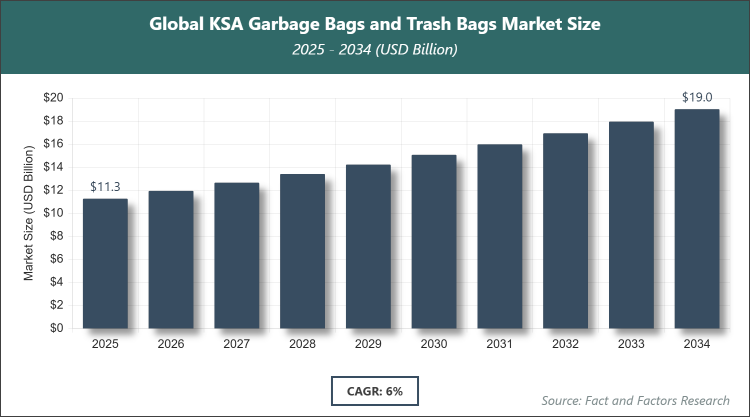
According to Facts & Factors, the global KSA Garbage Bags and Trash Bags market size was estimated at USD 11.27 billion in 2025 and is expected to reach USD 19.05 billion by the end of 2034. The KSA Garbage Bags and Trash Bags industry is anticipated to grow by a CAGR of 6% between 2026 and 2034. The KSA Garbage Bags and Trash Bags Market is driven by increasing waste generation due to urbanization and rising hygiene awareness.
 Market Overview
The KSA garbage bags and trash bags market refers to the sector focused on the manufacturing, supply, and utilization of disposable bags specifically designed for containing and disposing of waste materials in various settings within Saudi Arabia. These products are integral to waste management systems, helping to contain trash securely, reduce odors, prevent spills, and promote cleanliness. They cater to diverse needs, ranging from household waste collection to large-scale commercial and industrial disposal, and are crafted to meet standards of durability, capacity, and environmental compatibility.
Key Insights
- As per the analysis shared by our research analyst, the KSA Garbage Bags and Trash Bags market is estimated to grow annually at a CAGR of around 6% over the forecast period (2026-2034).
- In terms of revenue, the KSA Garbage Bags and Trash Bags market size was valued at around USD 11.27 billion in 2025 and is expected to reach USD 19.05 billion in 2034.
- The KSA Garbage Bags and Trash Bags market is driven by rapid urbanization, population growth, and government efforts to enhance waste management infrastructure.
- Based on the material, the market is dominated by polyethylene, with 60% share, because of its affordability, flexibility, and widespread availability in production.
- Based on the type, the market is dominated by star sealed, with 45% share, because it offers superior leak resistance and strength for handling wet waste.
- Based on the end-user, the market is dominated by residential, with 50% share, because of high daily household consumption and increasing consumer focus on home hygiene.
- Asia Pacific dominated the market with 40% share, because of rapid industrialization, urban expansion, and growing demand for efficient waste solutions in densely populated areas.
Market Dynamics
Growth Drivers
- Rapid Urbanization and Increasing Waste Generation
Urbanization in Saudi Arabia has led to a surge in municipal solid waste, necessitating reliable waste containment solutions like garbage and trash bags. As cities expand and populations concentrate in urban centers, the volume of daily waste from households and businesses rises significantly, driving demand for durable and convenient bags that facilitate proper disposal and reduce environmental litter.
This trend is amplified by lifestyle changes, including higher consumption of packaged goods and takeaway food, which generate more disposable waste. The market benefits from this as manufacturers innovate to produce bags with enhanced capacity and strength, supporting the kingdom's push toward cleaner urban environments and sustainable living practices.
- Government Initiatives and Regulations
Saudi Arabia's Vision 2030 emphasizes environmental sustainability and efficient waste management, prompting regulations that encourage the use of standardized garbage bags in public and private sectors. Initiatives like mandatory waste segregation and recycling programs increase the need for specialized bags, boosting market growth through compliance-driven demand.
These policies also promote partnerships between government entities and private firms to develop eco-friendly products, fostering innovation in biodegradable options. As a result, the market sees expanded adoption across municipalities and industries, aligning with national goals to minimize landfill use and enhance overall waste handling efficiency.
Restraints
- Fluctuating Raw Material Prices
The market faces challenges from volatile prices of petroleum-based raw materials like polyethylene, which are influenced by global oil market fluctuations. In Saudi Arabia, dependency on imported additives and resins can lead to cost instability, affecting production expenses and profit margins for local manufacturers.
This volatility may result in higher product prices, potentially slowing adoption among price-sensitive consumers and small businesses. Additionally, supply chain disruptions from international trade issues exacerbate the problem, limiting the ability to maintain consistent inventory and meet growing demand.
- Environmental Concerns Over Plastic Use
Growing awareness of plastic pollution restrains market expansion, as consumers and regulators push for reduced single-use plastics. In Saudi Arabia, this shifts preferences toward alternatives, potentially decreasing demand for traditional plastic bags and requiring costly transitions for manufacturers.
The restraint is compounded by potential bans or taxes on non-biodegradable products, which could increase operational challenges. Companies must invest in research for sustainable materials, but slow adoption due to higher costs hinders short-term market stability.
Opportunities
- Shift Toward Biodegradable and Eco-Friendly Products
The rising emphasis on sustainability opens opportunities for biodegradable garbage bags, aligning with Saudi Arabia's environmental targets. Manufacturers can capitalize by developing plant-based or compostable options that appeal to eco-conscious consumers and comply with emerging green regulations.
This shift enables market differentiation through innovative products, potentially capturing premium segments like hospitality and retail. Partnerships with recycling firms and government incentives further support expansion, creating avenues for long-term growth in a transitioning market.
- Expansion in E-Commerce and Retail Channels
Increasing online shopping and modern retail outlets in Saudi Arabia provide opportunities to distribute specialized trash bags through convenient channels. Brands can leverage digital platforms for targeted marketing, reaching urban households and businesses with customized products like scented or heavy-duty bags.
This expansion enhances visibility and accessibility, driving sales volume amid growing consumer preference for home delivery. Collaborations with e-commerce giants can also facilitate bulk purchases, strengthening market penetration in underserved areas.
Challenges
- Intense Competition from Local and International Players
The market experiences challenges from fierce competition, with numerous local and global brands vying for share through pricing and innovation. In Saudi Arabia, this leads to margin pressure and the need for continuous differentiation to retain customer loyalty.
Smaller players struggle against established firms with superior supply chains and branding, limiting their growth. Adapting to diverse consumer preferences across regions adds complexity, requiring strategic investments in marketing and product variety.
- Limited Recycling Infrastructure
Saudi Arabia's developing recycling systems pose challenges, as inadequate facilities hinder the promotion of recyclable bags and circular economy practices. This limits the appeal of eco-friendly products and increases reliance on landfills, conflicting with sustainability goals.
The challenge is intensified by low public awareness of recycling, reducing demand for advanced bag options. Investments in infrastructure are needed, but delays slow market evolution toward greener solutions.
Report Scope
Report Attribute |
Details |
Market Size 2025 |
USD 11.27 Billion |
Projected Market Size in 2034 |
USD 19.05 Billion |
CAGR Growth Rate |
6% CAGR |
Base Year |
2025 |
Forecast Years |
2026-2034 |
Key Market Players |
Berry Global Inc., The Clorox Company, Reynolds Consumer Products, Novolex, Poly-America L.P., and Others. |
Key Segment |
By Material, By Type, By End-User, and By Region |
Major Regions Covered |
North America, Europe, Asia Pacific, Latin America, and the Middle East & Africa |
Purchase Options |
Request customized purchase options to meet your research needs. Explore purchase options |
Market Segmentation
The KSA Garbage Bags and Trash Bags market is segmented by material, type, end-user, and region.
Based on Material Segment,the KSA Garbage Bags and Trash Bags market is divided into polyethylene, polypropylene, biodegradable, and others.
The most dominant segment is polyethylene, while the second most dominant is polypropylene. Polyethylene dominates due to its cost-effectiveness, high durability, and versatility in manufacturing various bag sizes, driving the market by meeting high-volume demands from residential and commercial users; polypropylene, as the second dominant, contributes by offering superior strength for heavy-duty applications, helping to expand the market in industrial sectors where tear resistance is critical.
Based on Type Segment,the KSA Garbage Bags and Trash Bags market is divided into star sealed, drawstring, flat seal, and others.
The most dominant segment is star sealed, while the second most dominant is drawstring. Star sealed dominates because of its leak-proof design and ability to handle uneven loads, driving market growth by enhancing user convenience in waste disposal; drawstring, as the second dominant, aids market expansion through easy closure and portability features, particularly appealing in household settings for quick and hygienic use.
Based on End-User Segment, the KSA Garbage Bags and Trash Bags market is divided into residential, commercial, industrial, and others.
The most dominant segment is residential, while the second most dominant is commercial. Residential dominates owing to consistent daily waste generation in households and rising hygiene standards, propelling the market by increasing volume sales; commercial, as the second dominant, supports growth via demand from offices, hotels, and retail for efficient waste management, fostering innovation in scented and antimicrobial bags.
Based on Region Segment, the KSA Garbage Bags and Trash Bags market is divided into North America, Europe, Asia Pacific, Latin America, and the Middle East & Africa.
The most dominant segment is Asia Pacific, while the second most dominant is North America. Asia Pacific dominates due to massive population density and accelerating urbanization, driving the market through heightened waste management needs; North America, as the second dominant, contributes by advanced consumer preferences for premium, eco-friendly bags, boosting overall market innovation and adoption.
Recent Developments
- In January 2025, Berry Global Inc. introduced a new line of biodegradable trash bags made from recycled materials, aimed at reducing environmental impact and complying with Saudi Arabia's sustainability regulations, enhancing their market position in the region.
- In October 2024, SABIC announced a partnership with local waste management firms to develop high-strength polyethylene bags for industrial use, focusing on improving durability and recyclability to support Vision 2030's circular economy goals.
Regional Analysis
- Asia Pacific to dominate the global market
Asia Pacific leads the global market due to its vast population and swift urban development, which generate substantial waste volumes requiring effective containment solutions. The region's economic growth fuels consumption patterns that increase demand for convenient and affordable trash bags. Manufacturing hubs in countries like China provide cost advantages, enabling competitive pricing and innovation in product designs. Government campaigns on cleanliness further propel adoption across urban and rural areas. China stands out as the dominating country, with its massive industrial base and consumer market driving significant market share.
Europe maintains strong growth through stringent environmental policies that favor sustainable and recyclable trash bags. The emphasis on reducing plastic waste encourages innovation in biodegradable alternatives, appealing to eco-aware consumers. Advanced waste management systems in urban centers support consistent demand. High living standards contribute to preferences for premium, scented bags in households. Germany dominates as the key country, leveraging its engineering expertise and regulatory framework to lead in high-quality, compliant products.
North America benefits from high consumer awareness of hygiene and convenience, driving demand for specialized bags like drawstring types. Robust retail networks and e-commerce facilitate easy access to diverse products. Industrial sectors contribute through bulk purchases for efficient waste handling. The region's focus on sustainability spurs development of bio-based options. The United States is the dominating country, with its large population and innovative companies setting trends in product variety and market expansion.
Latin America experiences steady expansion amid improving urban infrastructure and rising middle-class consumption. Efforts to address waste pollution boost adoption of durable bags in residential and commercial settings. Economic recovery enhances purchasing power for better quality products. Brazil emerges as the dominating country, supported by its populous cities and government initiatives for improved sanitation and waste collection.
The Middle East & Africa shows promising growth with increasing urbanization and tourism-driven waste needs. Investments in infrastructure under national visions like Saudi Arabia's 2030 plan promote modern waste solutions. Environmental concerns push for eco-friendly bags in commercial applications. Saudi Arabia dominates the region, benefiting from its economic diversification and large-scale projects that heighten demand for industrial and residential trash bags.
Competitive Analysis
The global KSA Garbage Bags and Trash Bags market is dominated by players:
- Berry Global Inc.
- The Clorox Company
- Reynolds Consumer Products
- Novolex
- Poly-America L.P.
- Inteplast Group
- Cosmoplast Industrial Company LLC
- SABIC
- Others
The global KSA Garbage Bags and Trash Bags market is segmented as follows:
By Material
- Polyethylene
- Polypropylene
- Biodegradable
- Others
By Type
- Star Sealed
- Drawstring
- Flat Seal
- Others
By End-User
- Residential
- Commercial
- Industrial
By Regional Segment Analysis
- North America
- The U.S.
- Canada
- Mexico
- Europe
- France
- The UK
- Spain
- Germany
- Italy
- Rest of Europe
- Asia Pacific
- China
- Japan
- India
- Australia
- Southeast Asia
- Rest of Asia Pacific
- The Middle East & Africa
- Saudi Arabia
- UAE
- Egypt
- Kuwait
- South Africa
- Rest of the Middle East & Africa
- Latin America
- Brazil
- Argentina
- Rest of Latin America
Industry Major Market Players
The global KSA Garbage Bags and Trash Bags market is dominated by players:
- Berry Global Inc.
- The Clorox Company
- Reynolds Consumer Products
- Novolex
- Poly-America L.P.
- Inteplast Group
- Cosmoplast Industrial Company LLC
- SABIC
- Others
Frequently Asked Questions



Copyright © 2025 - 2026, All Rights Reserved, Facts and Factors