
Search Market Research Report
IoT security Market Size, Share Global Analysis Report, 2026-2034

IoT security Market Size, Share, Growth Analysis Report By Component (Hardware, Software, and Services), By Security Type (Network Security, Endpoint Security, Cloud Security, Application Security, and Others), By Vertical (Consumer IoT, Industrial IoT, Healthcare, Transportation, Smart Cities, and Others), and By Region - Global Industry Insights, Overview, Comprehensive Analysis, Trends, Statistical Research, Market Intelligence, Historical Data and Forecast 2026-2034
Industry Insights
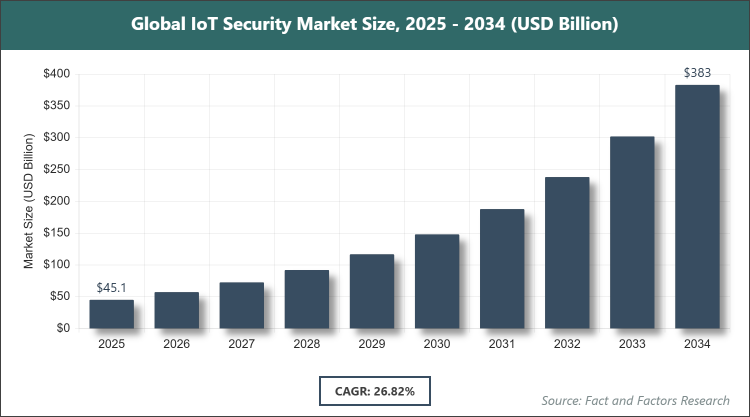
[215+ Pages Report] According to Facts & Factors, the global IoT security market size was estimated at USD 45.15 billion in 2025 and is expected to reach USD 383.11 billion by the end of 2034. The IoT security industry is anticipated to grow by a CAGR of 26.82% between 2026 and 2034. The IoT security Market is driven by escalating cyber threats and widespread IoT adoption.
 Market Overview
The IoT security market encompasses solutions and services designed to protect connected devices, networks, and data from cyber threats. It includes hardware for secure elements, software for encryption and threat detection, and services for implementation and monitoring. These measures safeguard against vulnerabilities in IoT ecosystems, ensuring data integrity, privacy, and operational continuity across various applications.
Key Insights
- As per the analysis shared by our research analyst, the global IoT security market is estimated to grow annually at a CAGR of around 26.82% over the forecast period (2026-2034)
- In terms of revenue, the global IoT security market size was valued at around USD 45.15 billion in 2025 and is projected to reach USD 383.11 billion by 2034.
- The market is driven by increasing cyber threats and regulatory compliance requirements
- Based on the component, the software segment dominated the market with a share of 45% due to its critical role in real-time threat detection and encryption
- Based on the security type, the network security segment dominated the market with a share of 35% owing to the need to protect interconnected IoT networks from breaches
- Based on the vertical, the industrial IoT segment dominated the market with a share of 30% because of high-stakes applications in manufacturing requiring robust protection
- North America dominated the global market with a share of 40% attributed to advanced technological infrastructure and stringent data protection laws
Growth Drivers
- Escalating Cyber Threats
The proliferation of IoT devices has expanded the attack surface for cybercriminals, necessitating advanced security solutions. High-profile breaches have highlighted vulnerabilities, driving investments in protective technologies to safeguard data and operations.
This driver is amplified by the integration of AI in threat detection, enabling proactive responses. As IoT adoption grows, the market expands through innovative solutions addressing evolving risks.
Restraints
- High Implementation Costs
The substantial investment required for comprehensive IoT security infrastructure poses a barrier for small and medium enterprises. Costs include hardware, software, and ongoing maintenance, limiting widespread adoption.
This restraint is compounded by the complexity of integrating security into existing IoT ecosystems, potentially delaying implementation and market penetration in cost-sensitive sectors.
Opportunities
- AI and Machine Learning Integration
Advancements in AI enable predictive analytics and automated threat response, opening new avenues for market growth. These technologies enhance security efficiency, attracting investments from various industries.
Collaborations between tech firms and security providers can accelerate innovation, capturing emerging markets in smart cities and healthcare.
Challenges
- Interoperability Issues
The diverse nature of IoT devices from multiple vendors creates compatibility problems for security solutions. This fragmentation hinders seamless implementation and increases vulnerability risks.
Addressing this requires standardized protocols, which demands industry-wide cooperation and could slow market progress until achieved.
Report Scope
Report Attribute |
Details |
Market Size 2025 |
USD 45.15 Billion |
Projected Market Size in 2034 |
USD 383.11 Billion |
CAGR Growth Rate |
26.82% CAGR |
Base Year |
2025 |
Forecast Years |
2026-2034 |
Key Market Players |
Cisco Systems, IBM Corporation, Palo Alto Networks, Microsoft Corporation, Symantec (Broadcom), Fortinet, Check Point Software Technologies, Trend Micro, Kaspersky Lab, Intel Corporation, and Others. |
Key Segment |
By Component, By Security Type, By Vertical, and By Region |
Major Regions Covered |
North America, Europe, Asia Pacific, Latin America, and the Middle East & Africa |
Purchase Options |
Request customized purchase options to meet your research needs. Explore purchase options |
Market Segmentation
The IoT security market is segmented by component, security type, vertical, and region.
Based on Component Segment, the IoT security market is divided into hardware, software, and services. The software segment is the most dominant, holding 45% share, due to its flexibility in deployment and ability to provide real-time updates, driving market growth through scalable protection solutions. The services segment is the second most dominant, with a 30% share, as it offers expert implementation and management, contributing to expansion by addressing skills gaps in organizations.
Based on Security Type Segment, the IoT security market is divided into network security, endpoint security, cloud security, application security, and others. The network security segment dominates with a 35% share, essential for protecting data in transit across connected devices, propelling market development amid rising interconnectivity. The endpoint security segment is second, holding a 25% share, focusing on device-level protection, and supporting growth as IoT endpoints multiply.
Based on Vertical Segment, the IoT security market is divided into consumer IoT, industrial IoT, healthcare, transportation, smart cities, and others. The industrial IoT segment leads with a 30% share, driven by critical infrastructure needs for robust security, fueling market expansion through digital transformation. The healthcare segment is second with a 20% share, emphasizing data privacy and contributing to growth via regulatory compliance.
Recent Developments
- In March 2025, Qualcomm acquired Edge Impulse to enhance AI-enabled IoT security solutions for industrial applications.
- In October 2025, IBM released advanced threat detection tools integrating AI for real-time IoT network monitoring.
- In January 2026, Cisco launched new endpoint security features for industrial IoT, focusing on zero-trust architectures.
Regional Analysis
- North America to dominate the global market
North America leads the IoT security market, driven by advanced technological infrastructure and high adoption rates in industries like manufacturing and healthcare. The United States dominates, with robust regulatory frameworks like NIST guidelines promoting secure IoT deployments. Strong R&D investments and the presence of major tech firms foster innovation, ensuring comprehensive protection against evolving threats.
Europe exhibits strong growth, supported by GDPR and emphasis on data privacy. Germany stands out as the dominating country, leveraging its industrial base for secure IIoT applications. The region's focus on sustainable digital transformation enhances market resilience through standardized security practices.
Asia Pacific is rapidly expanding, fueled by massive IoT deployments in smart cities and manufacturing. China emerges as the dominant country, with government initiatives like Made in China 2025 driving secure industrial IoT adoption. The region's diverse ecosystems contribute to innovative, cost-effective solutions.
Latin America shows emerging potential, with growth in telecommunications and agriculture. Brazil dominates, implementing IoT security in agrotech for supply chain integrity. Economic diversification supports market development through international partnerships.
The Middle East & Africa region is developing, led by smart city projects in the UAE. Saudi Arabia contributes through Vision 2030, focusing on secure IoT for energy and healthcare. Regional investments enhance capabilities despite infrastructure challenges.
Competitive Analysis
The global IoT security market is dominated by players:
- Cisco Systems
- IBM Corporation
- Palo Alto Networks
- Microsoft Corporation
- Symantec (Broadcom)
- Fortinet
- Check Point Software Technologies
- Trend Micro
- Kaspersky Lab
- Intel Corporation
The global IoT security market is segmented as follows:
By Component
- Hardware
- Software
- Services
By Security Type
- Network Security
- Endpoint Security
- Cloud Security
- Application Security
- Others
By Vertical
- Consumer IoT
- Industrial IoT
- Healthcare
- Transportation
- Smart Cities
- Others
By Region
- North America
- The U.S.
- Canada
- Mexico
- Europe
- France
- The UK
- Spain
- Germany
- Italy
- Rest of Europe
- Asia Pacific
- China
- Japan
- India
- Australia
- Southeast Asia
- Rest of Asia Pacific
- The Middle East & Africa
- Saudi Arabia
- UAE
- Egypt
- Kuwait
- South Africa
- Rest of the Middle East & Africa
- Latin America
- Brazil
- Argentina
- Rest of Latin America
Industry Major Market Players
The global IoT security market is dominated by players:
- Cisco Systems
- IBM Corporation
- Palo Alto Networks
- Microsoft Corporation
- Symantec (Broadcom)
- Fortinet
- Check Point Software Technologies
- Trend Micro
- Kaspersky Lab
- Intel Corporation
Frequently Asked Questions



Copyright © 2025 - 2026, All Rights Reserved, Facts and Factors