
Search Market Research Report
Industrial Automation Lens Market Size, Share Global Analysis Report, 2025 - 2034

Industrial Automation Lens Market Size, Share, Growth Analysis Report By Type (1 Inch, 1/2 Inch, 1/3 Inch, 1/4 Inch, 1/5 Inch and Others), By Application (Area Scan Camera and Line Scan Camera), And By Region - Global Industry Insights, Overview, Comprehensive Analysis, Trends, Statistical Research, Market Intelligence, Historical Data and Forecast 2025 - 2034
Industry Insights
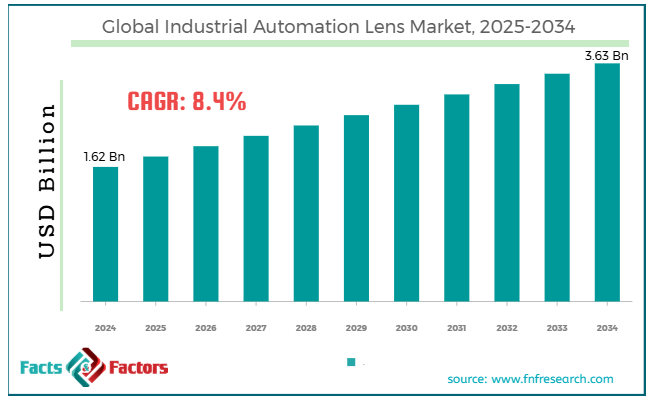
[222+ Pages Report] According to Facts & Factors, the global industrial automation lens market size was worth around USD 1.62 billion in 2024 and is predicted to grow to around USD 3.63 billion by 2034 with a compound annual growth rate (CAGR) of roughly 8.4% between 2025 and 2034.
 Market Overview
A conceptual framework or collection of viewpoints that are used to study and comprehend the ideas, procedures, innovations, and patterns of industrial automation is known as an "industrial automation lens." It entails looking at industrial systems and processes through the prism of automation, emphasizing how data analytics, control technology, and automated systems enhance productivity, efficiency, and safety in industrial settings. The industrial automation lens market is primarily driven by several factors including growing industrial automation, the advent of Industry 4.0, rising collaboration, increasing demand for productivity and efficiency and others.
Key Insights
- As per the analysis shared by our research analyst, the global industrial automation lens market is estimated to grow annually at a CAGR of around 8.4% over the forecast period (2025-2034).
- In terms of revenue, the global industrial automation lens market size was valued at around USD 1.62 billion in 2024 and is projected to reach USD 3.63 billion, by 2034.
- The rising collaboration among the market players is expected to drive market growth over the forecast period.
- Based on the type, the 1 inch segment is expected to dominate the market during the forecast period.
- Based on the application, the area scan camera segment is expected to capture the largest market share over the projected period.
- Based on region, North America is expected to dominate the market during the forecast period.
Growth Drivers
- Increasing demand for efficiency and productivity drives market growth
The industrial sector is constantly searching for methods to boost output and streamline processes. Automation technologies increase throughput, reduce the need for manual intervention, and streamline workflows to greatly increase production. Automated systems guarantee continuous operation and minimize lost productivity by decreasing downtime and increasing dependability through real-time monitoring and predictive maintenance.
According to Zapier Inc., 28% of SMBs claim automation shortens the time it takes to follow up with leads, and 34% claim it allows them to spend less time on administrative activities. Thus, the aforementioned stats drive the market growth over the projected timeframe.
Restraints
- High initial cost hinders market growth
An industrial automation system's deployment costs a substantial sum of capital. Modern machinery, new technology integration, and infrastructure setup can be costly, particularly for small and medium-sized businesses (SMEs). Businesses may be discouraged from making the first investment in automation projects due to their long return on investment, especially in an uncertain economic environment. Therefore, the high initial investment might negatively impact the market growth.
Opportunities
- Increasing acquisition offers a lucrative opportunity for market growth
The increasing acquisition is expected to offer a lucrative opportunity for market growth during the forecast period. For instance, in March 2024, Knowledge Lens was bought by Rockwell Automation, Inc., the leading industrial automation and digital transformation firm in the world. Knowledge Lens, an Indian company with headquarters in Bengaluru, combines digital technologies with deep data science, artificial intelligence (AI), and engineering know-how to give meaningful business insights from enterprise data. Knowledge Lens will become a part of Kalypso, Rockwell's leading digital services company, to help more manufacturers globally achieve transformative results more quickly.
One of Rockwell's fastest-growing divisions is its digital transformation services, driven by the growing need to allow data-based predictive and prescriptive insights and scale connectivity throughout the corporation. Knowledge Lens, when combined with Kalypso, will greatly increase Rockwell's capacity to harness data power, facilitate autonomous production, and promote ongoing optimization for a greater number of manufacturers.
Challenges
- Integration complexity poses a major challenge to market expansion
New automation technologies might be difficult and complex to integrate with legacy systems. Problems with compatibility between the new and old systems may raise the cost of integration and perhaps cause operational disruptions. Custom automation systems made to order are necessary for many industrial processes, which can make integration more difficult and expensive.
Report Scope
Report Attribute |
Details |
Market Size in 2024 |
USD 1.62 Billion |
Projected Market Size in 2034 |
USD 3.63 Billion |
CAGR Growth Rate |
8.4% CAGR |
Base Year |
2024 |
Forecast Years |
2025-2034 |
Key Market Players |
Panasonic, Omron, RICOH, B&R, Basler, Seeed Studio, Nikon, Teledyne FLIR, Sparkfun Electronics, 4D System, Adafruit, Canrill Optics, and others. |
Key Segment |
By Type, By Application, and Region |
Major Regions Covered |
North America, Europe, Asia Pacific, Latin America, and the Middle East &, Africa |
Purchase Options |
Request customized purchase options to meet your research needs. Explore purchase options |
Segmentation Analysis
The global industrial automation lens industry is segmented based on type, application and region.
Based on the type, the global industrial automation lens market is bifurcated into 1 Inch, 1/2 Inch, 1/3 Inch, 1/4 Inch, 1/5 Inch and Others. The 1 inch segment is expected to dominate the market during the forecast period. 1-inch lenses are well-known for their exceptional precision and picture quality, which makes them perfect for uses requiring close-up and precise visual examination. Technologies with high-resolution imaging capabilities are useful in industries including electronics, semiconductor manufacturing, and medicines. Demand for 1-inch lenses is also fueled by the development of sophisticated machine vision systems in industrial automation, which depend on superior lenses to provide accurate measurements and flaw identification.
Based on the application, the global industrial automation lens industry is bifurcated into area scan cameras and line scan cameras. The area scan camera segment is expected to capture the largest market share over the projected period. The segment expansion is attributed to the increasing adoption of machine vision systems. Machine vision systems that are utilized in manufacturing processes for defect identification, quality control, and precise measurement depend heavily on area scan cameras. To take clear, detailed pictures, high-performance lenses are necessary.
Furthermore, a wide range of industries, including the automotive, electronics, food and beverage, and pharmaceutical sectors, use machine vision systems that are outfitted with area scan cameras. This market segment's consistent growth is attributed to its adaptability and a broad variety of applications.
Regional Analysis
- North America is expected to dominate the market during the forecast period
North America held the largest market share and is expected to continue the same pattern over the forecast period. The regional expansion is attributable to technical advancement. The market is driven by the constant progress in lens technology, which offers improved durability, improved optical performance, and higher resolution. Innovative technology that boosts the capabilities of industrial automation systems is being developed and adopted by North American firms at a leading pace.
Also increasing in popularity is the combination of machine learning and artificial intelligence (AI) with machine vision systems. The demand for sophisticated lenses has increased because high-quality lenses are necessary to capture the detailed pictures required for AI-driven analysis and decision-making.
Furthermore, using advanced automation and machine vision technology is part of the drive towards Industry 4.0 projects and smart production. For these modern manufacturing settings to provide real-time monitoring, predictive maintenance, and increased operational efficiency, high-quality industrial lenses are needed. Data gathering and communication are improved by the widespread use of Industrial Internet of Things (IIoT) systems and devices in production. The successful deployment of IoT-enabled vision systems depends on high-performance lenses.
Besides, the Asia Pacific is expected to grow at the highest CAGR during the forecast period owing to the rapid expansion of several industries including automotive, manufacturing and others. Moreover, the increasing investment in advanced technologies especially in countries like China, Japan and India also propel the market growth in the Asia Pacific area.
Competitive Analysis
The global industrial automation lens market is dominated by players like:
- Panasonic
- Omron
- RICOH
- B&R
- Basler
- Seeed Studio
- Nikon
- Teledyne FLIR
- Sparkfun Electronics
- 4D System
- Adafruit
- Canrill Optics
The global industrial automation lens market is segmented as follows:
By Type
- 1 Inch
- 1/2 Inch
- 1/3 Inch
- 1/4 Inch
- 1/5 Inch
- Others
By Application
- Area Scan Camera
- Line Scan Camera
By Regional Segment Analysis
- North America
- The U.S.
- Canada
- Mexico
- Europe
- France
- The UK
- Spain
- Germany
- Italy
- Rest of Europe
- Asia Pacific
- China
- Japan
- India
- Australia
- Southeast Asia
- Rest of Asia Pacific
- The Middle East & Africa
- Saudi Arabia
- UAE
- Egypt
- Kuwait
- South Africa
- Rest of the Middle East & Africa
- Latin America
- Brazil
- Argentina
- Rest of Latin America
Industry Major Market Players
- Panasonic
- Omron
- RICOH
- B&R
- Basler
- Seeed Studio
- Nikon
- Teledyne FLIR
- Sparkfun Electronics
- 4D System
- Adafruit
- Canrill Optics
Frequently Asked Questions



Copyright © 2025 - 2026, All Rights Reserved, Facts and Factors