
Search Market Research Report
Forging Market Size, Share Global Analysis Report, 2026-2034

Forging Market Size, Share, Growth Analysis Report By Type (Closed Die Forging, Open Die Forging, Rolled Ring Forging, and Others), By Material (Carbon Steel, Alloy Steel, Aluminum, Stainless Steel, Titanium, and Others), By End-Use Industry (Automotive, Aerospace & Railways, Mechanical Equipment, Oil & Gas, Construction, and Others), and By Region - Global Industry Insights, Overview, Comprehensive Analysis, Trends, Statistical Research, Market Intelligence, Historical Data and Forecast 2026-2034
Industry Insights
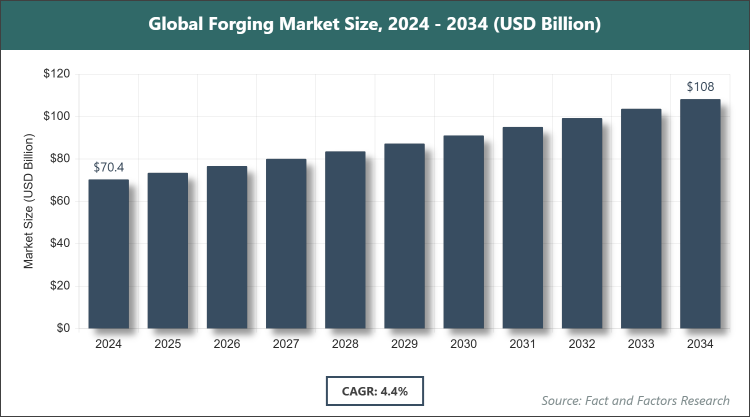
[250+ Pages Report] According to Facts & Factors, the global Forging market size was estimated at USD 70.36 billion in 2025 and is expected to reach USD 103.35 billion by 2034, growing at a CAGR of 4.4% from 2026 to 2034. Forging Market is driven by rising demand from automotive and aerospace sectors.
 Market Overview
Forging is a manufacturing process that involves shaping metal using localized compressive forces, typically delivered by a hammer or die, to create high-strength components with superior mechanical properties compared to other methods like casting or machining. This technique enhances the material's grain structure, improving durability, fatigue resistance, and overall performance, making it essential for producing critical parts in industries requiring reliability under extreme conditions. Forging can be performed hot, warm, or cold, depending on the material and desired outcome, and it minimizes waste while allowing for complex geometries in metals such as steel, aluminum, and titanium.
Key Insights
- The global forging market was valued at USD 70.36 billion in 2025 and is projected to reach USD 103.35 billion by 2034.
- The market is expected to grow at a CAGR of 4.4% during the forecast period.
- The forging market is driven by increasing demand in the automotive and aerospace industries.
- Based on the type segment Closed die forging dominates with 60% share due to its ability to produce precise, complex parts with minimal material waste and high repeatability.
- Based on the material segment Carbon steel dominates with 70% share owing to its excellent strength-to-cost ratio, versatility, and widespread use in load-bearing applications.
- Based on the end-use segment, Automotive dominates with 65% share because of the high-volume production of durable components like crankshafts, gears, and axles that require superior mechanical integrity.
- Asia Pacific dominates with 44.9% share due to rapid industrialization, low labor costs, and strong manufacturing bases in countries like China and India.
Growth Drivers
- Rising Demand from Automotive and Aerospace Sectors
The automotive industry relies heavily on forged components for their strength and reliability in critical parts such as engine crankshafts, transmission gears, and suspension systems. With global vehicle production on the rise, particularly in electric vehicles requiring lightweight yet robust parts, forging demand has surged. Additionally, advancements in forging technologies like precision forging have enabled manufacturers to meet stringent safety and efficiency standards, further propelling market growth.
The aerospace sector benefits from forging's ability to produce high-performance alloys that withstand extreme temperatures and stresses, such as turbine disks and landing gear. Increasing air travel and defense spending have boosted aircraft production, driving the need for forged parts that offer superior fatigue resistance and reduced weight, contributing significantly to overall market expansion.
Restraints
- High Initial Capital Investment and Operational Costs
Forging operations require substantial upfront investments in heavy machinery, dies, and heating equipment, which can be a barrier for small and medium-sized enterprises entering the market. Moreover, the energy-intensive nature of hot forging processes leads to high operational costs, especially with fluctuating energy prices, limiting scalability in cost-sensitive regions.
Environmental regulations on emissions from forging plants add compliance costs, potentially slowing adoption of new facilities. Competition from alternative manufacturing methods like additive manufacturing or casting, which may offer lower initial costs for certain applications, further restrains growth in price-competitive segments.
Opportunities
- Adoption of Lightweight Materials and Sustainable Practices
The shift toward lightweight materials like aluminum and titanium in forging presents opportunities for market expansion, particularly in electric vehicles and renewable energy applications where weight reduction improves efficiency. Innovations in eco-friendly forging processes, such as warm forging that reduces energy consumption, align with global sustainability goals and open doors to new contracts in green industries.
Emerging markets in Asia and Latin America offer growth potential through infrastructure development and industrialization, creating demand for forged components in construction and power generation. Partnerships with technology firms for automation and digital twins in forging can enhance precision and reduce waste, attracting investments and fostering long-term opportunities.
Challenges
- Supply Chain Disruptions and Raw Material Volatility
Fluctuations in raw material prices, such as steel and alloys, due to geopolitical tensions or mining disruptions, pose significant challenges to forging manufacturers by increasing production costs and affecting profitability. Supply chain issues, exacerbated by global events like pandemics, can delay deliveries and impact project timelines in time-sensitive industries like aerospace.
Skilled labor shortages in operating advanced forging equipment and maintaining quality standards add to operational challenges, potentially leading to defects or inefficiencies. Stringent quality certifications and testing requirements further complicate production, requiring ongoing investments in training and technology to remain competitive.
Report Scope
Report Attribute |
Details |
Market Size in 2024 |
USD 70.36 Billion |
Projected Market Size in 2034 |
USD 103.35 Billion |
CAGR Growth Rate |
4.4% CAGR |
Base Year |
2024 |
Forecast Years |
2025-2034 |
Key Market Players |
Bharat Forge Limited, Nippon Steel Corporation, ATI Inc., American Axle & Manufacturing Holdings, Inc., Bruck GmbH, Ellwood Group, Inc., Precision Castparts Corp., Asahi Forge Corporation, Trenton Forging, Canada Forgings Inc., ThyssenKrupp AG, Arconic Corporation, and Others. |
Key Segment |
By Type, By Material, By End-Use Industry, and By Region |
Major Regions Covered |
North America, Europe, Asia Pacific, Latin America, and the Middle East & Africa |
Purchase Options |
Request customized purchase options to meet your research needs. Explore purchase options |
Segmentation Analysis
The Forging market is segmented by type, material, end-use industry, and region.
Based on the type segment, the Forging market is divided into closed die forging, open die forging, rolled ring forging, and others. Closed die forging emerges as the most dominant subsegment, holding approximately 60% market share, followed by open die forging as the second most dominant with around 25%. Closed die forging's dominance stems from its precision in creating complex shapes with tight tolerances, reducing post-processing needs and material waste, which drives efficiency in high-volume production; this helps propel the overall market by enabling cost-effective manufacturing for industries like automotive and aerospace, where accuracy is paramount. Open die forging, while less precise, excels in producing large, custom components for heavy machinery, contributing to market growth through its flexibility in handling oversized parts that support infrastructure and energy sectors.
Based on the material segment, the Forging market is divided into carbon steel, alloy steel, aluminum, stainless steel, titanium, and others. Carbon steel is the most dominant subsegment with about 70% share, while aluminum is the second most dominant at roughly 15%. Carbon steel dominates due to its optimal balance of strength, ductility, and affordability, making it ideal for high-stress applications in automotive and construction; its widespread availability and ease of forging drive market expansion by facilitating large-scale production and cost reductions across various industries. Aluminum's growing prominence arises from its lightweight properties, corrosion resistance, and increasing use in aerospace and electric vehicles, aiding market growth by supporting the demand for fuel-efficient and sustainable components.
Based on end-use Industry segment, the Forging market is divided into automotive, aerospace & railways, mechanical equipment, oil & gas, construction, and others. Automotive holds the most dominant position with 65% share, followed by aerospace & railways at around 15%. The automotive sector's dominance is driven by the essential role of forged parts in ensuring vehicle safety and performance, such as in engines and chassis; this subsegment propels the market through high-volume demands from global manufacturers, fostering innovations in lightweight forging to meet emission standards. Aerospace & railways benefit from forging's ability to produce durable, high-integrity components resistant to fatigue, contributing to market advancement by addressing the needs of expanding air travel and rail infrastructure projects.
Recent Developments
- In January 2024, ThyssenKrupp AG launched a new forging line in Germany, expanding its global forging capacity by 15% to meet rising demand for high-precision components in the automotive and industrial sectors.
- In March 2024, Salzgitter AG formed a strategic partnership with Voestalpine AG to collaborate on the development and production of lightweight forged components for the automotive industry, aiming to enhance material efficiency and reduce vehicle weight.
- In May 2024, American Axle & Manufacturing Holdings Inc. completed the acquisition of Forged Products Company, a leading U.S.-based forging manufacturer, to broaden its product range and strengthen its market position in automotive forging.
- In May 2024, Balu Forge Industries Ltd. announced the strategic acquisition of 72,000-tonne forging lines in Karnataka, India, significantly boosting its production capabilities for heavy forged products in the engineering and defense sectors.
Regional Analysis
- Asia Pacific to dominate the global market
Asia Pacific holds the largest share in the global forging market, driven by rapid industrialization, robust manufacturing infrastructure, and high demand from the automotive and construction sectors. China, as the dominating country, leads with its massive production capacity, low-cost labor, and government support for industrial growth, enabling it to supply forged components globally. The region's focus on exports, coupled with investments in advanced forging technologies, ensures sustained dominance, while India's emerging role in aerospace and railways adds depth through cost-effective production and skilled workforce development.
North America exhibits strong growth potential, supported by technological advancements and a mature aerospace industry. The United States dominates this region, benefiting from key players in defense and automotive forging, with innovations in precision forging and sustainable materials driving efficiency. Investments in reshoring manufacturing and supply chain resilience further bolster the market, addressing demands for high-quality components in electric vehicles and renewable energy projects.
Europe maintains a significant position through its emphasis on high-precision forging and stringent quality standards. Germany stands out as the dominating country, leveraging its engineering expertise and automotive giants like BMW and Volkswagen to lead in advanced alloy forging. The region's push toward green manufacturing, including energy-efficient processes, supports growth amid regulatory pressures, while collaborations in aerospace enhance competitiveness.
Latin America shows moderate growth, fueled by mining and oil & gas sectors requiring durable forged parts. Brazil dominates, with its resource-rich economy driving demand for heavy forging in infrastructure and energy. Challenges like economic volatility are offset by foreign investments and regional trade agreements, promoting expansion in automotive exports.
The Middle East & Africa region experiences emerging growth, primarily from oil & gas and construction activities. Saudi Arabia leads as the dominating country, with Vision 2030 initiatives boosting industrial diversification and forging capabilities for energy infrastructure. While raw material availability aids production, skill gaps and geopolitical issues pose hurdles, yet opportunities in renewable energy projects promise future advancement.
Competitive Analysis
The global Forging market is dominated by players:
- Bharat Forge Limited
- Nippon Steel Corporation
- ATI Inc.
- American Axle & Manufacturing Holdings, Inc.
- Bruck GmbH
- Ellwood Group, Inc.
- Precision Castparts Corp.
- Asahi Forge Corporation
- Trenton Forging
- Canada Forgings Inc.
- ThyssenKrupp AG
- Arconic Corporation
The global Forging market is segmented as follows:
By Type
- Closed Die Forging
- Open Die Forging
- Rolled Ring Forging
- Others
By Material
- Carbon Steel
- Alloy Steel
- Aluminum
- Stainless Steel
- Titanium
- Others
By End-Use Industry
- Automotive
- Aerospace & Railways
- Mechanical Equipment
- Oil & Gas
- Construction
- Others
By Regional
- North America
- The U.S.
- Canada
- Mexico
- Europe
- France
- The UK
- Spain
- Germany
- Italy
- Rest of Europe
- Asia Pacific
- China
- Japan
- India
- Australia
- Southeast Asia
- Rest of Asia Pacific
- The Middle East & Africa
- Saudi Arabia
- UAE
- Egypt
- Kuwait
- South Africa
- Rest of the Middle East & Africa
- Latin America
- Brazil
- Argentina
- Rest of Latin America
Industry Major Market Players
- Bharat Forge Limited
- Nippon Steel Corporation
- ATI Inc.
- American Axle & Manufacturing Holdings, Inc.
- Bruck GmbH
- Ellwood Group, Inc.
- Precision Castparts Corp.
- Asahi Forge Corporation
- Trenton Forging
- Canada Forgings Inc.
- ThyssenKrupp AG
- Arconic Corporation
Frequently Asked Questions



Copyright © 2025 - 2026, All Rights Reserved, Facts and Factors