
Search Market Research Report
Foot Orthotics Insole Market Size, Share Global Analysis Report, 2026-2034

Foot Orthotics Insole Market Size, Share, Growth Analysis Report By Type (Prefabricated, Customized, and Others), By Application (Medical, Sports & Athletics, Personal, and Others), By End-User (Hospital Pharmacies, Retail Stores, Online Stores, and Others), and By Region - Global Industry Insights, Overview, Comprehensive Analysis, Trends, Statistical Research, Market Intelligence, Historical Data and Forecast 2026-2034
Industry Insights
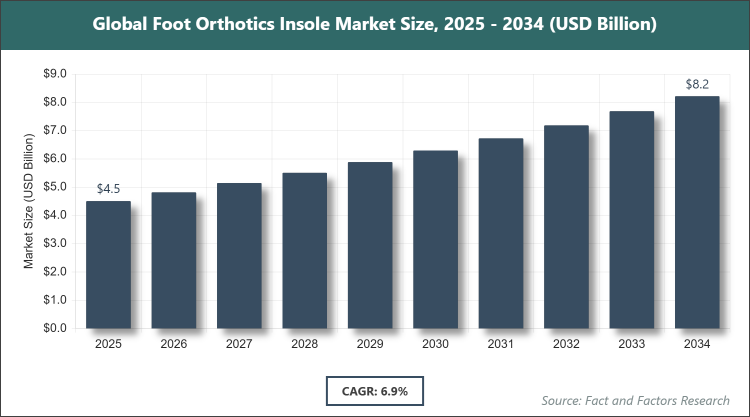
[232+ Pages Report] According to Facts & Factors, the global Foot Orthotics Insole market size was estimated at USD 4.51 billion in 2025 and is expected to reach USD 8.21 billion by the end of 2034. The Foot Orthotics Insole industry is anticipated to grow by a CAGR of 6.90% between 2026 and 2034. The Foot Orthotics Insole Market is driven by increasing prevalence of foot-related disorders and rising awareness about foot health.
 Market Overview
Foot orthotics insoles are specialized inserts designed to fit inside shoes, providing support, cushioning, and alignment to the feet to alleviate pain, correct biomechanical issues, and enhance overall foot function. This market includes the development, manufacturing, and distribution of both prefabricated and customized insoles made from various materials, catering to medical needs, athletic performance, and everyday comfort, while emphasizing advancements in ergonomics and materials science to address conditions like plantar fasciitis, flat feet, and diabetic foot complications.
Key Insights
- As per the analysis shared by our research analyst, the Foot Orthotics Insole market is estimated to grow annually at a CAGR of around 6.90% over the forecast period (2026-2034).
- In terms of revenue, the Foot Orthotics Insole market size was valued at around USD 4.51 billion in 2025 and is projected to reach USD 8.21 billion by 2034.
- Due to a variety of driving factors, the market is predicted to rise at a significant rate. The Foot Orthotics Insole Market is driven by a growing geriatric population, increasing sports activities, and advancements in 3D printing technology.
- Based on the Type, the customized segment dominated the market in 2025 with a market share of 63.20% and why it is due to rising patient preference for personalized comfort and better clinical outcomes.
- Based on the Application, the Medical segment dominated the market in 2025 with a market share of 45% and why it is due to the high prevalence of chronic conditions like diabetes and arthritis requiring therapeutic support.
- Based on the End-User, the Retail Stores segment dominated the market in 2025 with a market share of 52% and why it is because it offers easy accessibility and a wide variety of over-the-counter options for consumers.
- Based on region, North America was the leading revenue generator in 2025, holding a market share of 42.90%, due to advanced healthcare infrastructure and high adoption of customized orthotics.
Growth Drivers
- Increasing Prevalence of Foot-Related Disorders
The surge in conditions such as plantar fasciitis, flat feet, and diabetic neuropathy, driven by sedentary lifestyles and aging populations, has heightened the demand for orthotic insoles as a non-invasive treatment option. This growth is further supported by medical recommendations and insurance coverage for therapeutic devices, encouraging widespread adoption.
Moreover, technological integrations like sensor-equipped insoles for gait analysis enhance product efficacy, attracting health-conscious consumers and driving innovation in the market.
Restraints
- High Cost of Customized Insoles
The premium pricing of personalized orthotics, often requiring professional fittings and advanced materials, limits accessibility for lower-income groups and in developing regions. This restraint is compounded by reimbursement challenges in healthcare systems, affecting market penetration.
Additionally, the time-intensive customization process can deter quick purchases, favoring cheaper prefabricated alternatives and slowing overall growth.
Opportunities
- Advancements in 3D Printing and Materials
Innovations in additive manufacturing allow for rapid, cost-effective production of tailored insoles, opening markets in sports and pediatrics. This opportunity fosters collaborations with podiatrists for precise solutions.
Furthermore, the use of sustainable, bio-based materials appeals to eco-conscious consumers, expanding product lines and market reach.
Challenges
- Lack of Awareness in Emerging Markets
Limited knowledge about orthotic benefits in developing areas hinders adoption, coupled with inadequate healthcare infrastructure. This challenge requires educational campaigns to build demand.
Regulatory variations also complicate global expansion, necessitating adaptive strategies for compliance.
Report Scope
Report Attribute |
Details |
Market Size 2025 |
USD 4.51 Billion |
Projected Market Size in 2034 |
USD 8.21 Billion |
CAGR Growth Rate |
6.90% CAGR |
Base Year |
2025 |
Forecast Years |
2026-2034 |
Key Market Players |
Bauerfeind AG, Superfeet Worldwide LLC, Aetrex Worldwide Inc., Dr. Scholl's (Scholl’s Wellness Co.), FootBalance System Oy, Thuasne SAS, Acor Orthopedic Inc., Amfit Inc., Sole, Powerstep, and Others. |
Key Segment |
By Type, By Application, By End-User, and By Region |
Major Regions Covered |
North America, Europe, Asia Pacific, Latin America, and the Middle East & Africa |
Purchase Options |
Request customized purchase options to meet your research needs. Explore purchase options |
Market Segmentation
The Foot Orthotics Insole market is segmented by Type, Application, End-User, and region.
Based on Type Segment, the Foot Orthotics Insole market is divided into Prefabricated, Customized, and others. The most dominant segment is Customized, which leads due to its ability to provide precise fit and support tailored to individual foot anatomy, driving the market by improving treatment outcomes for chronic conditions and gaining preference among healthcare professionals. The second most dominant is Prefabricated, prominent for its affordability and immediate availability, contributing to market growth through mass accessibility in retail channels for general comfort needs.
Based on Application Segment, the Foot Orthotics Insole market is divided into Medical, Sports & Athletics, Personal, and others. The most dominant segment is Medical, excelling because of the rising incidence of orthopedic issues requiring therapeutic intervention, propelling the market via prescriptions from clinicians for pain management. The second most dominant is Sports & Athletics, valued for enhancing performance and preventing injuries, boosting market expansion through demand from active lifestyles.
Based on End-User Segment, the Foot Orthotics Insole market is divided into Hospital Pharmacies, Retail Stores, Online Stores, and others. The most dominant segment is Retail Stores, dominating due to convenient over-the-counter purchases and wide product variety, driving the market with impulse buys for everyday use. The second most dominant is Online Stores, essential for customized ordering and global reach, contributing to market progress through e-commerce growth.
Recent Developments
- In June 2025, Bauerfeind AG launched a new line of 3D-printed customized insoles integrating smart sensors for real-time foot pressure monitoring, targeting athletes and diabetic patients.
- In September 2025, Superfeet announced a partnership with a leading 3D scanning app developer to enhance in-store customization services, expanding their retail presence.
- In November 2025, Aetrex Worldwide introduced eco-friendly insoles made from recycled materials, aligning with sustainability trends and appealing to environmentally conscious consumers.
Regional Analysis
- North America to dominate the global market
North America leads the Foot Orthotics Insole market, bolstered by advanced podiatric care and high healthcare spending. The United States dominates, with widespread access to customized fittings through clinics and insurance coverage for therapeutic devices, supported by awareness campaigns on foot health. Canada's integrated healthcare system complements this, while Mexico contributes via growing medical tourism.
Asia-Pacific exhibits rapid growth, fueled by urbanization and rising disposable incomes. China leads, adopting western wellness trends and expanding manufacturing for affordable insoles in domestic markets. India's aging population drives demand, with Japan's tech-savvy consumers favoring innovative products.
Europe sustains consistent advancement, emphasizing quality standards. Germany dominates, leveraging strong R&D in orthopedics for premium exports. The United Kingdom follows with NHS-supported prescriptions, while France prioritizes sports applications.
Latin America shows emerging potential, amid health initiatives. Brazil leads, incorporating insoles in diabetes management programs for urban populations. Argentina supports through athletic endorsements, fostering regional adoption.
Middle East & Africa experiences gradual uptake, influenced by expatriate demands. Saudi Arabia dominates, integrating orthotics in Vision 2030 health reforms for chronic care. South Africa aids with retail expansions in urban centers.
Competitive Analysis
The global Foot Orthotics Insole market is dominated by players:
- Bauerfeind AG
- Superfeet Worldwide LLC
- Aetrex Worldwide Inc.
- Dr. Scholl's (Scholl’s Wellness Co.)
- FootBalance System Oy
- Thuasne SAS
- Acor Orthopedic Inc.
- Amfit Inc.
- Sole
- Powerstep
The global Foot Orthotics Insole market is segmented as follows:
By Type
- Prefabricated
- Customized
- Others
By Application
- Medical
- Sports & Athletics
- Personal
- Others
By End-User
- Hospital Pharmacies
- Retail Stores
- Online Stores
- Others
By Region
- North America
- The U.S.
- Canada
- Mexico
- Europe
- France
- The UK
- Spain
- Germany
- Italy
- Rest of Europe
- Asia Pacific
- China
- Japan
- India
- Australia
- Southeast Asia
- Rest of Asia Pacific
- The Middle East & Africa
- Saudi Arabia
- UAE
- Egypt
- Kuwait
- South Africa
- Rest of the Middle East & Africa
- Latin America
- Brazil
- Argentina
- Rest of Latin America
Industry Major Market Players
- Bauerfeind AG
- Superfeet Worldwide LLC
- Aetrex Worldwide Inc.
- Dr. Scholl's (Scholl’s Wellness Co.)
- FootBalance System Oy
- Thuasne SAS
- Acor Orthopedic Inc.
- Amfit Inc.
- Sole
- Powerstep
Frequently Asked Questions



Copyright © 2025 - 2026, All Rights Reserved, Facts and Factors