
Search Market Research Report
Food Safety Testing Services Market Size, Share Global Analysis Report, 2026-2034

Food Safety Testing Services Market Size, Share, Growth Analysis Report By Test Type (Pathogen, Genetically Modified Organism, Allergen, Mycotoxin, Chemical and Pesticides, and Others), By Food Tested (Meat, Poultry & Seafood, Dairy Products, Processed Foods, Fruits & Vegetables, and Others), By Technology (Traditional, Rapid, Molecular, and Others), and By Region - Global Industry Insights, Overview, Comprehensive Analysis, Trends, Statistical Research, Market Intelligence, Historical Data and Forecast 2026-2034
Industry Insights
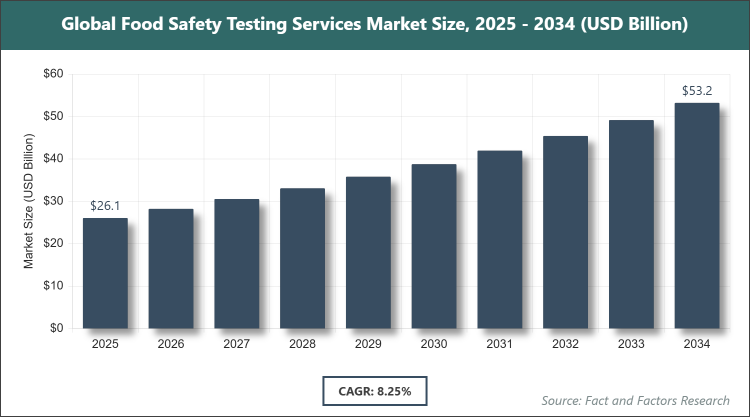
[240+ Pages Report] According to Facts & Factors, the global Food Safety Testing Services market size was estimated at USD 26.08 billion in 2025 and is expected to reach USD 52.99 billion by the end of 2034. The Food Safety Testing Services industry is anticipated to grow by a CAGR of 8.25% between 2026 and 2034. The Food Safety Testing Services Market is driven by the rising incidence of foodborne illnesses and stringent regulatory standards.
 Market Overview
Food safety testing services encompass the analytical processes and methodologies provided by specialized laboratories and firms to detect contaminants, pathogens, allergens, and other hazards in food products, ensuring compliance with regulatory standards and safeguarding public health. This market involves third-party testing entities that offer comprehensive services, including microbiological, chemical, and physical analyses for various stages of the food supply chain, from raw materials to finished goods, focusing on preventing foodborne illnesses and maintaining quality without direct involvement in production.
Key Insights
- As per the analysis shared by our research analyst, the Food Safety Testing Services market is estimated to grow annually at a CAGR of around 8.25% over the forecast period (2026-2034).
- In terms of revenue, the Food Safety Testing Services market size was valued at around USD 26.08 billion in 2025 and is projected to reach USD 52.99 billion by 2034.
- Due to a variety of driving factors, the market is predicted to rise at a significant rate. The Food Safety Testing Services Market is driven by increasing regulatory compliance requirements, globalization of food supply chains, and heightened consumer awareness of food safety.
- Based on the Test Type, the Pathogen segment dominated the market in 2025 with a market share of 61.60% and why it is due to pathogens being the leading cause of foodborne illnesses, necessitating frequent and rigorous testing to prevent outbreaks.
- Based on the Food Tested, the Meat, Poultry & Seafood segment dominated the market in 2025 with a market share of 32.24% and why it is dominated owing to high susceptibility to contamination and strict regulations on these perishable products.
- Based on the Technology, the Rapid segment dominated the market in 2025 with a market share of 55% and why it is dominated as it offers quick results essential for timely decision-making in fast-paced supply chains.
- Based on region, North America was the leading revenue generator in 2025, holding a market share of 43.57%, due to stringent regulations, high food import volumes, and advanced testing infrastructure.
Growth Drivers
- Increasing Incidence of Foodborne Illnesses
The rising number of foodborne disease outbreaks globally has heightened the need for robust testing services to identify and mitigate risks early in the supply chain. This driver is fueled by complex global trade networks that increase contamination possibilities, prompting governments and companies to invest in preventive measures.
Additionally, consumer demand for transparency and safe products encourages food producers to utilize certified testing services, fostering market growth through enhanced trust and brand protection.
Restraints
- High Costs of Advanced Testing Technologies
The expense associated with implementing cutting-edge testing methods and equipment can be prohibitive for small-scale food businesses, limiting market accessibility. This restraint is exacerbated by the need for skilled personnel and ongoing maintenance, which adds to operational burdens.
Furthermore, varying regulatory requirements across regions complicate standardization, potentially delaying adoption and increasing compliance costs for multinational operations.
Opportunities
- Advancements in Rapid Testing Technologies
Innovations such as PCR and biosensor-based methods offer faster, more accurate results, opening doors for on-site testing and real-time monitoring. This opportunity allows for expansion into emerging markets where quick turnaround is crucial for perishable goods.
Moreover, partnerships between tech firms and testing labs can accelerate development, providing scalable solutions that cater to diverse industry needs and drive competitive differentiation.
Challenges
- Regulatory Variations Across Regions
Differing standards and enforcement levels globally create complexities in harmonizing testing protocols, affecting cross-border trade. This challenge requires adaptive strategies to navigate compliance landscapes effectively.
Ongoing efforts to align international regulations are essential, but inconsistencies persist, impacting efficiency and increasing the risk of non-compliance for exporters.
Report Scope
Report Attribute |
Details |
Market Size 2025 |
USD 26.08 Billion |
Projected Market Size in 2034 |
USD 52.99 Billion |
CAGR Growth Rate |
8.25% CAGR |
Base Year |
2025 |
Forecast Years |
2026-2034 |
Key Market Players |
SGS SA, Eurofins Scientific, Bureau Veritas, Intertek Group PLC, ALS Limited, Thermo Fisher Scientific Inc., Merieux NutriSciences, TUV SUD, AsureQuality Limited, Neogen Corporation, and Others. |
Key Segment |
By Test Type, By Food Tested, By Technology, and By Region |
Major Regions Covered |
North America, Europe, Asia Pacific, Latin America, and the Middle East & Africa |
Purchase Options |
Request customized purchase options to meet your research needs. Explore purchase options |
Market Segmentation
The Food Safety Testing Services market is segmented by Test Type, Food Tested, Technology, and region.
Based on Test Type Segment, the Food Safety Testing Services market is divided into Pathogen, Genetically Modified Organism, Allergen, Mycotoxin, Chemical and Pesticides, and others. The most dominant segment is Pathogen, which leads due to its association with the majority of foodborne illnesses and mandatory regulatory requirements for detection, driving the market by ensuring public health safety and preventing costly recalls. The second most dominant is Chemical and Pesticides, prominent for addressing residue limits in agricultural products, contributing to market growth through compliance with international trade standards and consumer demands for residue-free foods.
Based on Food Tested Segment, the Food Safety Testing Services market is divided into Meat, Poultry & Seafood, Dairy Products, Processed Foods, Fruits & Vegetables, and others. The most dominant segment is Meat, Poultry & Seafood, excelling because of high contamination risks from bacteria like Salmonella and E. coli, propelling the market via stringent inspections in processing plants. The second most dominant is Processed Foods, valued for its complex ingredients requiring multi-contaminant testing, boosting market expansion by supporting shelf-stable product safety.
Based on Technology Segment, the Food Safety Testing Services market is divided into Traditional, Rapid, Molecular, and others. The most dominant segment is Rapid, dominating due to its efficiency in providing quick results for time-sensitive decisions, driving the market with adoption in high-volume industries. The second most dominant is Molecular, essential for precise pathogen identification, contributing to market progress through advanced diagnostics in labs.
Recent Developments
- In April 2025, SGS signed a Memorandum of Understanding with the Ministry of Economy of the United Arab Emirates to advance food safety and quality compliance cooperation.
- In October 2025, SGS expanded its presence in the North American rapid food testing market with a new food and nutraceutical testing facility in Fairfield, New Jersey.
- In August 2025, ALS launched InviRapid, providing rapid, on-site detection of food allergens within minutes in diverse samples.
Regional Analysis
- North America to dominate the global market
North America leads the Food Safety Testing Services market, supported by rigorous FDA regulations and high food import volumes. The United States dominates, with initiatives like the Food Safety Modernization Act mandating preventive controls and frequent testing in processing facilities. Canada's harmonized standards enhance regional trade, while Mexico contributes through export-oriented agriculture requiring compliance certifications.
Asia-Pacific shows rapid expansion, driven by urbanization and food export growth. China leads, implementing strict standards post-scandals to ensure safety in domestic and international markets. India's focus on spice and produce testing complements this, with Japan's advanced tech adoption in seafood emphasizing precision.
Europe maintains steady progress, emphasizing EU-wide traceability. Germany dominates, leveraging robust labs for chemical residue analysis in imports. The United Kingdom advances post-Brexit with independent regulations, while France prioritizes allergen testing in bakery products.
Latin America exhibits emerging potential, amid agribusiness expansion. Brazil leads, adopting international norms for meat exports to meet global demands. Argentina supports through grain testing, fostering safer supply chains in the region.
Middle East & Africa experiences gradual uptake, influenced by import reliance. Saudi Arabia dominates, incorporating testing in Vision 2030 for hospitality safety. South Africa aids with fruit export compliance, addressing regional food security.
Competitive Analysis
The global Food Safety Testing Services market is dominated by players:
- SGS SA
- Eurofins Scientific
- Bureau Veritas
- Intertek Group PLC
- ALS Limited
- Thermo Fisher Scientific Inc.
- Merieux NutriSciences
- TUV SUD
- AsureQuality Limited
- Neogen Corporation
The global Food Safety Testing Services market is segmented as follows:
By Test Type
- Pathogen
- Genetically Modified Organism
- Allergen
- Mycotoxin
- Chemical and Pesticides
- Others
By Food Tested
- Meat, Poultry & Seafood
- Dairy Products
- Processed Foods
- Fruits & Vegetables
- Others
By Technology
- Traditional
- Rapid
- Molecular
- Others
By Region
- North America
- The U.S.
- Canada
- Mexico
- Europe
- France
- The UK
- Spain
- Germany
- Italy
- Rest of Europe
- Asia Pacific
- China
- Japan
- India
- Australia
- Southeast Asia
- Rest of Asia Pacific
- The Middle East & Africa
- Saudi Arabia
- UAE
- Egypt
- Kuwait
- South Africa
- Rest of the Middle East & Africa
- Latin America
- Brazil
- Argentina
- Rest of Latin America
Industry Major Market Players
- SGS SA
- Eurofins Scientific
- Bureau Veritas
- Intertek Group PLC
- ALS Limited
- Thermo Fisher Scientific Inc.
- Merieux NutriSciences
- TUV SUD
- AsureQuality Limited
- Neogen Corporation
Frequently Asked Questions



Copyright © 2025 - 2026, All Rights Reserved, Facts and Factors