
Search Market Research Report
Fire Suppression Market Size, Share Global Analysis Report, 2026-2034

Fire Suppression Market Size, Share, Growth Analysis Report By Product Type (Fire Extinguishers, Gas, Water, Dry Chemical Powder, Sprinklers, and Others), By Application (Commercial, Industrial, Residential, and Others), By End-User (Oil & Gas, Manufacturing, Healthcare, Hospitality, Data Centers, and Others), and By Region - Global Industry Insights, Overview, Comprehensive Analysis, Trends, Statistical Research, Market Intelligence, Historical Data and Forecast 2026-2034
Industry Insights
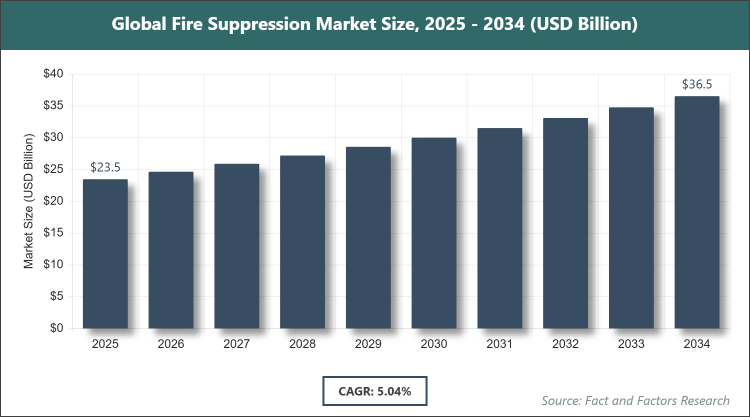
[235+ Pages Report] According to Facts & Factors, the global Fire Suppression market size was estimated at USD 23.47 billion in 2025 and is expected to reach USD 36.53 billion by the end of 2034. The Fire Suppression industry is anticipated to grow by a CAGR of 5.04% between 2026 and 2034. The Fire Suppression Market is driven by rising cases of fire accidents in commercial and residential infrastructure.
 Market Overview
Fire suppression refers to the systems and technologies designed to detect, control, and extinguish fires in various environments, utilizing agents such as water, gas, foam, or chemicals to minimize damage, protect lives, and prevent fire spread. This market encompasses a range of active systems integrated into buildings and facilities, focusing on rapid response mechanisms that comply with safety regulations and enhance overall fire management strategies without relying on passive structural elements.
Key Insights
- As per the analysis shared by our research analyst, the Fire Suppression market is estimated to grow annually at a CAGR of around 5.04% over the forecast period (2026-2034).
- In terms of revenue, the Fire Suppression market size was valued at around USD 23.47 billion in 2025 and is projected to reach USD 36.53 billion by 2034.
- Due to a variety of driving factors, the market is predicted to rise at a significant rate. The Fire Suppression Market is driven by increasing infrastructural development, stringent safety regulations, and technological advancements in fire safety systems.
- Based on the Product Type, the Fire Extinguishers segment dominated the market in 2025 with a market share of 58%, and this is due to their essential role in initial fire response, versatility across environments, and ability to quickly mitigate small fires before escalation.
- Based on the Application, the Industrial segment dominated the market in 2025 with a market share of 52% and why it is due to high-risk operations in manufacturing and processing facilities requiring robust systems to protect assets and ensure operational continuity.
- Based on the End-User, the Oil & Gas segment dominated the market in 2025 with a market share of 35% and why it is dominated because it involves flammable materials and remote locations, necessitating advanced suppression to prevent catastrophic incidents and comply with industry-specific regulations.
- Based on region, North America was the leading revenue generator in 2025, holding a market share of 37%, due to advanced infrastructural development, strict fire safety codes, and high adoption in commercial and industrial sectors.
Growth Drivers
- Rising Construction Industry and Infrastructural Development
The surge in global population and urbanization has led to extensive construction of residential, commercial, and industrial buildings, thereby increasing the demand for integrated fire suppression systems to ensure occupant safety and property protection. This growth is particularly evident in emerging economies where new infrastructure projects prioritize fire safety as a core component of building design.
Furthermore, government initiatives promoting smart cities and sustainable development further amplify the need for advanced suppression technologies that align with energy-efficient and eco-friendly building practices, fostering innovation and market expansion.
Restraints
- High Cost of Advanced Fire Suppression Technologies
The elevated expenses associated with installing and maintaining sophisticated systems, including smart sensors and clean agents, deter adoption among small and medium-sized enterprises, limiting market penetration in cost-sensitive regions. These costs encompass not only initial procurement but also ongoing certification and upgrades to meet evolving standards.
Additionally, the complexity of integrating these systems into existing structures without disrupting operations adds to the financial burden, potentially slowing growth in retrofit applications and underdeveloped markets.
Opportunities
- Technological Advancements in Smart and Eco-Friendly Systems
Innovations such as AI-integrated detection, IoT-enabled monitoring, and environmentally sustainable agents present opportunities for enhanced system efficiency and reduced ecological impact, appealing to green building initiatives. These advancements allow for real-time data analysis and predictive maintenance, improving response times and reliability.
Moreover, collaborations between manufacturers and tech firms can accelerate the development of customizable solutions, expanding market reach into niche sectors like data centers and renewable energy facilities.
Challenges
- Affordability Issues for Small-Scale Industries
Smaller organizations often struggle with the upfront and operational costs of high-end suppression systems, which can hamper widespread adoption and create market disparities. This challenge is compounded by limited access to financing options tailored for safety investments.
Efforts to address this include developing cost-effective alternatives and subsidy programs, but the lack of awareness and technical expertise in implementation remains a barrier to equitable market growth.
Report Scope
Report Attribute |
Details |
Market Size 2025 |
USD 23.47 Billion |
Projected Market Size in 2034 |
USD 36.53 Billion |
CAGR Growth Rate |
5.04% CAGR |
Base Year |
2025 |
Forecast Years |
2026-2034 |
Key Market Players |
Honeywell International Inc., Johnson Controls, Robert Bosch GmbH, Fike Corporation, Minimax USA LLC, GENTEX Corporation, Halma Plc, HOCHIKI America Corporation, Siemens AG, Raytheon Technologies Corporation, and Others. |
Key Segment |
By Product Type, By Application, By End-User, and By Region |
Major Regions Covered |
North America, Europe, Asia Pacific, Latin America, and the Middle East & Africa |
Purchase Options |
Request customized purchase options to meet your research needs. Explore purchase options |
Market Segmentation
The Fire Suppression market is segmented by Product Type, Application, End-User, and region.
Based on Product Type Segment, the Fire Suppression market is divided into Fire Extinguishers, Gas, Water, Dry Chemical Powder, Sprinklers, and others. The most dominant segment is Fire Extinguishers, which leads due to their portability, ease of use in early-stage fire control, and widespread mandatory placement in buildings, driving the market by enabling quick intervention that prevents larger outbreaks and reduces overall damage costs. The second most dominant is Sprinklers, prominent for their automatic activation in large areas and effectiveness in containing fires in commercial spaces, contributing to market growth through compliance with building codes and integration in new constructions.
Based on Application Segment, the Fire Suppression market is divided into Commercial, Industrial, Residential, and others. The most dominant segment is Industrial, excelling because of the high incidence of fire hazards in manufacturing and processing environments, propelling the market via specialized systems that safeguard heavy machinery and hazardous materials. The second most dominant is Commercial, valued for protecting public spaces like offices and retail outlets, boosting market expansion by meeting occupancy safety requirements and insurance mandates.
Based on End-User Segment, the Fire Suppression market is divided into Oil & Gas, Manufacturing, Healthcare, Hospitality, Data Centers, and others. The most dominant segment is Oil & Gas, dominating due to inherent risks of explosions and fires in extraction and refining operations, driving the market with tailored gaseous and foam systems that ensure rapid suppression in volatile settings. The second most dominant is Data Centers, essential for protecting sensitive electronics from fire without water damage, contributing to market progress through demand for clean agent technologies in the growing digital infrastructure.
Recent Developments
- In July 2025, Honeywell International Inc. announced the acquisition of Li-ion Tamer, enhancing its capabilities in lithium-ion battery fire detection and suppression for electric vehicles and energy storage.
- In June 2025, Johnson Controls introduced the Hygood Inert Gas System 300 (IGS-300), designed for data centers to provide eco-friendly fire suppression for sensitive electronic equipment.
- In August 2025, Firetrace International partnered with FirePro Systems to distribute condensed-aerosol fire-suppression technology in the U.S., targeting industrial and energy sectors with low-maintenance solutions.
Regional Analysis
- North America to dominate the global market
North America leads the Fire Suppression market, bolstered by rigorous fire safety regulations and substantial investments in infrastructure. The United States dominates, with initiatives like NFPA standards mandating advanced systems in high-rise buildings and industrial parks, supported by insurance incentives for compliant installations. Canada's contributions through harmonized codes enhance cross-border trade, while wildfire-prone areas drive residential adoption.
Asia-Pacific exhibits rapid growth, driven by industrialization and urban expansion. China leads, implementing GB 50140 codes for fire safety in factories and skyscrapers, accelerating demand amid manufacturing booms. India's infrastructure push in smart cities complements this, with Japan emphasizing seismic-resilient systems in densely populated zones.
Europe sustains consistent progress, emphasizing sustainability and compliance. Germany dominates, integrating EN 12845 standards in eco-buildings, with the UK advancing post-regulatory reforms for public safety. Nordic nations bolster this with timber-focused innovations in energy-efficient structures.
Latin America shows promising development, amid economic recovery and safety awareness. Brazil leads, adopting ABNT NBR norms in urban developments vulnerable to electrical fires, while Mexico supports through industrial upgrades in manufacturing hubs.
Middle East & Africa experiences steady uptake, influenced by oil-driven economies. Saudi Arabia dominates, incorporating suppression in Vision 2030 megaprojects for hospitality and transport, addressing desert climate risks. South Africa aids with institutional enhancements in mining and urban areas.
Competitive Analysis
The global Fire Suppression market is dominated by players:
- Honeywell International Inc.
- Johnson Controls
- Robert Bosch GmbH
- Fike Corporation
- Minimax USA LLC
- GENTEX Corporation
- Halma Plc
- HOCHIKI America Corporation
- Siemens AG
- Raytheon Technologies Corporation
The global Fire Suppression market is segmented as follows:
By Product Type
- Fire Extinguishers
- Gas
- Water
- Dry Chemical Powder
- Sprinklers
- Others
By Application
- Commercial
- Industrial
- Residential
- Others
By End-User
- Oil & Gas
- Manufacturing
- Healthcare
- Hospitality
- Data Centers
- Others
By Region
- North America
- The U.S.
- Canada
- Mexico
- Europe
- France
- The UK
- Spain
- Germany
- Italy
- Rest of Europe
- Asia Pacific
- China
- Japan
- India
- Australia
- Southeast Asia
- Rest of Asia Pacific
- The Middle East & Africa
- Saudi Arabia
- UAE
- Egypt
- Kuwait
- South Africa
- Rest of the Middle East & Africa
- Latin America
- Brazil
- Argentina
- Rest of Latin America
Industry Major Market Players
- Honeywell International Inc.
- Johnson Controls
- Robert Bosch GmbH
- Fike Corporation
- Minimax USA LLC
- GENTEX Corporation
- Halma Plc
- HOCHIKI America Corporation
- Siemens AG
- Raytheon Technologies Corporation
Frequently Asked Questions



Copyright © 2025 - 2026, All Rights Reserved, Facts and Factors