
Search Market Research Report
Energy Efficient Lighting Market Size, Share Global Analysis Report, 2026-2034

Energy Efficient Lighting Market Size, Share, Growth Analysis Report By Type (LED, HID, LFL, CFL, and Others), By Application (Residential, Commercial, Industrial, and Others), By End-User (Residential, Commercial, Industrial, and Others), and By Region - Global Industry Insights, Overview, Comprehensive Analysis, Trends, Statistical Research, Market Intelligence, Historical Data and Forecast 2026-2034
Industry Insights
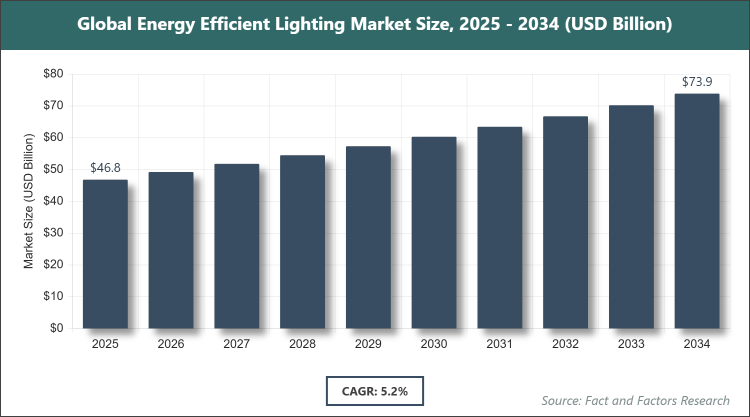
[220+ Pages Report] According to Facts & Factors, the global energy efficient lighting market size was estimated at USD 46.8 billion in 2025 and is expected to reach USD 72.8 billion by the end of 2034. The energy efficient lighting industry is anticipated to grow by a CAGR of 5.2% between 2026 and 2034. The energy efficient lighting Market is driven by increasing adoption of LED technology and government initiatives for energy conservation.
 Market Overview
The energy efficient lighting market encompasses technologies and products designed to minimize energy consumption while providing adequate illumination, including LED, CFL, and other advanced lighting solutions that replace traditional incandescent and fluorescent systems.
Key Insights
- As per the analysis shared by our research analyst, the global energy efficient lighting market is estimated to grow annually at a CAGR of around 5.2% over the forecast period (2026-2034).
- In terms of revenue, the global energy efficient lighting market size was valued at around USD 46.8 billion in 2025 and is projected to reach USD 72.8 billion by 2034.
- The market is driven by rising demand for sustainable solutions and technological advancements in LED systems.
- Based on the type, the LED sub-segment held the largest market share of 75% due to its superior energy savings and longer lifespan.
- Based on the application, the commercial sub-segment dominated with a 45% share owing to widespread adoption in offices and retail spaces for cost reduction.
- Based on the end-user, the commercial sub-segment led with a 45% share because of regulatory pressures and operational efficiency needs.
- Based on the region, Asia Pacific held the largest share of 42%, attributed to rapid urbanization and government energy-efficiency policies.
Growth Drivers
- Increasing Demand for Energy Conservation
The global push towards reducing carbon footprints has heightened the need for lighting solutions that consume less power, with LEDs offering up to 80% energy savings compared to traditional bulbs. This trend is supported by international agreements like the Paris Accord, encouraging widespread adoption across sectors.
Government incentives, such as subsidies for LED installations in developing economies, further accelerate this shift, making energy-efficient options more accessible and economically viable for consumers and businesses alike.
Restraints
- High Initial Costs
The upfront investment required for advanced lighting systems, including LEDs and smart controls, remains a barrier, particularly in price-sensitive markets where traditional options are cheaper to install initially.
This cost disparity can delay adoption in residential and small-scale commercial applications, despite long-term savings, as budget constraints and lack of financing options hinder widespread implementation.
Opportunities
- Rise of Smart Lighting Integration
The integration of IoT and AI in lighting systems presents opportunities for automated, adaptive solutions that optimize energy use based on occupancy and natural light, expanding into smart homes and cities.
Emerging markets in Asia and Africa offer untapped potential, where infrastructure development and urbanization create demand for scalable, connected lighting ecosystems that enhance efficiency and user experience.
Challenges
- Limited Consumer Awareness in Developing Regions
In many emerging economies, awareness about the benefits of energy-efficient lighting is low, leading to continued reliance on outdated technologies and slower market penetration.
Technical challenges, such as compatibility issues with existing infrastructure and varying quality standards, complicate adoption and require education and standardization efforts to overcome.
Report Scope
Report Attribute |
Details |
Market Size 2025 |
USD 46.8 Billion |
Projected Market Size in 2034 |
USD 72.8 Billion |
CAGR Growth Rate |
5.2% CAGR |
Base Year |
2025 |
Forecast Years |
2026-2034 |
Key Market Players |
Signify N.V. (Philips Lighting), OSRAM Licht AG, Acuity Brands, Inc., Eaton Corporation plc, Schneider Electric SE, General Electric (GE), Cree Lighting, Panasonic Corporation, Hubbell Inc., Zumtobel Group, and Others. |
Key Segment |
By Type, By Application, By End-User, and By Region |
Major Regions Covered |
North America, Europe, Asia Pacific, Latin America, and the Middle East & Africa |
Purchase Options |
Request customized purchase options to meet your research needs. Explore purchase options |
Market Segmentation
The energy efficient lighting market is segmented by type, application, end-user, and region.
Based on Type Segment, the energy efficient lighting market is divided into LED, HID, LFL, CFL, and others. LED is the most dominant segment, holding 75% share, due to its high luminous efficacy, durability, and declining costs, which drive mass adoption and contribute significantly to overall market expansion by replacing inefficient alternatives. HID is the second most dominant, with a 15% share, valued for its high-intensity output in industrial settings, aiding market growth through specialized applications where brightness is critical.
Based on Application Segment, the energy efficient lighting market is divided into residential, commercial, industrial, and other. Commercial is the most dominant segment, capturing 45% share, as it benefits from energy cost savings in large-scale operations like offices and retail, propelling market growth via regulatory compliance and ROI-focused upgrades. Residential is the second most dominant, with a 30% share, driven by consumer demand for affordable, long-lasting solutions that reduce household electricity bills and support sustainable living trends.
Based on End-User Segment, the energy efficient lighting market is divided into residential, commercial, industrial, and others. Commercial leads are the most dominant segment, with a 45% share, owing to the need for efficient, low-maintenance lighting in business environments, fostering market growth through energy audits and green building certifications. Industrial is the second most dominant, holding a 25% share, as it addresses harsh conditions with robust, energy-saving options that enhance safety and productivity, thereby boosting overall market demand.
Recent Developments
- In December 2024, Qwatt Technologies launched the industry's first 36V LED Module for signage and lighting applications, enhancing efficiency for commercial uses.
- In July 2024, Energy Efficiency Services (EESL) partnered with Padma Vadhya to expand energy-efficient solutions in Telangana, India, focusing on infrastructure maintenance.
- In November 2024, Lightpanel introduced a new LED strip achieving 215 lumens per watt, surpassing industry standards by 30% for light guide panels.
Regional Analysis
- Asia Pacific to dominate the global market
The Asia Pacific region dominates the energy efficient lighting market due to rapid urbanization, large-scale infrastructure projects, and supportive government policies promoting LED adoption in countries like China and India. This dominance is fueled by high population density and increasing energy demands, making efficient lighting essential for sustainable development.
North America follows closely, driven by stringent energy regulations, smart building initiatives, and incentives for retrofitting in the U.S. and Canada. The region's focus on innovation and sustainability, particularly in commercial and residential sectors, supports steady growth through advanced technologies like IoT-integrated systems.
Europe emphasizes green building standards and carbon reduction goals, with countries like Germany and the UK leading in adopting human-centric and smart lighting. The region's mature market benefits from EU directives phasing out inefficient bulbs, encouraging widespread upgrades and fostering a competitive landscape for energy-efficient solutions.
Latin America shows emerging potential, with Brazil and Mexico investing in urban modernization and energy conservation programs. Challenges like economic variability are offset by growing awareness and international partnerships, positioning the region for accelerated adoption in residential and industrial applications.
The Middle East & Africa region is growing through infrastructure booms in the UAE and South Africa, where energy-efficient lighting aids in reducing power consumption amid high temperatures. Government initiatives for smart cities and renewable integration are key drivers, enhancing market penetration in commercial and public sectors.
Competitive Analysis
The global energy efficient lighting market is dominated by players:
- Signify N.V. (Philips Lighting)
- OSRAM Licht AG
- Acuity Brands, Inc.
- Eaton Corporation plc
- Schneider Electric SE
- General Electric (GE)
- Cree Lighting
- Panasonic Corporation
- Hubbell Inc.
- Zumtobel Group
The global energy efficient lighting market is segmented as follows:
By Type
- LED
- HID
- LFL
- CFL
- Others
By Application
- Residential
- Commercial
- Industrial
- Others
By End-User
- Residential
- Commercial
- Industrial
- Others
By Region
- North America
- The U.S.
- Canada
- Mexico
- Europe
- France
- The UK
- Spain
- Germany
- Italy
- Rest of Europe
- Asia Pacific
- China
- Japan
- India
- Australia
- Southeast Asia
- Rest of Asia Pacific
- The Middle East & Africa
- Saudi Arabia
- UAE
- Egypt
- Kuwait
- South Africa
- Rest of the Middle East & Africa
- Latin America
- Brazil
- Argentina
- Rest of Latin America
Industry Major Market Players
The global energy efficient lighting market is dominated by players:
- Signify N.V. (Philips Lighting)
- OSRAM Licht AG
- Acuity Brands, Inc.
- Eaton Corporation plc
- Schneider Electric SE
- General Electric (GE)
- Cree Lighting
- Panasonic Corporation
- Hubbell Inc.
- Zumtobel Group
Frequently Asked Questions



Copyright © 2025 - 2026, All Rights Reserved, Facts and Factors