
Search Market Research Report
EDS, WDS, EBSD, Micro-XRF Instruments Market Size, Share Global Analysis Report, 2026-2034

EDS, WDS, EBSD, Micro-XRF Instruments Market Size, Share, Growth Analysis Report By Type (EDS, WDS, EBSD, Micro-XRF, and Others), By Application (Semiconductor Analysis, Material Science & Metallurgy, Geology & Mining, Life Sciences, Environmental Analysis, and Others), By End-User (Academic & Research Institutes, Industrial Laboratories, Government & Defense Labs, and Others), and By Region - Global Industry Insights, Overview, Comprehensive Analysis, Trends, Statistical Research, Market Intelligence, Historical Data and Forecast 2026-2034
Industry Insights
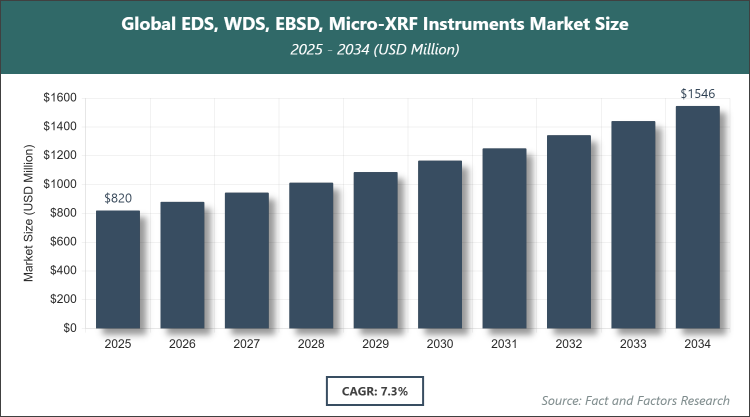
[237 + Pages Report] According to Facts & Factors, the global EDS, WDS, EBSD, Micro-XRF Instruments market size was estimated at USD 0.82 billion in 2025 and is expected to reach USD 1.55 billion by the end of 2034. The EDS, WDS, EBSD, Micro-XRF Instruments industry is anticipated to grow by a CAGR of 7.3% between 2026 and 2034. The EDS, WDS, EBSD, Micro-XRF Instruments Market is driven by rising demand for precise elemental and microstructural analysis in semiconductors, advanced materials, and nanotechnology research.
 Market Overview
The EDS, WDS, EBSD, Micro-XRF Instruments market encompasses specialized analytical tools used for high-resolution elemental composition, chemical mapping, crystallographic orientation, and trace element detection at microscopic scales. Energy Dispersive Spectroscopy (EDS) provides rapid qualitative and quantitative elemental analysis, Wavelength Dispersive Spectroscopy (WDS) offers superior spectral resolution for light elements and trace detection, Electron Backscatter Diffraction (EBSD) maps crystal structures and grain orientations, while Micro-XRF delivers non-destructive elemental mapping with excellent sensitivity for bulk and thin-film samples. These instruments are typically integrated with scanning electron microscopes (SEM) or operate as standalone systems, serving critical roles in quality control, failure analysis, and research across multiple high-tech industries where understanding material composition and structure at the micro and nano level is essential for innovation and reliability.
Key Insights
- As per the analysis shared by our research analyst, the EDS, WDS, EBSD, Micro-XRF Instruments market is estimated to grow annually at a CAGR of around 7.3% over the forecast period (2026-2034).
- In terms of revenue, the EDS, WDS, EBSD, Micro-XRF Instruments market size was valued at around USD 0.82 billion in 2025 and is projected to reach USD 1.55 billion by 2034.
- The EDS, WDS, EBSD, Micro-XRF Instruments Market is driven by expanding semiconductor manufacturing and advanced materials research.
- Based on the Type, the EDS segment dominated the market in 2025 with a share of 52% due to its cost-effectiveness, fast acquisition speed, and seamless integration with SEM systems across diverse applications.
- Based on the Application, the Semiconductor Analysis segment dominated the market in 2025 with a share of 39%, owing to stringent requirements for elemental purity and defect analysis in chip fabrication.
- Based on the End-User, the Industrial Laboratories segment dominated the market in 2025 with a share of 47% because of the continuous need for quality control and failure analysis in manufacturing environments.
- North America dominated the global EDS, WDS, EBSD, Micro-XRF Instruments market in 2025 with a share of 36%, attributed to the strong presence of semiconductor giants, robust R&D funding, and advanced microscopy infrastructure.
Growth Drivers
- Expansion of Semiconductor and Nanotechnology Sectors
The rapid growth of semiconductor fabrication, 5G/6G technologies, and nanoscale device development requires ultra-precise elemental and structural characterization, significantly boosting the adoption of these instruments for process optimization and yield improvement.
Government investments in domestic chip manufacturing and materials innovation programs further accelerate procurement of high-end EDS, EBSD, and Micro-XRF systems by both industry and research facilities.
Restraints
- High Capital Investment and Maintenance Costs
Advanced detectors and integrated systems command premium pricing, limiting accessibility for smaller laboratories and academic institutions in cost-sensitive regions.
Requirement for skilled operators and periodic calibration adds to total ownership costs, slowing replacement cycles in budget-constrained environments.
Opportunities
- Integration with AI and Automated Workflows
Artificial intelligence-powered data analysis and automated mapping features are transforming instrument usability, enabling faster insights and reducing operator dependency, which appeals to high-throughput industrial users.
Emerging applications in battery materials, additive manufacturing, and biomedical implants create new demand streams for combined EDS-EBSD-Micro-XRF platforms.
Challenges
- Technical Complexity and Skilled Workforce Shortage
Interpreting combined datasets from multiple techniques demands specialized expertise that remains scarce globally, leading to underutilization of advanced capabilities.
Evolving sample preparation requirements for new materials and stringent regulatory standards for accuracy further complicate adoption and increase operational hurdles.
Report Scope
Report Attribute |
Details |
Market Size 2025 |
USD 0.82 Billion |
Projected Market Size in 2034 |
USD 1.55 Billion |
CAGR Growth Rate |
7.3% CAGR |
Base Year |
2025 |
Forecast Years |
2026-2034 |
Key Market Players |
Bruker Corporation, Thermo Fisher Scientific Inc., Oxford Instruments plc, EDAX LLC (AMETEK), JEOL Ltd., Hitachi High-Tech Corporation, Gatan Inc., Rigaku Corporation, Ametek Inc., HORIBA Ltd., and Others. |
Key Segment |
By Type, By Application, By End-User, and By Region |
Major Regions Covered |
North America, Europe, Asia Pacific, Latin America, and the Middle East & Africa |
Purchase Options |
Request customized purchase options to meet your research needs. Explore purchase options |
Market Segmentation
The EDS, WDS, EBSD, Micro-XRF Instruments market is segmented by type, application, end-user, and region.
Based on Type Segment, the EDS, WDS, EBSD, Micro-XRF Instruments market is divided into EDS, WDS, EBSD, micro-XRF, and others. The most dominant segment is EDS, driven by its versatility and widespread attachment to SEM platforms. The second most dominant is EBSD, fueled by growing emphasis on crystallographic analysis. EDS dominates due to its rapid data acquisition, broad elemental coverage, and lower entry cost, helping drive market growth by serving as the primary analytical tool in routine quality control and research workflows across industries.
Based on Application Segment, the EDS, WDS, EBSD, Micro-XRF Instruments market is divided into semiconductor analysis, material science & metallurgy, geology & mining, life sciences, environmental analysis, and others. The most dominant segment is Semiconductor Analysis, owing to the critical need for contamination and composition control. The second most dominant is Material Science & Metallurgy. Semiconductor Analysis leads because of escalating complexity in chip design and the necessity for sub-micron elemental mapping, propelling market expansion through sustained demand from foundries and device manufacturers.
Based on End-User Segment, the EDS, WDS, EBSD, Micro-XRF Instruments market is divided into academic & research institutes, industrial laboratories, government & defense labs, and others. The most dominant segment is Industrial Laboratories, supported by continuous production monitoring requirements. The second most dominant is Academic & Research Institutes. Industrial Laboratories dominate due to their focus on process optimization, failure analysis, and regulatory compliance, driving market growth by generating recurring revenue through upgrades and service contracts.
Recent Developments
- In August 2025, Gatan (AMETEK) launched the EDAX Orbis II Micro-XRF system, delivering improved sensitivity and mapping speed for non-destructive elemental analysis.
- In October 2024, Gatan introduced the EDAX Elite T Ultra EDS system for (S)TEM, offering enhanced detection efficiency across a wider range of elements.
- In March 2025, Bruker Corporation unveiled the eWARP wide-area pixelated EBSD detector, setting new benchmarks for speed and signal efficiency in materials characterization.
- In April 2025, Oxford Instruments NanoAnalysis released the Ultim Max Infinity EDS detector series with breakthrough count rates and resolution improvements.
- In February 2025, Thermo Fisher Scientific expanded its Apreo ChemiSEM portfolio with integrated EDS-EBSD capabilities for advanced semiconductor and battery research workflows.
Regional Analysis
- North America to dominate the global market
North America leads the EDS, WDS, EBSD, Micro-XRF Instruments market through its concentration of leading semiconductor manufacturers, national laboratories, and world-class universities, driving continuous innovation. The region maintains technological superiority with early adoption of hybrid and AI-enhanced systems. The United States dominates within North America, supported by CHIPS Act funding, extensive private R&D investment, and a dense ecosystem of microscopy centers that accelerate development and deployment of next-generation analytical tools for both commercial and defense applications.
Europe maintains strong momentum in the EDS, WDS, EBSD, Micro-XRF Instruments market, backed by collaborative research networks and stringent quality standards in the automotive and aerospace sectors. Focus on sustainable materials and circular economy initiatives further stimulates demand. Germany leads the region, leveraging its advanced manufacturing base and institutions like Fraunhofer and Max Planck to pioneer high-resolution applications, ensuring steady integration of these instruments into industrial and academic workflows.
Asia-Pacific exhibits the fastest growth in the EDS, WDS, EBSD, Micro-XRF Instruments market, propelled by massive semiconductor foundry expansions and rising investments in domestic technology self-reliance. Government-backed innovation hubs accelerate localization efforts. China dominates, with its vast electronics manufacturing ecosystem and strategic push toward high-end instrumentation, rapidly scaling adoption of EDS and EBSD systems in new fabrication facilities and materials research centers.
Latin America is gradually expanding its presence in the EDS, WDS, EBSD, Micro-XRF Instruments market, supported by mining industries and emerging academic collaborations. Brazil leads, utilizing these tools for mineral exploration and metallurgical process optimization while building research capacity through international partnerships.
The Middle East & Africa region shows selective uptake in the EDS, WDS, EBSD, Micro-XRF Instruments market, driven by oil & gas, mining, and new technology diversification programs. The United Arab Emirates leads through smart-city and advanced manufacturing initiatives that incorporate high-precision analytical capabilities in research infrastructure.
Competitive Analysis
The global EDS, WDS, EBSD, Micro-XRF Instruments market is dominated by players:
- Bruker Corporation
- Thermo Fisher Scientific Inc.
- Oxford Instruments plc
- EDAX LLC (AMETEK)
- JEOL Ltd.
- Hitachi High-Tech Corporation
- Gatan, Inc.
- Rigaku Corporation
- Ametek Inc.
- HORIBA Ltd.
The global EDS, WDS, EBSD, Micro-XRF Instruments market is segmented as follows:
By Type
- EDS
- WDS
- EBSD
- Micro-XRF
By Application
- Semiconductor Analysis
- Material Science & Metallurgy
- Geology & Mining
- Life Sciences
- Environmental Analysis
- Others
By End-User
- Academic & Research Institutes
- Industrial Laboratories
- Government & Defense Labs
- Others
By Region
- North America
- The U.S.
- Canada
- Mexico
- Europe
- France
- The UK
- Spain
- Germany
- Italy
- Rest of Europe
- Asia Pacific
- China
- Japan
- India
- Australia
- Southeast Asia
- Rest of Asia Pacific
- The Middle East & Africa
- Saudi Arabia
- UAE
- Egypt
- Kuwait
- South Africa
- Rest of the Middle East & Africa
- Latin America
- Brazil
- Argentina
- Rest of Latin America
Industry Major Market Players
- Bruker Corporation
- Thermo Fisher Scientific Inc.
- Oxford Instruments plc
- EDAX LLC (AMETEK)
- JEOL Ltd.
- Hitachi High-Tech Corporation
- Gatan, Inc.
- Rigaku Corporation
- Ametek Inc.
- HORIBA Ltd.
Frequently Asked Questions
Which region will contribute notably towards the EDS, WDS, EBSD, Micro-XRF Instruments market value?



Copyright © 2025 - 2026, All Rights Reserved, Facts and Factors