
Search Market Research Report
DIN Rail Terminal Blocks Market Size, Share Global Analysis Report, 2026-2034

DIN Rail Terminal Blocks Market Size, Share, Growth Analysis Report By Type (Push-In Terminal Blocks, Screw Terminal Blocks, Spring-Cage Terminal Blocks, Insulation Displacement Terminal Blocks, and Others), By Application (Power Distribution, Industrial Control Systems, Building Automation, Transportation, and Others), and By Region - Global Industry Insights, Overview, Comprehensive Analysis, Trends, Statistical Research, Market Intelligence, Historical Data and Forecast 2026-2034
Industry Insights
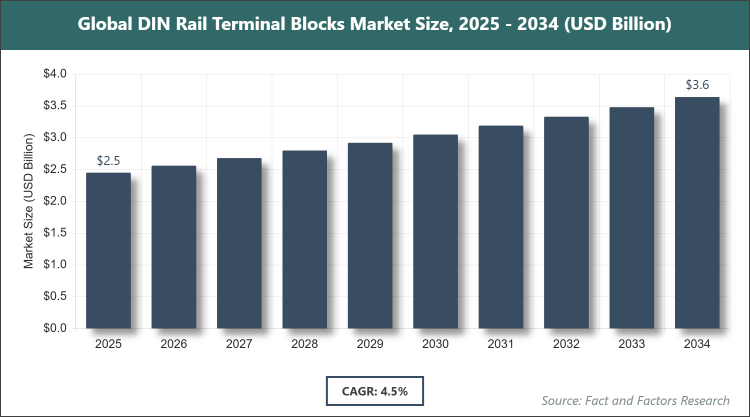
According to Facts & Factors, the global DIN Rail Terminal Blocks market size was estimated at USD 2.45 billion in 2025 and is expected to reach USD 3.65 billion by the end of 2034. The DIN Rail Terminal Blocks industry is anticipated to grow by a CAGR of 4.5% between 2026 and 2034. The DIN Rail Terminal Blocks Market is driven by the rapid expansion of industrial automation, renewable energy projects, and infrastructure modernization worldwide.
 Market Overview
DIN Rail Terminal Blocks are modular electrical connectors mounted on standardized DIN rails, designed to securely terminate and connect wires in control panels, switchgear, and automation systems. They provide organized wiring solutions that enhance safety, reliability, and ease of maintenance in various electrical installations. These components are critical in ensuring efficient power distribution and signal transmission in industrial environments, commercial buildings, and transportation infrastructure. The market encompasses a variety of designs tailored to different voltage levels, current capacities, and connection technologies, catering to the evolving needs of modern electrical systems.
Key Insights
- As per the analysis shared by our research analyst, the DIN Rail Terminal Blocks market is projected to grow at a CAGR of 4.5% during the forecast period 2026-2034.
- In terms of revenue, the market was valued at USD 2.45 billion in 2025 and is anticipated to reach USD 3.65 billion by 2034.
- The market is driven by surging demand for automation in manufacturing sectors and increasing investments in renewable energy infrastructure.
- Based on the type segment, Push-in terminal blocks dominate with approximately 40% share owing to their tool-free installation, faster assembly times, and superior vibration resistance in demanding industrial environments.
- Based on the application segment, Power distribution dominates with about 35% share as they are essential for safe and efficient electricity management in industrial setups.
- Based on the end-user segment, Manufacturing sector dominates with 45% share due to high adoption in factory automation and control panels.
- Based on the region, Asia Pacific holds the largest share of around 42% due to rapid industrialization in China and India combined with government initiatives for smart manufacturing.
Market Dynamics
- Growth Drivers Industrial Automation Expansion
The growth of Industry 4.0 initiatives worldwide has accelerated the adoption of DIN Rail Terminal Blocks in automated manufacturing facilities where reliable, modular wiring is essential for PLCs, sensors, and actuators. These blocks enable quick reconfiguration and maintenance, reducing downtime in high-volume production lines. In parallel, the integration of IoT devices and smart sensors in factories requires compact, high-density connection solutions that DIN Rail systems provide efficiently, supporting real-time data transmission and control while maintaining electrical safety standards.
- Renewable Energy Integration
Expansion of solar and wind power installations demands robust terminal blocks for inverters, combiner boxes, and grid connection points where high current and environmental resistance are critical. Governments' push toward net-zero emissions further boosts infrastructure projects incorporating advanced terminal solutions. This driver is amplified by electrification trends in transportation and buildings, creating sustained demand for reliable connectivity components that withstand harsh outdoor conditions and variable loads.
- Restraints Raw Material Price Volatility
Fluctuations in copper, plastic resins, and alloy prices directly impact manufacturing costs of terminal blocks, squeezing margins for suppliers amid global supply chain uncertainties. Prolonged volatility can delay project timelines as buyers seek cost-effective alternatives. Additionally, dependency on specialized suppliers for high-performance materials limits scalability during periods of geopolitical tension or resource shortages.
- Intense Competition and Standardization Issues
The presence of numerous regional and global players leads to price wars, particularly in cost-sensitive emerging markets, challenging profitability. Inconsistent regional standards for electrical safety can complicate international trade and product certification processes.
- Opportunities Smart and Intelligent Terminal Blocks
Development of terminal blocks with integrated diagnostics, LED indicators, and wireless connectivity opens new avenues in predictive maintenance and smart grids, appealing to industries seeking digital transformation. Rising adoption in electric vehicle charging infrastructure and data centers provides high-growth niches where advanced features like high-voltage handling and thermal management add significant value.
- Emerging Markets Infrastructure Boom
Rapid urbanization and industrialization in Asia, Latin America, and Africa create substantial demand for electrical infrastructure upgrades, favoring modular DIN Rail solutions for their ease of installation and scalability. Policy incentives for renewable energy and smart cities further accelerate opportunities for localized manufacturing and customized offerings.
- Challenges Supply Chain Disruptions
Global reliance on Asian manufacturing hubs for components exposes the market to logistics delays, tariffs, and raw material shortages triggered by trade tensions or natural disasters. This challenge necessitates greater inventory buffers and diversified sourcing, increasing operational costs for manufacturers.
- Regulatory Compliance and Environmental Standards
Evolving RoHS, REACH, and IEC safety regulations require continuous product redesign and testing, raising compliance expenses and time-to-market for new variants. Stricter environmental norms around material recyclability and hazardous substances add pressure on innovation while balancing cost and performance.
Report Scope
Report Attribute |
Details |
Market Size 2025 |
USD 2.45 Billion |
Projected Market Size in 2034 |
USD 3.65 Billion |
CAGR Growth Rate |
4.5% CAGR |
Base Year |
2025 |
Forecast Years |
2026-2034 |
Key Market Players |
Phoenix Contact, WAGO, Weidmuller, ABB, TE Connectivity, and Others. |
Key Segment |
By Type (Push-In, Screw, Spring-Cage, Insulation Displacement), By Application (Power Distribution, Industrial Control Systems, Building Automation, Transportation), By End-User (Manufacturing, Energy & Power, Transportation, Commercial), and By Region |
Major Regions Covered |
North America, Europe, Asia Pacific, Latin America, and the Middle East & Africa |
Purchase Options |
Request customized purchase options to meet your research needs. Explore purchase options |
Market Segmentation
The DIN Rail Terminal Blocks market is segmented by type, application, end-user, and region.
Based on Type Segment, the DIN Rail Terminal Blocks market is divided into push-in terminal blocks, screw terminal blocks, spring-cage terminal blocks, insulation displacement terminal blocks, and others. The most dominant segment is push-in terminal blocks because they offer tool-free, vibration-resistant connections that significantly reduce installation time and labor costs while maintaining secure contact under harsh conditions, driving their adoption in high-volume automation projects. The second most dominant is screw terminal blocks, which provide proven high-current capacity and mechanical strength, making them ideal for heavy-duty power applications where reliability and adjustability are prioritized over speed of assembly, thus helping sustain demand in traditional industrial setups.
Based on Application Segment, the DIN Rail Terminal Blocks market is divided into power distribution, industrial control systems, building automation, transportation, and others. The most dominant segment is power distribution because these blocks ensure safe, organized high-current connections critical for substations, distribution panels, and renewable integration points, supporting grid stability and efficiency. The second most dominant is industrial control systems, which benefit from modular wiring for PLCs and sensors, enabling flexible reconfiguration that accelerates factory upgrades and minimizes operational downtime.
Based on End-User Segment, the DIN Rail Terminal Blocks market is divided into manufacturing, energy & power, transportation, commercial, and others. The most dominant segment is manufacturing because extensive use in automated assembly lines, robotic systems, and control cabinets drives volume demand for reliable, space-saving connectivity solutions. The second most dominant is energy & power, where terminal blocks support renewable installations, substations, and grid modernization projects requiring high-reliability components under varying loads and environmental stresses.
Based on Region Segment, the DIN Rail Terminal Blocks market is divided into North America, Europe, Asia Pacific, Latin America, and the Middle East & Africa. The most dominant region is Asia Pacific driven by massive manufacturing output and infrastructure investments. The second most dominant is Europe, supported by strong automation and renewable energy policies.
Recent Developments
- WAGO launched its XCOM series featuring advanced push-in CAGE CLAMP technology in early 2024, enhancing installation speed and reliability for industrial control applications across global markets.
- Phoenix Contact introduced the CLIPLINE Complete 4.0 system in late 2023 with hybrid blocks incorporating diagnostic LEDs, achieving widespread deployment in smart grid substations throughout North America by 2024.
- Amphenol expanded its pluggable terminal block portfolio in March 2024 with EN 50155-certified solutions tailored for rail signaling systems, addressing growing demand in transportation electrification projects.
Regional Analysis
- Asia Pacific to dominate the global market
Asia Pacific leads the DIN Rail Terminal Blocks market due to its status as the global manufacturing powerhouse, particularly in electronics, automotive, and heavy industries where automation is rapidly scaling. China dominates the region thanks to its vast industrial base, extensive government support for smart factories and renewable energy, and presence of major OEMs requiring high-volume terminal solutions. India follows closely with accelerating infrastructure projects, Make in India initiatives, and growth in power transmission networks. The region's cost-competitive manufacturing ecosystem, combined with rising foreign investments in automation technologies, sustains strong demand for modular DIN Rail components. Southeast Asian nations contribute through expanding electronics assembly and data center developments.
Europe maintains a significant position driven by stringent safety regulations, leadership in renewable energy deployment, and advanced industrial automation. Germany dominates as the engineering hub with major players like Phoenix Contact and Weidmüller headquartered there, fueling innovation in high-performance terminal blocks for automotive, machinery, and energy sectors. The UK, France, and Italy support growth through infrastructure upgrades and building automation projects aligned with EU green deal objectives.
North America shows steady expansion supported by reshoring of manufacturing, investments in electric vehicle infrastructure, and modernization of power grids. The United States dominates the region with robust demand from industrial automation, data centers, and renewable projects across states like California and Texas. Canada contributes through energy and mining sectors.
Latin America exhibits emerging potential fueled by mining operations, renewable energy adoption, and urban infrastructure growth. Brazil dominates due to its large industrial base and investments in hydropower and wind projects requiring reliable electrical connectivity. Mexico benefits from nearshoring trends in automotive and electronics manufacturing.
The Middle East & Africa region grows through oil & gas, infrastructure, and renewable diversification efforts. The UAE and Saudi Arabia dominate with mega-projects in smart cities, solar farms, and industrial zones demanding high-quality terminal blocks for harsh environments. South Africa contributes via mining and power distribution upgrades.
Competitive Analysis
The global DIN Rail Terminal Blocks market is dominated by players:
- Phoenix Contact
- WAGO
- Weidmüller
- ABB
- TE Connectivity
- Omron
- Amphenol
- Wieland Electric
The global DIN Rail Terminal Blocks market is segmented as follows:
By Type
- Push-In Terminal Blocks
- Screw Terminal Blocks
- Spring-Cage Terminal Blocks
- Insulation Displacement Terminal Blocks
- Others
By Application
- Power Distribution
- Industrial Control Systems
- Building Automation
- Transportation
- Others
By End-User
- Manufacturing
- Energy & Power
- Transportation
- Commercial
- Others
By Regional Segment Analysis
- North America
- The U.S.
- Canada
- Mexico
- Europe
- France
- The UK
- Spain
- Germany
- Italy
- Rest of Europe
- Asia Pacific
- China
- Japan
- India
- Australia
- Southeast Asia
- Rest of Asia Pacific
- The Middle East & Africa
- Saudi Arabia
- UAE
- Egypt
- Kuwait
- South Africa
- Rest of the Middle East & Africa
- Latin America
- Brazil
- Argentina
- Rest of Latin America
Industry Major Market Players
The global DIN Rail Terminal Blocks market is dominated by players:
- Phoenix Contact
- WAGO
- Weidmüller
- ABB
- TE Connectivity
- Omron
- Amphenol
- Wieland Electric
Frequently Asked Questions



Copyright © 2025 - 2026, All Rights Reserved, Facts and Factors