
Search Market Research Report
Digital ATC Towers Market Size, Share Global Analysis Report, 2026 - 2034

Digital ATC Towers Market Size, Share, Growth Analysis Report By Operation Type (Single Remote Tower, Multiple Remote Tower and Contingency Remote Tower), By System (Hardware (Radars, Remote Tower Module, Cameras and Others) and Network Solutions and Software), By Application (Communication, Information and Control, Flight Data Handling, Surveillance and Visualization), And By Region - Global Industry Insights, Overview, Comprehensive Analysis, Trends, Statistical Research, Market Intelligence, Historical Data and Forecast 2026 - 2034
Industry Insights
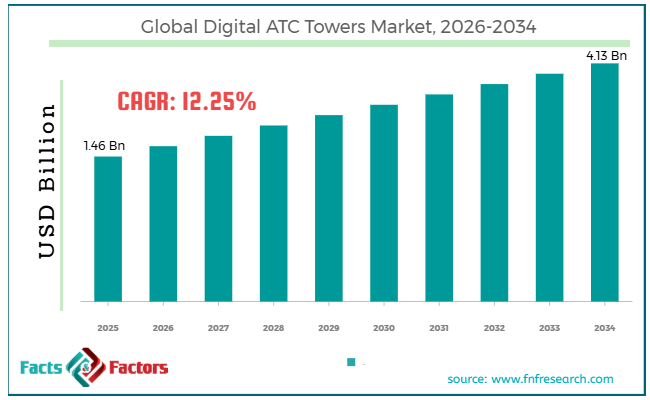
[227+ Pages Report] According to Facts & Factors, the global digital ATC towers market size was worth around USD 1.46 billion in 2025 and is predicted to grow to around USD 4.13 billion by 2034 with a compound annual growth rate (CAGR) of roughly 12.25% between 2026 and 2034.
 Market Overview
An airport's advanced technological system for remotely managing and monitoring air traffic is called a digital air traffic control (ATC) tower. Digital ATC towers employ high-resolution cameras, sensors, and other digital technology to offer a virtual depiction of the airport and its environs, in place of traditional physical control towers with controllers stationed on-site. Air traffic control has advanced significantly with digital ATC towers, which provide superior safety, effectiveness, and adaptability over conventional control tower arrangements.
Key Insights
- As per the analysis shared by our research analyst, the global digital ATC towers market is estimated to grow annually at a CAGR of around 12.25% over the forecast period (2026-2034).
- In terms of revenue, the global digital ATC towers market size was valued at around USD 1.46 billion in 2025 and is projected to reach USD 4.13 billion, by 2034.
- The technological advancement is expected to drive market growth over the forecast period.
- Based on the operation type, the multiple remote tower segment is expected to dominate the market during the forecast period.
- Based on the system, the network solutions and software segment is expected to capture the largest market share over the forecast period.
- Based on the application, the communication segment is expected to hold a prominent market share during the forecast period.
- Based on region, North America is expected to dominate the market during the forecast period.
Growth Drivers
- Increased air traffic drives the market growth
The increasing demand for air travel around the globe leads to an increase in aviation traffic at airports across the globe. Conventional ATC towers might find it difficult to effectively manage the increasing number of planes. The growth of digital ATC towers is fueled by their scalability and flexibility in handling increased traffic levels. According to the International Air Transport Association (IATA), in December of 2025, air travel resumed, and in total, traffic in 2025 approached pre-pandemic levels once again. Total traffic increased by 36.9% in 2025 compared to 2022, as measured by revenue passenger kilometers, or RPKs. 2025 traffic was 94.1 percent of what was seen before the 2019 epidemic.
December 2025 saw a 25.3% rise in overall traffic over December 2022, with 97.5% of the data from December 2019 being captured. Fourth-quarter traffic was 98.2% of 2019; this was a strong rebound toward the end of the year. Thus, the aforementioned stats drive the market growth over the anticipated timeframe.
Restraints
- Cost and integration challenges hinder market growth
Deploying digital ATC towers can come with a significant upfront cost, which covers infrastructure setup, technology procurement, and training. It could be difficult for many airports, particularly the smaller or less financially stable ones, to defend the expense of switching from analog to digital towers.
Furthermore, it can be difficult to integrate digital ATC tower systems with the current air traffic management infrastructure, which includes flight data processing systems, communication networks, and radar systems. Delays in implementation and higher costs may result from compatibility problems, data synchronization difficulties, and interoperability issues. Thus, the high cost and integration challenges limit the market growth over the projected period.
Opportunities
- Increasing collaboration offers a lucrative opportunity for market growth
Increasing collaboration is expected to offer an attractive opportunity for the digital ATC tower market over the projected timeframe. For instance, in March 2025, a Memorandum of Understanding (MoU) bringing seamless integration between tower and apron operations with industry leading digital solutions was announced by ADB SAFEGATE and Fraport AG. The decision to form the strategic collaboration was made by the parties because they shared the goal of advancing automation, digitization, and sustainability at Frankfurt Airport (FRA), the biggest aviation hub in Germany. To support the high availability of the safety-critical ADB SAFEGATE systems at FRA, the MoU will establish a common framework for managed services.
Furthermore, the relationship guarantees ongoing cooperation on the development of a long-term product roadmap to enhance and fortify synergies within the tower and apron solutions of ADB SAFEGATE.
Challenges
- Cybersecurity risk poses a major challenge to market expansion
Due to their heavy reliance on networked technology and data transmission systems, digital ATC towers are susceptible to malware assaults, hacking, and data breaches, among other cybersecurity risks. Strong cybersecurity safeguards are necessary to safeguard sensitive air traffic data and vital control systems, but they can be difficult and expensive to implement.
Report Scope
Report Attribute |
Details |
Market Size in 2025 |
USD 1.46 Billion |
Projected Market Size in 2034 |
USD 4.13 Billion |
CAGR Growth Rate |
12.25% CAGR |
Base Year |
2025 |
Forecast Years |
2026-2034 |
Key Market Players |
Frequentis, Avinor AS, Kongsberg, Indra Sistemas S.A., L3Harris Technologies, Leonardo S.p.A., NATS Limited, Northrop Grumman Corporation, Lockheed Martin Corporation, Raytheon Technologies Corporation, Saab AB, Rohde & Schwarz, SkySoft-ATM, Searidge Technologies, Thales Group, and others. |
Key Segment |
By Operation Type, By System, By Application, and Region |
Major Regions Covered |
North America, Europe, Asia Pacific, Latin America, and the Middle East &, Africa |
Purchase Options |
Request customized purchase options to meet your research needs. Explore purchase options |
Segmentation Analysis
The global digital ATC towers industry is segmented based on operation type, system, application and region.
Based on the operation type, the global digital ATC towers market is bifurcated into single remote tower, multiple remote tower and contingency remote tower. The multiple remote tower segment is expected to dominate the market during the forecast period. Air navigation service providers (ANSPs) may effectively handle air traffic at various airports from centralized control centers because of the scalability and flexibility offered by digital ATC towers with multiple remote tower capabilities. By optimizing resource allocation, lowering staffing needs, and improving overall operational efficiency, this centralized approach generates cost savings and revenue growth. Thus, driving the segment growth.
Based on the system, the global digital ATC towers industry is segmented into hardware (radars, remote tower module, cameras and others) and network solutions and software. The network solutions and software segment is expected to capture the largest market share over the forecast period. Software, which includes everything from control algorithms and data processing software to user interfaces and operational management systems, is essential to the operation and performance of digital ATC towers.
By providing cutting-edge software solutions customized to meet the specific requirements of digital ATC tower operators, software development companies with a focus on aviation and ATC solutions can profit from the expanding industry. To improve operational efficiency, safety, and dependability, this entails creating cutting-edge data analytics tools, predictive maintenance software, and integration platforms.
Based on the application, the global Digital ATC Towers market is segmented into communication, information and control, flight data handling, surveillance and visualization. The communication segment is expected to hold a prominent market share during the forecast period. To interact with next-generation technologies like 5G, satellite communication, and internet protocol (IP) networks, communication methods for digital ATC towers are constantly changing.
With the increased bandwidth, decreased latency, and increased dependability of these technologies, real-time audio, video, and data stream transmission—all crucial for ATC operations—is now possible. Communication solution providers who adopt these developments might seize new business opportunities by providing cutting-edge goods and services that make use of the potential of emerging communication technology.
Regional Analysis
- North America is expected to dominate the market during the forecast period
North America is expected to dominate the market over the forecast period. There are a number of the busiest airports in the world in North America, and air travel there is still increasing steadily. It might be difficult for conventional ATC towers to effectively handle growing volumes of aviation traffic. Airports throughout the region are drawn to digital ATC towers because they provide improved capabilities, scalability, and flexibility to meet the demands of increasing air traffic.
For instance, as per the data published by IATA, the yearly traffic increase for North American carriers increased by 28.3% in 2025 over 2022. There was a 22.4% increase in capacity and a 3.9 percentage point increase in load factor to 84.6%. In comparison with December 2022, traffic increased by 13.5%. Furthermore, regulatory support is expected to florish the market growth in the region.
Competitive Analysis
The global digital ATC towers market is dominated by players like:
- Frequentis
- Avinor AS
- Kongsberg
- Indra Sistemas S.A.
- L3Harris Technologies
- Leonardo S.p.A.
- NATS Limited
- Northrop Grumman Corporation
- Lockheed Martin Corporation
- Raytheon Technologies Corporation
- Saab AB
- Rohde & Schwarz
- SkySoft-ATM
- Searidge Technologies
- Thales Group
The global digital ATC towers market is segmented as follows:
By Operation Type
- Single Remote Tower
- Multiple Remote Tower
- Contingency Remote Tower
By System
- Hardware
- Radars
- Remote Tower Module
- Cameras
- Others
- Network Solutions and Software
By Application
- Communication
- Information and Control
- Flight Data Handling
- Surveillance
- Visualization
By Region
- North America
- The U.S.
- Canada
- Mexico
- Europe
- France
- The UK
- Spain
- Germany
- Italy
- Rest of Europe
- Asia Pacific
- China
- Japan
- India
- Australia
- Southeast Asia
- Rest of Asia Pacific
- The Middle East & Africa
- Saudi Arabia
- UAE
- Egypt
- Kuwait
- South Africa
- Rest of the Middle East & Africa
- Latin America
- Brazil
- Argentina
- Rest of Latin America
Industry Major Market Players
- Frequentis
- Avinor AS
- Kongsberg
- Indra Sistemas S.A.
- L3Harris Technologies
- Leonardo S.p.A.
- NATS Limited
- Northrop Grumman Corporation
- Lockheed Martin Corporation
- Raytheon Technologies Corporation
- Saab AB
- Rohde & Schwarz
- SkySoft-ATM
- Searidge Technologies
- Thales Group
Frequently Asked Questions



Copyright © 2025 - 2026, All Rights Reserved, Facts and Factors