
Search Market Research Report
Crown Moulding Market Size, Share Global Analysis Report, 2026-2034

Crown Moulding Market Size, Share, Growth Analysis Report By Type (Polyurethane, Urethane, MDF, Wood, Polystyrene, PVC, Plaster, Aluminum, and Others), By Application (Ceiling, Door, Window, Wall, Fireplace, Cabinet, General Purpose, and Others), By End User (Residential, Commercial, Industrial, and Others), and By Region - Global Industry Insights, Overview, Comprehensive Analysis, Trends, Statistical Research, Market Intelligence, Historical Data and Forecast 2026-2034
Industry Insights
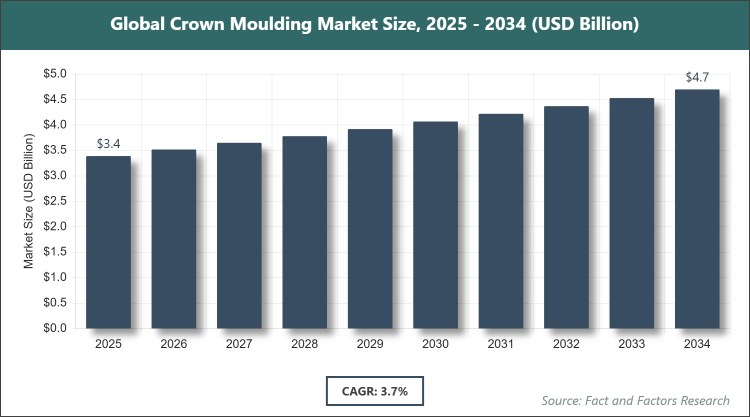
[220+ Pages Report] According to Facts & Factors, the global Crown Moulding market size was estimated at USD 3.39 billion in 2025 and is expected to reach USD 4.81 billion by the end of 2034. The Crown Moulding industry is anticipated to grow by a CAGR of 3.7% between 2026 and 2034. The Crown Moulding Market is driven by increasing demand for interior aesthetics and home renovations.
 Market Overview
Crown moulding refers to a decorative trim element typically installed at the junction where walls meet ceilings in interior spaces. It serves as an architectural feature that enhances the visual appeal of rooms by providing a smooth transition between surfaces, concealing imperfections, and adding elegance to both residential and commercial environments. Available in various materials and designs, crown moulding can range from simple profiles to intricate patterns, allowing for customization to match different interior styles, from traditional to modern. This market encompasses the production, distribution, and installation of these mouldings, catering to the growing emphasis on interior design and architectural detailing in construction and renovation projects.
Key Insights
- As per the analysis shared by our research analyst, the global Crown Moulding market is estimated to grow annually at a CAGR of around 3.7% over the forecast period (2026-2034).
- In terms of revenue, the global Crown Moulding market size was valued at around USD 3.39 Billion in 2025 and is projected to reach USD 4.81 Billion, by 2034.
- The market is driven by increasing residential and commercial construction activities.
- Based on the type, the Polyurethane segment dominated the market in 2025, with a market share of 35% & why it is dominated due to its lightweight nature, durability, moisture resistance, and ease of installation compared to traditional materials.
- Based on the application, the Ceiling segment dominated the market in 2025, with a market share of 40% & why it is dominated as it enhances room aesthetics by providing a seamless transition between walls and ceilings, making it a staple in interior design.
- Based on the end user, the Residential segment dominated the market in 2025, with a market share of 55% & why it is dominated owing to rising home renovation trends and consumer preference for personalized living spaces.
- The Asia Pacific region dominated the market in 2025, with a market share of 38% & why it is dominated due to rapid urbanization, expanding construction sector, and increasing disposable incomes driving demand for decorative interiors.
Growth Drivers
- Increasing Demand for Interior Aesthetics and Home Décor
The surge in consumer interest for enhancing living and working spaces has significantly propelled the crown moulding market. With a growing focus on personalized interiors, homeowners and businesses are investing in decorative elements to elevate architectural appeal. This trend is particularly evident in urban areas where modern lifestyles emphasize stylish and functional designs, leading to higher adoption of crown mouldings in new builds and renovations.
Furthermore, the rise of social media and home improvement shows has influenced consumers to undertake DIY projects, boosting demand for easy-to-install materials like polyurethane and MDF. This driver is expected to sustain market growth as aesthetic preferences continue to evolve with changing design trends.
- Expansion of Construction and Renovation Activities
Rapid urbanization and infrastructure development worldwide are key catalysts for the crown moulding market. Emerging economies are witnessing a boom in residential and commercial projects, necessitating decorative trims to meet building standards and enhance property values. Government initiatives for affordable housing and smart cities further amplify this demand, creating opportunities for manufacturers to supply bulk materials.
In addition, the post-pandemic recovery has spurred renovation spending, with property owners upgrading interiors to adapt to remote work and leisure needs. This factor not only drives volume sales but also encourages innovation in sustainable and cost-effective moulding solutions.
Restraints
- High Costs of Premium Materials and Installation
The expense associated with high-quality materials such as hardwood or plaster poses a barrier for budget-conscious consumers, limiting market penetration in price-sensitive segments. Professional installation adds to the overall cost, deterring DIY enthusiasts and small-scale projects, which could otherwise expand the customer base.
Moreover, economic fluctuations can reduce discretionary spending on non-essential home improvements, impacting sales during downturns. This restraint highlights the need for affordable alternatives to broaden accessibility and mitigate pricing pressures.
- Environmental Regulations on Synthetic Materials
Stringent regulations on materials like PVC and certain synthetics due to environmental concerns restrict product options and increase compliance costs for manufacturers. This can lead to supply chain disruptions and higher prices, affecting market competitiveness in eco-conscious regions.
Additionally, consumer shifts toward sustainable products challenge traditional offerings, forcing companies to invest in R&D for greener alternatives, which may slow short-term growth.
Opportunities
- Rising Preference for Customizable and Modular Décor
The demand for personalized interior solutions opens avenues for innovative crown moulding designs, including modular and 3D-printed options. This allows manufacturers to cater to niche markets like luxury homes and themed commercial spaces, fostering brand differentiation.
Advancements in technology enable quicker production and customization, reducing lead times and appealing to fast-paced construction projects. This opportunity can drive premium segment growth and expand market reach through online configurators.
- Growth in Smart Homes and Luxury Housing
Integration of crown mouldings with smart lighting and home automation systems presents new applications, enhancing functionality alongside aesthetics. The luxury real estate boom in developing regions offers high-margin opportunities for ornate and durable products.
Furthermore, partnerships with architects and interior designers can promote specialized offerings, tapping into high-end projects and boosting market visibility.
Challenges
- Fluctuating Raw Material Prices
Volatility in prices of wood, polymers, and other inputs affects production costs and profit margins, making it difficult for manufacturers to maintain stable pricing. This can lead to supply shortages and delayed deliveries, eroding customer trust.
Global supply chain issues, exacerbated by geopolitical tensions, compound this challenge, requiring robust sourcing strategies to ensure continuity.
- Competition from Alternative Decorative Solutions
The availability of substitutes like wallpapers, LED strips, and wall panels competes directly with crown mouldings, offering easier and cheaper installation options. This shifts consumer preferences, particularly in modern minimalist designs where traditional trims may seem outdated.
Innovation in alternatives could further erode market share, necessitating continuous product evolution to highlight unique benefits like durability and timeless appeal.
Report Scope
Report Attribute |
Details |
Market Size 2025 |
USD 3.39 Billion |
Projected Market Size in 2034 |
USD 4.81 Billion |
CAGR Growth Rate |
3.7% CAGR |
Base Year |
2025 |
Forecast Years |
2026-2034 |
Key Market Players |
RowlCrown, Metrie, Canamould, American Pro Décor, RapidFit, Ekena Millwork, Alexandria, Focal Point, House of Fara, Woodgrain Millwork, NMC, Ornamental Moulding, and Others. |
Key Segment |
By Type, By Application, By End User, and By Region |
Major Regions Covered |
North America, Europe, Asia Pacific, Latin America, and the Middle East & Africa |
Purchase Options |
Request customized purchase options to meet your research needs. Explore purchase options |
Market Segmentation
The Crown Moulding market is segmented by type, application, end-user, and region.
Based on Type Segment, the Crown Moulding market is divided into Polyurethane, Urethane, MDF, Wood, Polystyrene, PVC, Plaster, Aluminum, and others. The most dominant segment is Polyurethane, which leads due to its versatility, resistance to moisture and pests, and affordability, making it ideal for various climates and applications; the second most dominant is MDF, valued for its smooth finish and paintability, driving market growth through widespread use in cost-effective renovations and its ability to mimic more expensive materials while offering stability and ease of cutting.
Based on Application Segment, the Crown Moulding market is divided into Ceiling, Door, Window, Wall, Fireplace, Cabinet, General Purpose, and others. The most dominant segment is Ceiling, prevalent because it effectively conceals wiring and imperfections while adding height illusion to rooms, boosting overall interior value; the second most dominant is Door, which enhances entryways and frames, contributing to market expansion by integrating with architectural styles and providing a polished look that appeals to both residential and commercial users.
Based on End-User Segment, the Crown Moulding market is divided into Residential, Commercial, Industrial, and others. The most dominant segment is Residential, driven by home improvement trends and personalization needs, where it elevates living spaces affordably; the second most dominant is Commercial, growing rapidly in hospitality and retail for creating inviting atmospheres, thus propelling the market through large-scale installations and durability requirements.
Recent Developments
- In 2024, Metrie announced the launch of a new line of sustainable MDF crown mouldings made from recycled wood fibers, aiming to cater to eco-conscious consumers and expand its presence in the green building sector. This development aligns with global sustainability trends and is expected to boost the company's market share by offering environmentally friendly options without compromising on quality or aesthetics.
- In 2025, Ekena Millwork acquired RapidFit, a smaller firm specializing in polyurethane mouldings, to enhance its product portfolio and strengthen supply chain capabilities. This merger allows for greater innovation in lightweight and customizable designs, targeting the growing demand in residential renovations and commercial projects across North America.
- In early 2026, Woodgrain Millwork introduced advanced 3D-printed crown moulding prototypes at an industry trade show, focusing on intricate patterns for luxury applications. This innovation reduces production time and costs, positioning the company as a leader in technological advancements within the market.
Regional Analysis
- Asia Pacific to dominate the global market
The Asia Pacific region stands out due to its rapid urbanization and booming construction industry, with China emerging as the dominating country through massive infrastructure projects and a surging middle-class population seeking modern interiors. This area's economic growth fosters extensive residential and commercial developments, where crown mouldings are increasingly adopted for aesthetic enhancements in high-rise buildings and urban homes. Cultural shifts toward Western-style designs further accelerate demand, supported by local manufacturing hubs that ensure affordable supply chains. The region's focus on affordable housing initiatives also integrates decorative elements like crown mouldings to improve property appeal and value. Overall, Asia Pacific's dynamic market environment positions it as a key growth engine for the industry.
North America maintains a strong position, led by the United States as the dominating country, where a mature real estate market and high renovation rates drive consistent demand for crown mouldings in suburban and urban settings. The emphasis on home improvement, influenced by media and e-commerce, encourages widespread adoption in DIY and professional projects. Technological integrations, such as smart home compatibility, add to its appeal in modern constructions. Economic stability and a preference for durable materials like polyurethane support sustained growth. This region's established distribution networks ensure accessibility, making it a reliable contributor to global market trends.
Europe exhibits steady progress, with Germany as the dominating country, renowned for its precision engineering and architectural heritage that incorporates crown mouldings in both historical restorations and contemporary builds. Stringent building standards promote the use of sustainable materials, aligning with the region's environmental policies. Growing tourism and hospitality sectors demand elegant interiors, boosting commercial applications. Innovation in design and manufacturing keeps the market competitive. Europe's cultural appreciation for ornate details ensures ongoing relevance in residential and public spaces.
Latin America shows emerging potential, dominated by Brazil, where expanding urban centers and improving economic conditions spur construction activities incorporating crown mouldings for enhanced living standards. Government housing programs emphasize affordable yet stylish interiors, driving residential demand. The region's tropical climate favors moisture-resistant materials like PVC. Increasing foreign investments in real estate further stimulate growth. Despite economic variability, the focus on modernization positions Latin America for gradual market expansion.
The Middle East & Africa region is gaining traction, with GCC countries like Saudi Arabia dominating through ambitious mega-projects and luxury developments that feature elaborate crown mouldings in palaces, hotels, and malls. Oil wealth funds high-end constructions, prioritizing aesthetic grandeur. Urbanization in Africa adds to residential needs, though challenges like infrastructure gaps exist. Sustainable building practices are emerging, influenced by global trends. This area's strategic location facilitates trade, supporting future growth in the market.
Competitive Analysis
The global Crown Moulding market is dominated by players:
- RowlCrown
- Metrie
- Canamould
- American Pro Décor
- RapidFit
- Ekena Millwork
- Alexandria
- Focal Point
- House of Fara
- Woodgrain Millwork
- NMC
- Ornamental Moulding
- Others
The global Crown Moulding market is segmented as follows:
By Type
- Polyurethane
- Urethane
- MDF
- Wood
- Polystyrene
- PVC
- Plaster
- Aluminum
- Others
By Application
- Ceiling
- Door
- Window
- Wall
- Fireplace
- Cabinet
- General Purpose
- Others
By End User
- Residential
- Commercial
- Industrial
- Others
By Region
- North America
- The U.S.
- Canada
- Mexico
- Europe
- France
- The UK
- Spain
- Germany
- Italy
- Rest of Europe
- Asia Pacific
- China
- Japan
- India
- Australia
- Southeast Asia
- Rest of Asia Pacific
- The Middle East & Africa
- Saudi Arabia
- UAE
- Egypt
- Kuwait
- South Africa
- Rest of the Middle East & Africa
- Latin America
- Brazil
- Argentina
- Rest of Latin America
Industry Major Market Players
The global Crown Moulding market is dominated by players:
- RowlCrown
- Metrie
- Canamould
- American Pro Décor
- RapidFit
- Ekena Millwork
- Alexandria
- Focal Point
- House of Fara
- Woodgrain Millwork
- NMC
- Ornamental Moulding
- Others
Frequently Asked Questions



Copyright © 2025 - 2026, All Rights Reserved, Facts and Factors