
Search Market Research Report
Coffee Shops Market Size, Share Global Analysis Report, 2026-2034

Coffee Shops Market Size, Share, Growth Analysis Report By Type (Franchise, Independent, Specialty Coffee Shops, and Others), By Offering (Beverages, Food Items, and Others), By Service (Dine-in, Takeaway/Delivery, and Others), and By Region - Global Industry Insights, Overview, Comprehensive Analysis, Trends, Statistical Research, Market Intelligence, Historical Data and Forecast 2026-2034
Industry Insights
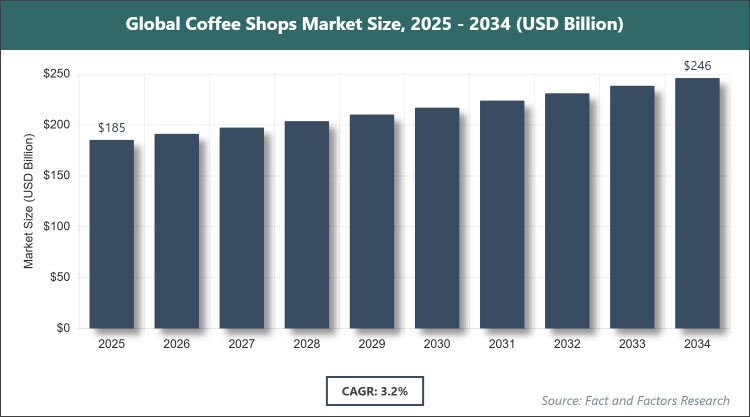
[240+ Pages Report] According to Facts & Factors, the global Coffee Shops market size was estimated at USD 185.4 billion in 2025 and is expected to reach USD 246.1 billion by the end of 2034. The Coffee Shops industry is anticipated to grow by a CAGR of 3.2% between 2026 and 2034. The Coffee Shops Market is driven by rising consumer preference for specialty and premium coffee experiences.
 Market Overview
The coffee shops market refers to the sector encompassing establishments that primarily serve coffee beverages, along with complementary food items and services, functioning as social venues for relaxation, work, and community gatherings while emphasizing ambiance, quality brews, and customer experience. These outlets range from independent cafes offering artisanal blends to franchised chains providing standardized menus, catering to diverse consumer preferences for convenience, sustainability, and innovation in beverage preparation. The market integrates elements of hospitality, retail, and food service, focusing on trends like ethical sourcing, customizable options, and digital integration to enhance accessibility and loyalty in a competitive landscape driven by evolving lifestyles and the cultural significance of coffee consumption.
Key Insights
- As per the analysis shared by our research analyst, the global Coffee Shops market is estimated to grow annually at a CAGR of around 3.2% over the forecast period (2026-2034).
- In terms of revenue, the global Coffee Shops market size was valued at around USD 185.4 billion in 2025 and is projected to reach USD 246.1 billion by 2034.
- The coffee shop market is projected to witness significant growth due to increasing urbanization and demand for on-the-go premium beverages.
- Based on the Type, the Independent segment accounted for the largest market share of 53.2% due to its focus on unique, localized experiences appealing to consumers seeking authenticity.
- Based on the Offering, the Beverages segment dominated the market with the highest share, owing to the core role of coffee drinks in driving foot traffic and revenue.
- Based on the Service, the Dine-in segment held the leading position with a substantial share because of the social and experiential aspects valued by customers.
- Based on the region, the North America region captured around 35% market share, driven by high consumer spending and a mature cafe culture.
Growth Drivers
- Rising Urbanization and Lifestyle Changes
Rapid urbanization globally is creating a demand for convenient social spaces like coffee shops, where professionals and students seek environments for work, meetings, and relaxation amid busy schedules. The shift toward premium, specialty coffees reflects evolving consumer tastes for quality and variety, boosting menu innovations like cold brews and plant-based options. This trend is particularly strong in emerging markets, where rising disposable incomes enable frequent visits.
Furthermore, digital integration, such as mobile ordering and loyalty apps, enhances accessibility, driving repeat business. This driver fosters market expansion by aligning with modern lifestyles, encouraging franchise growth, and independent ventures in urban hubs.
Restraints
- High Operational Costs
Escalating rents in prime locations and fluctuating coffee bean prices due to climate impacts increase operational expenses, squeezing profit margins for smaller operators. Labor shortages in service industries add to challenges, requiring higher wages to attract staff. Economic uncertainties can reduce consumer spending on non-essentials.
Additionally, competition from home brewing systems and delivery services diverts potential customers. These factors hinder growth, particularly for independents, necessitating efficiency measures like automation to sustain viability.
Opportunities
- Sustainability and Ethical Sourcing
Consumer preference for eco-friendly practices offers opportunities for shops adopting sustainable sourcing, fair-trade beans, and recyclable packaging, differentiating brands in a crowded market. Certifications like Rainforest Alliance attract conscious buyers, enhancing loyalty. Expansion into plant-based and organic offerings taps into health trends.
Moreover, partnerships with local farmers strengthen supply chains and community ties. This opportunity drives premium pricing and market share gains through green initiatives.
Challenges
- Intense Competition
The proliferation of chains and independents leads to market saturation in urban areas, intensifying price wars and innovation pressures. Evolving consumer preferences require constant menu updates, straining resources. Regulatory changes on health and sustainability add compliance burdens.
Furthermore, economic downturns can shift spending to cheaper alternatives. These challenges demand strategic differentiation and agile operations to maintain relevance.
Report Scope
Report Attribute |
Details |
Market Size 2025 |
USD 185.4 Billion |
Projected Market Size in 2034 |
USD 246.1 Billion |
CAGR Growth Rate |
3.2% CAGR |
Base Year |
2025 |
Forecast Years |
2026-2034 |
Key Market Players |
Starbucks Corporation, Luckin Coffee Inc., Dunkin' Donuts, Pret A Manger, The Coffee Bean & Tea Leaf, Costa Coffee, Tim Hortons, Caffè Nero, Blue Bottle Coffee, Peet's Coffee, and Others. |
Key Segment |
By Type, By Offering, By Service, and By Region |
Major Regions Covered |
North America, Europe, Asia Pacific, Latin America, and the Middle East & Africa |
Purchase Options |
Request customized purchase options to meet your research needs. Explore purchase options |
Market Segmentation
The coffee shop market is segmented by type, offering, service, and region.
Based on Type Segment, the Coffee Shops market is divided into Franchise, Independent, Specialty Coffee Shops, and others. The most dominant segment is Independent, which holds the largest share due to its emphasis on unique atmospheres and local flavors that resonate with consumers seeking personalized experiences, driving the market by fostering community loyalty and innovation in niche offerings; the second most dominant is Franchise, known for consistent quality and brand recognition, contributing to market growth through scalable expansion and standardized services.
Based on the Offering Segment, the Coffee Shops market is divided into Beverages, Food Items, and others. The most dominant segment is Beverages, commanding the highest share because of the central role of coffee in attracting customers and generating repeat visits, which drives the market by enabling upselling and menu diversification; the second most dominant is Food Items, complementing drinks for full meals, propelling market expansion through increased average spend per visit.
Based on Service Segment, the Coffee Shops market is divided into Dine-in, Takeaway/Delivery, and others. The most dominant segment is Dine-in, holding the biggest share due to its provision of social and work spaces that encourage longer stays, driving the market by boosting ancillary sales; the second most dominant is Takeaway/Delivery, catering to convenience seekers, contributing to market growth amid digital ordering trends.
Recent Developments
- In 2025, Starbucks expanded its sustainable sourcing initiatives, partnering with farmers for ethical bean production amid rising demand for eco-friendly coffee.
- In early 2026, Luckin Coffee launched AI-driven personalization in apps, enhancing customer engagement in competitive Asian markets.
- In 2025, Dunkin' introduced plant-based menu options, tapping into health trends and broadening appeal.
Regional Analysis
- North America to dominate the global market
North America stands as the premier region in the coffee shop market, with the United States dominating through its vibrant cafe culture and high consumer spending on premium beverages that foster innovation in specialty offerings. The region's advanced digital infrastructure supports seamless ordering and loyalty programs, enhancing customer retention. Robust economic conditions enable chain expansions, while diverse demographics drive menu adaptations. The U.S. leads from its entrepreneurial ecosystem and trend-setting urban centers.
Europe maintains a rich heritage in coffee consumption, led by Italy as the dominant country via its iconic espresso bars, influencing global standards. EU sustainability regulations promote ethical sourcing, appealing to conscious consumers. Collaborative cafe concepts blend tradition with modernity, supporting tourism. Italy's dominance arises from cultural significance and the export of cafe models.
Asia Pacific emerges rapidly with urbanization fueling cafe booms, dominated by China through massive chain growth like Luckin, adapting to local tastes. Government support for consumer sectors boosts infrastructure. China's lead stems from population scale and digital payment integration.
Latin America grows with coffee heritage, led by Brazil via domestic consumption and export synergies. Urban expansions create social hubs. Brazil's position strengthens fromits bean production advantages.
The Middle East & Africa advances through modernization, with Saudi Arabia dominating via Vision 2030's cafe investments. Cultural shifts embrace Western styles. Saudi Arabia's lead comes from economic diversification.
Competitive Analysis
The global Coffee Shops market is dominated by players:
- Starbucks Corporation
- Luckin Coffee Inc.
- Dunkin' Donuts
- Pret A Manger
- The Coffee Bean & Tea Leaf
- Costa Coffee
- Tim Hortons
- Caffè Nero
- Blue Bottle Coffee
- Peet's Coffee
The global Coffee Shops market is segmented as follows:
By Type
- Franchise
- Independent
- Specialty Coffee Shops
- Others
By Offering
- Beverages
- Food Items
- Others
By Service
- Dine-in
- Takeaway/Delivery
- Others
By Region
- North America
- The U.S.
- Canada
- Mexico
- Europe
- France
- The UK
- Spain
- Germany
- Italy
- Rest of Europe
- Asia Pacific
- China
- Japan
- India
- Australia
- Southeast Asia
- Rest of Asia Pacific
- The Middle East & Africa
- Saudi Arabia
- UAE
- Egypt
- Kuwait
- South Africa
- Rest of the Middle East & Africa
- Latin America
- Brazil
- Argentina
- Rest of Latin America
Industry Major Market Players
- Starbucks Corporation
- Luckin Coffee Inc.
- Dunkin' Donuts
- Pret A Manger
- The Coffee Bean & Tea Leaf
- Costa Coffee
- Tim Hortons
- Caffè Nero
- Blue Bottle Coffee
- Peet's Coffee
Frequently Asked Questions



Copyright © 2025 - 2026, All Rights Reserved, Facts and Factors