
Search Market Research Report
Bovine Ephemeral Fever Vaccines Market Size, Share Global Analysis Report, 2026-2034

Bovine Ephemeral Fever Vaccines Market Size, Share, Growth Analysis Report By Type (Live Vaccines, Killed Vaccines, and Others), By Application (Cattle, Water Buffaloes, and Others), By End User (Animal Hospitals, Pharmaceutical Industries, Medical Device Companies, and Others), and By Region - Global Industry Insights, Overview, Comprehensive Analysis, Trends, Statistical Research, Market Intelligence, Historical Data and Forecast 2026-2034
Industry Insights
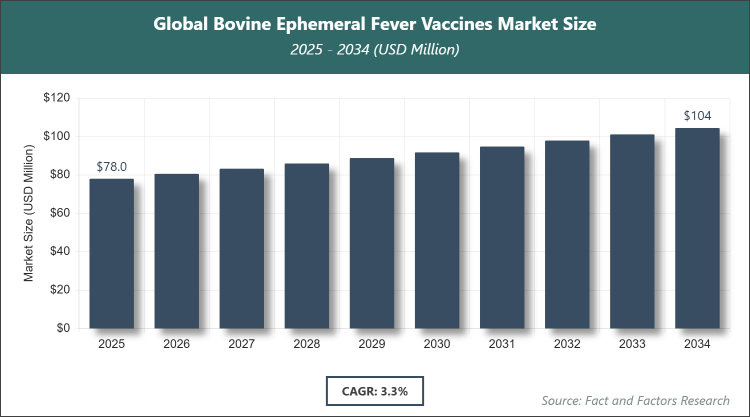
[220 Pages Report] According to Facts & Factors, the global bovine ephemeral fever vaccines market size was estimated at USD 78 million in 2025 and is expected to reach USD 105 million by the end of 2034. The Bovine Ephemeral Fever Vaccines industry is anticipated to grow by a CAGR of 3.3% between 2026 and 2034. The Bovine Ephemeral Fever Vaccines Market is driven by the increasing prevalence of the disease in tropical and subtropical regions.
 Market Overview
The bovine ephemeral fever vaccines market encompasses the development, production, and distribution of vaccines aimed at preventing bovine ephemeral fever, a viral disease affecting cattle and water buffaloes, transmitted by insect vectors such as mosquitoes and midges, leading to symptoms like fever, lameness, and reduced productivity, with a focus on immunization strategies to safeguard livestock health in endemic areas through various formulations that stimulate immune responses without causing the disease itself. This market involves key stakeholders, including veterinary pharmaceutical companies, animal health organizations, and farmers, emphasizing preventive healthcare to mitigate economic losses in the dairy and beef industries while addressing regional variations in disease incidence and vaccination practices.
Key Insights
- As per the analysis shared by our research analyst, the Bovine Ephemeral Fever Vaccines market is expected to grow at a CAGR of 3.3% during the forecast period of 2026-2034.
- In terms of revenue, the Bovine Ephemeral Fever Vaccines market size was valued at about USD 78 million in 2025 and is expected to reach USD 105 million by 2034.
- The Bovine Ephemeral Fever Vaccines market is driven by the increasing prevalence of the disease in tropical and subtropical regions and growing awareness among farmers.
- Based on the type, the live vaccines segment dominated the market with a share of 55% in 2025 due to its ability to provide long-lasting immunity and high efficacy in preventing outbreaks.
- Based on the application, the cattle segment dominated the market with a share of 70% in 2025, owing to the higher population of cattle globally and the greater economic impact of the disease on dairy and beef production.
- Based on the end user, the animal hospitals segment dominated the market with a share of 45% in 2025 as they serve as primary points for vaccination campaigns and treatment in affected regions.
- Asia Pacific dominated the market with a share of 40% in 2025 due to high disease incidence in subtropical climates and large livestock populations in countries like China and India.
Growth Drivers
- Increasing Prevalence of Bovine Ephemeral Fever
The rising incidence of bovine ephemeral fever in tropical and subtropical regions, driven by climate conditions favorable to insect vectors, is a primary growth driver, as it necessitates widespread vaccination to prevent economic losses in milk production and animal health, prompting governments and farmers to invest in preventive measures. This trend is further supported by expanding livestock farming in emerging economies where the disease is endemic, leading to increased demand for effective vaccines.
Additionally, global trade in cattle heightens the risk of disease spread, encouraging proactive immunization programs that boost market growth through collaborations between veterinary organizations and pharmaceutical companies to develop and distribute vaccines efficiently.
- Advancements in Vaccine Technology
Innovations in vaccine formulations, such as improved live attenuated and inactivated options with better stability and safety profiles, are accelerating market expansion by enhancing efficacy and reducing side effects, making them more appealing to farmers and veterinarians. These advancements include thermostable vaccines that address cold chain challenges in remote areas, thereby broadening accessibility.
Moreover, ongoing research in recombinant and subunit vaccines offers opportunities for multivalent products that protect against multiple diseases, driving adoption in integrated animal health strategies and contributing to sustained market growth.
- Government Initiatives and Awareness Programs
Supportive policies, subsidies, and vaccination campaigns by governments in endemic regions are key drivers, as they promote herd immunity and reduce outbreak impacts, fostering market growth through increased procurement and distribution networks. This is complemented by educational efforts raising awareness among farmers about the benefits of vaccination.
Furthermore, international health organizations' involvement in disease control programs amplifies demand, leading to partnerships that enhance vaccine availability and affordability, ultimately supporting long-term market development.
Restraints
- Limited Infrastructure in Developing Regions
Inadequate cold chain facilities and distribution networks in rural areas of developing countries restrict vaccine access, hindering market penetration and leading to suboptimal vaccination coverage. This restraint is exacerbated by logistical challenges in transporting temperature-sensitive products.
Additionally, the high cost of establishing infrastructure poses barriers for small-scale farmers, resulting in reliance on alternative disease management methods and slowing overall market growth in high-prevalence areas.
- Lack of Awareness Among Farmers
Low awareness about the disease and vaccine benefits in certain regions limits adoption, as farmers may prioritize immediate costs over long-term prevention, impacting demand. This is particularly evident in subsistence farming communities with limited access to veterinary education.
Compounding this, misinformation or cultural practices can deter vaccination, necessitating targeted awareness campaigns to overcome resistance and unlock market potential.
Opportunities
- Emerging Markets in Asia and Africa
Untapped potential in rapidly growing livestock sectors of Asia and Africa presents opportunities, as increasing urbanization and meat demand drive the need for disease prevention, allowing vaccine manufacturers to expand through local partnerships. This includes tailoring products to regional needs.
Such expansion can be supported by investments in local production facilities, reducing costs and improving supply chains, thereby capturing new market shares in high-growth areas.
- R&D in Novel Vaccine Formulations
Investments in next-generation vaccines, like recombinant types with enhanced durability, offer opportunities to differentiate products and meet evolving regulatory standards, attracting funding and collaborations. This focuses on addressing current limitations in efficacy.
Leveraging biotechnology advancements can lead to innovative solutions, such as oral vaccines for easier administration, fostering market growth through improved user compliance and broader application.
Challenges
- Regulatory Hurdles
Stringent approval processes and varying regulations across countries delay product launches, posing challenges for global manufacturers in navigating compliance requirements. This includes adapting to local standards for safety and efficacy.
Ongoing changes in veterinary regulations add complexity, requiring continuous adaptation and potentially increasing development costs, which can impede timely market entry.
- Vector Control Difficulties
The reliance on insect vectors for disease transmission makes complete prevention challenging, as vaccines alone may not suffice without integrated pest management, affecting overall effectiveness perceptions. This necessitates complementary strategies.
Seasonal variations and climate changes influence outbreak patterns, complicating vaccination timing and requiring flexible approaches to maintain market relevance.
Report Scope
Report Attribute |
Details |
Market Size 2025 |
USD 78 Million |
Projected Market Size in 2034 |
USD 105 Million |
CAGR Growth Rate |
3.3% CAGR |
Base Year |
2025 |
Forecast Years |
2026-2034 |
Key Market Players |
Zoetis Inc., Kyoto Biken Laboratories, Inc., Indian Immunologicals Ltd., CAVAC, Onderstepoort Biological Products SOC Ltd., Green Cross Veterinary Products Co Ltd., Veterinary Serum & Vaccine Research Institute, and Others. |
Key Segment |
By Type, By Application, By End User, and By Region |
Major Regions Covered |
North America, Europe, Asia Pacific, Latin America, and the Middle East & Africa |
Purchase Options |
Request customized purchase options to meet your research needs. Explore purchase options |
Market Segmentation
The Bovine Ephemeral Fever Vaccines market is segmented by type, application, end-user, and region.
Based on Type Segment, the bovine ephemeral fever vaccines market is divided into live vaccines, killed vaccines, and others. The most dominant segment is live vaccines, leading due to their superior ability to induce strong and long-lasting immunity mimicking natural infection, which is crucial in endemic areas for herd protection and drives the market by reducing outbreak frequency and severity thus supporting livestock productivity; the second most dominant is killed vaccines, valued for their safety profile especially in immunocompromised animals, contributing to market growth by offering alternatives in regions with strict regulatory requirements and enhancing overall vaccination coverage.
Based on Application Segment, the bovine ephemeral fever vaccines market is divided into cattle, water buffaloes, and others. The most dominant segment is cattle, commanding the largest share because of the vast global cattle population and significant economic losses from reduced milk and meat production during outbreaks, propelling market expansion through targeted vaccination programs in dairy and beef industries; the second most dominant is water buffaloes, important in regions like Asia where they are key for agriculture, aiding market drive by addressing disease in mixed farming systems and preventing cross-species impacts.
Based on End User Segment, the bovine ephemeral fever vaccines market is divided into animal hospitals, pharmaceutical industries, medical device companies, and others. The most dominant segment is animal hospitals, dominating as they are central hubs for diagnosis, treatment, and vaccination drives, boosting the market through direct administration and education to farmers; the second most dominant is pharmaceutical industries, which support growth by focusing on R&D and large-scale production, ensuring supply chain efficiency and innovation in vaccine development.
Recent Developments
- In January 2024, Zoetis Inc. announced the expansion of its bovine vaccine portfolio with a new live attenuated vaccine for bovine ephemeral fever, aimed at improving immunity duration in high-risk regions.
- In March 2023, Kyoto Biken Laboratories, Inc. launched an inactivated bovine ephemeral fever vaccine variant with enhanced adjuvants for better efficacy in water buffaloes.
- In July 2022, Indian Immunologicals Ltd. introduced a cost-effective killed vaccine formulation targeted at smallholder farmers in Asia to increase accessibility.
- In November 2021, CAVAC collaborated with local governments in Southeast Asia for a vaccination campaign using their live vaccine, focusing on outbreak prevention.
Regional Analysis
- Asia Pacific to dominate the global market
Asia Pacific leads the bovine ephemeral fever vaccines market with China as the dominating country, where large cattle and water buffalo populations in subtropical climates facilitate frequent outbreaks, driving demand for vaccines through government-subsidized programs that emphasize preventive healthcare, supported by local manufacturing that ensures affordability and rapid distribution to rural farmers, while rising meat and dairy consumption further amplifies the need for herd protection to maintain economic stability in agriculture-dependent economies.
North America follows, with the United States dominating due to advanced veterinary infrastructure and research investments by major companies, enabling quick response to imported cases despite low endemicity, bolstered by stringent regulations that promote vaccine adoption in export-oriented livestock sectors, creating a stable market through collaborations between academia and industry for innovation in vaccine technologies.
Europe exhibits steady growth led by Germany, where focus on animal welfare and food safety standards encourages vaccination even in non-endemic areas, integrated with EU-wide disease surveillance systems that facilitate cross-border trade, while partnerships with global players enhance product availability and support market expansion through emphasis on sustainable farming practices.
Latin America is emerging, dominated by Brazil with its extensive cattle ranching industry vulnerable to vector-borne diseases, where increasing awareness and government initiatives for disease control drive vaccine uptake, aided by tropical conditions that mirror endemic patterns, promoting regional production to reduce import dependency and boost local economies.
The Middle East & Africa region is characterized by Africa as the key area, particularly South Africa, where sporadic outbreaks in livestock-dependent communities necessitate vaccines for livelihood protection, supported by international aid programs that improve access, while challenges in infrastructure are addressed through mobile units, fostering gradual market growth in high-prevalence zones.
Competitive Analysis
The global Bovine Ephemeral Fever Vaccines market is dominated by players:
- Zoetis Inc.
- Kyoto Biken Laboratories, Inc.
- Indian Immunologicals Ltd.
- CAVAC
- Onderstepoort Biological Products SOC Ltd.
- Green Cross Veterinary Products Co Ltd.
- Veterinary Serum & Vaccine Research Institute
The global Bovine Ephemeral Fever Vaccines market is segmented as follows:
By Type
- Live Vaccines
- Killed Vaccines
- Others
By Application
- Cattle
- Water Buffaloes
- Others
By End User
- Animal Hospitals
- Pharmaceutical Industries
- Medical Device Companies
- Others
By Region
- North America
- The U.S.
- Canada
- Mexico
- Europe
- France
- The UK
- Spain
- Germany
- Italy
- Rest of Europe
- Asia Pacific
- China
- Japan
- India
- Australia
- Southeast Asia
- Rest of Asia Pacific
- The Middle East & Africa
- Saudi Arabia
- UAE
- Egypt
- Kuwait
- South Africa
- Rest of the Middle East & Africa
- Latin America
- Brazil
- Argentina
- Rest of Latin America
Industry Major Market Players
The global Bovine Ephemeral Fever Vaccines market is dominated by players:
- Zoetis Inc.
- Kyoto Biken Laboratories, Inc.
- Indian Immunologicals Ltd.
- CAVAC
- Onderstepoort Biological Products SOC Ltd.
- Green Cross Veterinary Products Co Ltd.
- Veterinary Serum & Vaccine Research Institute
Frequently Asked Questions



Copyright © 2025 - 2026, All Rights Reserved, Facts and Factors