
Search Market Research Report
Audio Communication Monitoring Market Size, Share Global Analysis Report, 2026-2034

Audio Communication Monitoring Market Size, Share, Growth Analysis Report By Component (Solutions, Services), By Deployment Mode (Cloud-based, On-Premises), By End-User (BFSI, IT & Telecom, Healthcare, Retail & eCommerce, Government & Public Sector, and Others), and By Region - Global Industry Insights, Overview, Comprehensive Analysis, Trends, Statistical Research, Market Intelligence, Historical Data and Forecast 2026-2034
Industry Insights
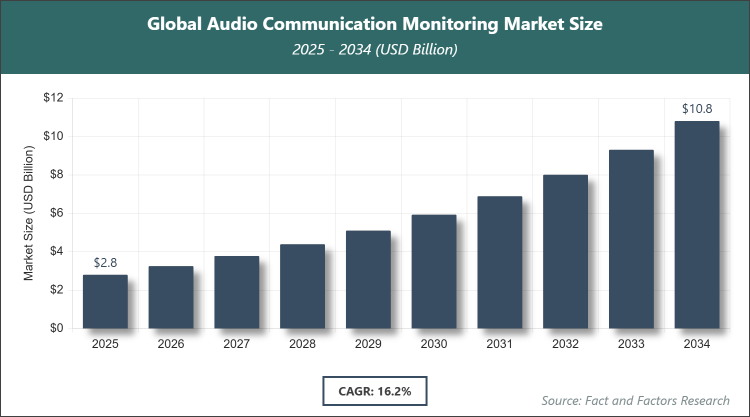
According to Facts & Factors, the global Audio Communication Monitoring market size was estimated at USD 2.8 billion in 2025 and is expected to reach USD 10.9 billion by the end of 2034. The Audio Communication Monitoring industry is anticipated to grow by a CAGR of 16.2% between 2026 and 2034. The Audio Communication Monitoring Market is driven by the growing need for regulatory compliance, real-time fraud detection, and advanced customer interaction analytics across enterprises.
 Market Overview
The Audio Communication Monitoring market encompasses hardware, software, and services used to capture, record, analyze, and manage audio interactions across various communication channels such as phone calls, VoIP, video conferencing, and unified communication systems. It helps organizations ensure compliance with regulatory standards, improve call quality, detect fraud, enhance customer experience, and mitigate security risks in real time. The market integrates advanced technologies including speech analytics, artificial intelligence (AI), natural language processing (NLP), and sentiment analysis to transform raw audio data into actionable business intelligence.
Key Insights
- As per the analysis shared by our research analyst, the global Audio Communication Monitoring Market is expected to grow at a CAGR of 16.2% during the forecast period 2026-2034.
- In terms of revenue, the market size was valued at USD 2.8 Billion in 2025 and is projected to reach USD 10.9 Billion by 2034.
- The market is primarily driven by increasing regulatory compliance requirements, rising incidences of tele-fraud & cybercrime, and rapid adoption of AI-powered voice analytics.
- Based on the Component segment, Solutions is the most dominant subsegment holding approximately 55% share owing to high demand for advanced analytics, call recording, and real-time monitoring tools.
- Based on the Deployment Mode segment, Cloud-based is the most dominant subsegment because of its scalability, lower upfront costs, remote accessibility, and seamless integration capabilities.
- Based on the End-User segment, BFSI is the most dominant subsegment holding 36% share as financial institutions face stringent regulations and high fraud risks.
- Based on the Region segment, North America is the most dominant region holding the highest share due to strong presence of key technology players, early technology adoption, and stringent data protection laws.
Growth Drivers
- Rising Regulatory Compliance and Fraud Detection Needs
The increasing number of strict government regulations such as GDPR, PCI-DSS, HIPAA, and MiFID II has compelled organizations across BFSI, healthcare, and telecom sectors to implement robust audio monitoring solutions. Furthermore, the surge in telemarketing fraud, voice phishing (vishing), and cybercrimes has pushed companies to adopt real-time audio surveillance and analytics for early threat detection.
- Rapid Adoption of Cloud-Based Communication Platforms
The massive shift toward cloud telephony, VoIP, and unified communications as a service (UCaaS) has accelerated the demand for scalable, flexible, and remotely accessible audio monitoring solutions. Cloud deployment reduces infrastructure costs and allows real-time analytics, driving strong market growth.
Restraints
- High Implementation and Integration Costs
Small and medium-sized enterprises often hesitate to adopt advanced audio monitoring systems due to significant initial investment, complex integration with legacy systems, and ongoing maintenance expenses.
- Data Privacy and Ethical Concerns
Continuous recording and analysis of conversations raise serious concerns regarding data privacy, employee consent, and ethical usage of voice data, which can restrain market expansion in certain regions.
Opportunities
- Emergence of AI, NLP, and Real-Time Analytics
Integration of artificial intelligence, machine learning, and natural language processing enables predictive analytics, sentiment scoring, and automated compliance checks, opening new growth avenues across industries.
- Growing Demand from SMEs and Emerging Markets
Affordable cloud-based solutions and increasing awareness about compliance and security are creating lucrative opportunities for audio communication monitoring providers in SMEs and high-growth regions.
Challenges
- Technical Complexity and Skill Gap
Deploying sophisticated audio monitoring systems requires advanced technical expertise, skilled professionals, and continuous system updates, posing a major challenge for many organizations.
- Integration with Multi-Channel Communication Platforms
Ensuring seamless monitoring across diverse channels (voice, video, chat, email) while maintaining data accuracy remains technically challenging.
Report Scope
Report Attribute |
Details |
Market Size 2025 |
USD 2.8 Billion |
Projected Market Size in 2034 |
USD 10.9 Billion |
CAGR Growth Rate |
16.2% CAGR |
Base Year |
2025 |
Forecast Years |
2026-2034 |
Key Market Players |
NICE Systems Ltd., Verint Systems, Cisco Systems, AudioCodes Ltd., Enghouse Interactive, Nuance Communications, Genesys, Avaya Inc., IBM, Behavox Ltd., and Others. |
Key Segment |
By Component, By Deployment Mode, By End-User, and By Region |
Major Regions Covered |
North America, Europe, Asia Pacific, Latin America, and the Middle East & Africa |
Purchase Options |
Request customized purchase options to meet your research needs. Explore purchase options |
Market Segmentation
The Audio Communication Monitoring market is segmented by Component, Deployment Mode, End-User, and region.
Based on Component Segment, the Audio Communication Monitoring market is divided into Solutions, Services, and others. Solutions dominate the market as organizations prefer comprehensive software platforms that offer call recording, quality analysis, speech analytics, and real-time monitoring. The Services segment is growing steadily due to increasing demand for professional consulting, managed services, and system integration support.
Based on Deployment Mode Segment, the Audio Communication Monitoring market is divided into Cloud-based, On-Premises, and others. Cloud-based deployment is the most dominant and fastest-growing segment because it provides high scalability, cost-efficiency, automatic updates, and easy remote access, making it highly suitable for modern hybrid work environments.
Based on End-User Segment, the Audio Communication Monitoring market is divided into BFSI, IT & Telecom, Healthcare, Retail & eCommerce, Government & Public Sector, and others. The BFSI sector is the most dominant and second-most dominant is IT & Telecom. The BFSI segment leads due to strict regulatory oversight, massive volume of customer calls, and high risk of financial fraud.
Recent Developments
- In May 2024, Daiwa Capital Markets Europe partnered with Intelligent Voice and Relativity to launch an advanced multilingual machine learning-based audio and digital communication monitoring system.
- Several leading players have introduced AI-powered real-time sentiment analysis and automated compliance scoring features in their platforms.
- NICE Systems significantly expanded its partnership ecosystem with major cloud providers for seamless UCaaS monitoring integration.
- AudioCodes launched next-generation voice analytics solutions with enhanced support for Microsoft Teams and Zoom environments.
- Behavox introduced advanced behavioral analytics modules specifically targeted at detecting insider threats through audio communication patterns.
Regional Analysis
- North America to dominate the global market
North America currently leads the global Audio Communication Monitoring market. The United States is the primary contributor due to the presence of major technology companies, early and widespread adoption of advanced analytics, strict regulatory environment, and high concentration of contact centers and financial institutions. Canada also contributes steadily through growing investments in public safety and compliance technologies.
Europe holds the second-largest share owing to stringent data protection laws such as GDPR and increasing focus on compliance in the banking and telecom sectors. Countries like the United Kingdom, Germany, and France are leading adopters.
The Asia Pacific region is expected to register the fastest growth rate during the forecast period. Rapid digital transformation, expanding BPO and contact center industry, rising regulatory focus in countries like India, China, Japan, and South Korea, and growing adoption of cloud communication platforms are fueling strong market expansion.
Latin America is showing promising growth supported by increasing digitalization, regulatory reforms, and growth in the banking and telecom sectors, particularly in Brazil and Mexico.
The Middle East & Africa region is gradually adopting audio monitoring solutions, primarily driven by government initiatives, smart city projects, and growth in the banking and oil & gas sectors in GCC countries.
Competitive Analysis
The global Audio Communication Monitoring market is dominated by players:
- NICE Systems Ltd.
- Verint Systems Inc.
- Cisco Systems, Inc.
- AudioCodes Ltd.
- Enghouse Interactive
- Nuance Communications, Inc.
- Genesys
- Avaya Inc.
- IBM Corporation
- Behavox Ltd.
- Intelligent Voice
- Nectar Services Corporation
- Fonetic Solutions
- Ameyo
- And Others.
The global Audio Communication Monitoring market is segmented as follows:
By Component
- Solutions
- Services
By Deployment Mode
- Cloud-based
- On-Premises
By End-User
- BFSI
- IT & Telecom
- Healthcare
- Retail & eCommerce
- Government & Public Sector
- Others
By Regional
- North America
- The U.S.
- Canada
- Mexico
- Europe
- France
- The UK
- Spain
- Germany
- Italy
- Rest of Europe
- Asia Pacific
- China
- Japan
- India
- Australia
- Southeast Asia
- Rest of Asia Pacific
- The Middle East & Africa
- Saudi Arabia
- UAE
- Egypt
- Kuwait
- South Africa
- Rest of the Middle East & Africa
- Latin America
- Brazil
- Argentina
- Rest of Latin America
Industry Major Market Players
Frequently Asked Questions



Copyright © 2025 - 2026, All Rights Reserved, Facts and Factors