
Search Market Research Report
Anti-Vibration Mounts Market Size, Share Global Analysis Report, 2026-2034

Anti-Vibration Mounts Market Size, Share, Growth Analysis Report By Type (Cylindrical Mounts, Bushing Mounts, Conical Mounts, and Others), By Application (General Industry, Marine Industry, Transportation Vehicles, and Others), By End-User (Industrial Manufacturing, Automotive & Transportation, Marine & Offshore, and Others), and By Region - Global Industry Insights, Overview, Comprehensive Analysis, Trends, Statistical Research, Market Intelligence, Historical Data and Forecast 2026-2034
Industry Insights
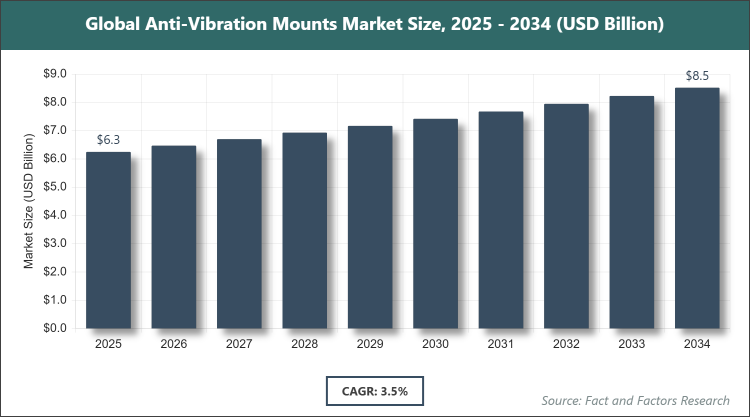
[250+ Pages Report] According to Facts & Factors, the global Anti-Vibration Mounts market size was estimated at USD 6.25 billion in 2025 and is expected to reach USD 8.5 billion by 2034, growing at a CAGR of 3.5% from 2026 to 2034. The Anti-Vibration Mounts Market is driven by rising industrialization and demand for vibration control in machinery and vehicles.
 Market Overview
The anti-vibration mounts market involves devices designed to isolate and dampen vibrations, shocks, and noise in mechanical systems, typically made from materials like rubber, metal, or composites to protect equipment, enhance performance, and improve user comfort in applications across industries such as manufacturing, automotive, and marine. These mounts function by absorbing energy from oscillating forces, preventing transmission to surrounding structures, and are essential for maintaining operational efficiency, reducing wear, and ensuring safety in dynamic environments without specifying quantitative aspects.
Key Insights
- The global Anti-Vibration Mounts market was valued at USD 6.25 billion in 2025 and is projected to reach USD 8.5 billion by 2034.
- The market is expected to grow at a CAGR of 3.5% during the forecast period from 2026 to 2034.
- The market is driven by expanding manufacturing sectors, advancements in automotive technologies, and increasing focus on noise reduction in industrial equipment.
- Based on the Type segment, Cylindrical Mounts subsegment dominated with 40% share due to their versatility, effective damping across frequencies, and widespread use in various machinery.
- Based on the Application segment, General Industry subsegment dominated with 50% share owing to broad applicability in manufacturing and processing equipment for vibration isolation.
- Based on the End-User segment, Industrial Manufacturing subsegment dominated with 45% share because of the need to protect heavy machinery and improve workplace safety.
- Asia Pacific dominated the global market with 35% share attributed to rapid industrialization, growing automotive production, and expanding manufacturing hubs in countries like China and India.
Growth Drivers
- Rising Industrialization and Machinery Demand
The surge in global manufacturing activities, particularly in emerging economies, has heightened the need for anti-vibration mounts to ensure equipment longevity and operational efficiency by mitigating vibrations that cause premature wear. This driver is supported by investments in automation and heavy machinery across sectors like construction and energy.
Furthermore, technological advancements in mount designs, such as hybrid materials combining rubber and metal for superior performance, are encouraging adoption in high-precision applications, contributing to market expansion through improved product reliability and customization options.
Restraints
- High Costs of Advanced Materials
The expense associated with premium materials like advanced polymers and composites used in high-performance mounts limits accessibility for small-scale industries, especially in cost-sensitive regions, hindering widespread adoption. This restraint is compounded by fluctuating raw material prices, affecting profit margins for manufacturers.
Additionally, the need for specialized installation and maintenance adds to overall costs, deterring budget-constrained end-users from upgrading to modern solutions, thus slowing market penetration in developing markets.
Opportunities
- Advancements in Electric Vehicles and Aerospace
The shift towards electric vehicles requires innovative vibration control to manage battery and motor oscillations, opening avenues for specialized mounts in the automotive sector. Similarly, aerospace demands lightweight, high-durability mounts for aircraft components, fostering growth through R&D in composite technologies.
Moreover, sustainability trends are prompting the development of eco-friendly, recyclable mounts, attracting environmentally conscious industries and enabling market entry into green initiatives via partnerships and certifications.
Challenges
- Stringent Regulatory Standards
Compliance with international safety and environmental regulations for vibration levels in workplaces and vehicles increases development and testing costs, posing challenges for smaller players. Variations in standards across regions complicate global supply chains.
In addition, rapid technological changes require continuous innovation, straining resources for manufacturers to keep pace while ensuring product certification, which can delay market entry and affect competitiveness.
Report Scope
Report Attribute |
Details |
Market Size 2025 |
USD 6.25 Billion |
Projected Market Size in 2034 |
USD 8.5 Billion |
CAGR Growth Rate |
3.5% CAGR |
Base Year |
2025 |
Forecast Years |
2026-2034 |
Key Market Players |
ContiTech, Hutchinson, Sumitomo Riko, Trelleborg AB, LORD Corporation, Vibracoustic, Eaton, Moog Inc., Barry Controls, Avon Rubber, Taylor Devices, Getzner Werkstoffe, Enidine, Aeroflex, Cooper Standard Automotive, and Others. |
Key Segment |
By Type, By Application, By End-User, and By Region |
Major Regions Covered |
North America, Europe, Asia Pacific, Latin America, and the Middle East & Africa |
Purchase Options |
Request customized purchase options to meet your research needs. Explore purchase options |
Market Segmentation
The Anti-Vibration Mounts market is segmented by type, application, end-user, and region.
Based on Type Segment, the Anti-Vibration Mounts market is divided into Cylindrical Mounts, Bushing Mounts, Conical Mounts, and others. The most dominant subsegment is Cylindrical Mounts, holding approximately 40% market share, primarily due to their simple design, cost-effectiveness, and ability to handle radial and axial loads effectively in diverse industrial settings; this dominance drives the market by providing reliable solutions for standard machinery, facilitating broader adoption, and supporting efficiency improvements. The second most dominant is Bushing Mounts, with around 30% share, favored for their compact size and superior isolation in automotive suspensions; it propels market growth by addressing specific needs in transportation, enhancing vehicle comfort and durability.
Based on Application Segment, the Anti-Vibration Mounts market is divided into General Industry, Marine Industry, Transportation Vehicles, and others. General Industry dominates with about 50% share, driven by extensive use in pumps, compressors, and generators to reduce noise and extend equipment life; it contributes to market expansion by catering to the core manufacturing sector, promoting productivity gains. Marine Industry follows as the second dominant with 25% share, essential for isolating vibrations in ship engines and offshore platforms; this helps drive the market through specialized applications that ensure safety and reliability in harsh environments.
Based on End-User Segment, the Anti-Vibration Mounts market is divided into Industrial Manufacturing, Automotive & Transportation, Marine & Offshore, and others. Industrial Manufacturing leads with roughly 45% share, attributed to the critical role in protecting heavy-duty equipment from vibrational damage; this segment boosts the overall market by demanding high-volume, robust mounts that optimize operations. Automotive & Transportation ranks second with 30% share, benefiting from mounts in vehicles for smoother rides and reduced wear; it drives growth by aligning with the expanding EV and logistics sectors.
Recent Developments
- In March 2025, Trelleborg AB introduced a new line of eco-friendly anti-vibration mounts made from recycled rubber composites, targeting the automotive sector to meet sustainability regulations and reporting a 15% increase in demand.
- In September 2025, Hutchinson partnered with a major electric vehicle manufacturer to develop customized bushing mounts for battery systems, enhancing vibration isolation and contributing to quieter EV performance.
- In January 2026, ContiTech announced the acquisition of a vibration control startup, integrating AI-driven design tools to optimize mount performance for industrial applications.
Regional Analysis
- Asia Pacific to dominate the global market
Asia Pacific commands over 35% market share, propelled by booming manufacturing and automotive industries, with China as the dominating country through its vast production bases and government incentives for industrial upgrades that reduce noise pollution and enhance equipment efficiency.
North America follows closely, driven by advanced aerospace and automotive sectors, where the United States dominates with innovations in high-tech mounts supported by R&D investments and strict OSHA regulations on workplace vibrations.
Europe maintains a strong position, focusing on sustainable and precision engineering, led by Germany as the dominating country with its automotive giants like BMW integrating advanced mounts for vehicle refinement and compliance with EU environmental standards.
Latin America grows moderately, emphasizing mining and construction, with Brazil dominating through infrastructure projects that utilize mounts for heavy machinery in remote areas, aided by economic recovery initiatives.
The Middle East & Africa region emerges gradually, prioritizing oil & gas applications, with the UAE leading in the Middle East via offshore platform developments, while South Africa dominates in Africa through mining equipment enhancements.
Competitive Analysis
The global Anti-Vibration Mounts market is dominated by players:
- ContiTech
- Hutchinson
- Sumitomo Riko
- Trelleborg AB
- LORD Corporation
- Vibracoustic
- Eaton
- Moog Inc.
- Barry Controls
- Avon Rubber
- Taylor Devices
- Getzner Werkstoffe
- Enidine
- Aeroflex
- Cooper Standard Automotive
The global Anti-Vibration Mounts market is segmented as follows:
By Type
- Cylindrical Mounts
- Bushing Mounts
- Conical Mounts
- Others
By Application
- General Industry
- Marine Industry
- Transportation Vehicles
- Others
By End-User
- Industrial Manufacturing
- Automotive & Transportation
- Marine & Offshore
- Others
By Region
- North America
- The U.S.
- Canada
- Mexico
- Europe
- France
- The UK
- Spain
- Germany
- Italy
- Rest of Europe
- Asia Pacific
- China
- Japan
- India
- Australia
- Southeast Asia
- Rest of Asia Pacific
- The Middle East & Africa
- Saudi Arabia
- UAE
- Egypt
- Kuwait
- South Africa
- Rest of the Middle East & Africa
- Latin America
- Brazil
- Argentina
- Rest of Latin America
Industry Major Market Players
Frequently Asked Questions



Copyright © 2025 - 2026, All Rights Reserved, Facts and Factors