
Search Market Research Report
Acrolein Market Size, Share Global Analysis Report, 2026-2034

Acrolein Market Size, Share, Growth Analysis Report By Process (Propylene Oxidation Method, Glycerol Dehydration Method, and Others), By Application (Methionine, Pesticides, Glutaraldehyde, Water Treatment Agent, and Others), By End-User (Agrochemical, Polymer, Pharmaceutical, Water Treatment, and Others), and By Region - Global Industry Insights, Overview, Comprehensive Analysis, Trends, Statistical Research, Market Intelligence, Historical Data and Forecast 2026-2034
Industry Insights
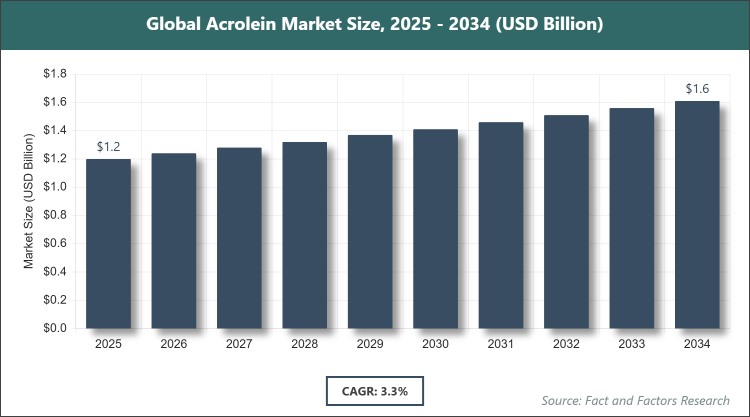
[228+ Pages Report] According to Facts & Factors, the global Acrolein market size was estimated at USD 1.2 billion in 2025 and is expected to reach USD 1.7 billion by the end of 2034. The Acrolein industry is anticipated to grow by a CAGR of 3.3% between 2026 and 2034. The Acrolein Market is driven by increasing demand in agrochemicals and water treatment applications.
 Market Overview
The acrolein market involves the production, distribution, and application of acrolein, a colorless, volatile liquid aldehyde known for its pungent odor and high reactivity, primarily used as a chemical intermediate in various industrial processes. Derived mainly from propylene or glycerol, acrolein serves as a building block for synthesizing compounds essential in agriculture, polymers, and water management, where its biocidal and cross-linking properties are leveraged. This market caters to sectors requiring precise chemical transformations, reflecting its role in enhancing product efficacy and environmental compliance through controlled usage and handling protocols.
Key Insights
- As per the analysis shared by our research analyst, the global Acrolein market is estimated to grow annually at a CAGR of around 3.3% over the forecast period (2026-2034).
- In terms of revenue, the global Acrolein market size was valued at around USD 1.2 billion in 2025 and is projected to reach USD 1.7 billion by 2034.
- The Acrolein market is projected to witness significant growth due to rising agrochemical demand and advancements in sustainable production methods.
- Based on the Process, the Propylene Oxidation Method segment accounted for the largest market share of 85% due to its established efficiency and cost-effectiveness in large-scale production.
- Based on the Application, the Methionine segment dominated the market with the highest share, owing to its critical role in animal feed additives amid growing livestock industries.
- Based on the End-User, the Agrochemical segment held the leading position with a substantial share because of acrolein's effectiveness in pesticide formulations for crop protection.
- Based on the region, the Asia Pacific region captured around 40% market share, driven by rapid industrialization and high chemical manufacturing activities in emerging economies.
Growth Drivers
- Rising Demand in Agrochemicals
The escalating need for effective pesticides and herbicides in agriculture to boost crop yields is propelling acrolein demand, as it acts as a key precursor in synthesizing potent agrochemicals. With global food production pressures intensifying due to population growth, acrolein's role in enhancing pest control solutions becomes indispensable, supporting sustainable farming practices. Innovations in formulation technologies further amplify its utility, enabling targeted applications that minimize environmental impact while maximizing efficacy.
Moreover, collaborations between chemical manufacturers and agricultural firms foster the development of advanced products, integrating acrolein derivatives for improved resistance management. This synergy not only expands market penetration in developing regions but also aligns with regulatory pushes for safer, more efficient agrochemicals, driving overall market expansion through enhanced productivity and resource optimization.
Restraints
- Fluctuations in Raw Material Prices
Volatility in propylene and glycerol prices, influenced by crude oil market dynamics and supply chain disruptions, poses a significant barrier to stable acrolein production costs. This uncertainty affects profit margins for manufacturers, potentially leading to reduced investments in capacity expansion and technological upgrades. Stringent environmental regulations on emissions during production further exacerbate these challenges, requiring additional compliance expenditures.
Additionally, dependency on fossil-based feedstocks exposes the market to geopolitical risks and energy price swings, deterring long-term planning. These factors collectively hinder market growth, particularly in price-sensitive regions, necessitating diversification strategies to mitigate impacts and ensure supply continuity.
Opportunities
- Advancements in Bio-Based Production
The shift toward sustainable manufacturing using bio-glycerol from biodiesel byproducts offers a green alternative, reducing reliance on petroleum-derived materials and appealing to eco-conscious consumers. This innovation lowers carbon footprints and opens new revenue streams through premium pricing for environmentally friendly products. Research investments in catalytic processes enhance yield efficiency, making bio-based acrolein competitive in cost and performance.
Furthermore, government incentives for renewable chemicals accelerate adoption, fostering partnerships across value chains. This opportunity not only addresses regulatory pressures but also positions the market for growth in emerging applications like biopolymers, enhancing resilience against traditional supply vulnerabilities.
Challenges
- Health and Safety Concerns
Acrolein's toxicity and irritant properties necessitate rigorous handling and storage protocols, increasing operational complexities and costs for end-users. Public awareness and regulatory scrutiny on exposure risks can limit market expansion in sensitive sectors, requiring continuous investment in safety technologies. Incidents of mishandling may lead to reputational damage, affecting stakeholder confidence.
In addition, evolving health standards demand ongoing product reformulations, straining resources for smaller players. These challenges underscore the need for industry-wide education and innovation in safer alternatives to sustain growth while prioritizing worker and environmental protection.
Report Scope
Report Attribute |
Details |
Market Size 2025 |
USD 1.2 Billion |
Projected Market Size in 2034 |
USD 1.7 Billion |
CAGR Growth Rate |
3.3% CAGR |
Base Year |
2025 |
Forecast Years |
2026-2034 |
Key Market Players |
Evonik, Adisseo, Arkema, Dow, Daicel, Hubei Shengling Technology, Wuhan Ruiji Chemical, Hubei Jinghong Chemical, Puyang Shenghuade Chemical, Wuhan Rison Trading, and Others. |
Key Segment |
By Process, By Application, By End-User, and By Region |
Major Regions Covered |
North America, Europe, Asia Pacific, Latin America, and the Middle East & Africa |
Purchase Options |
Request customized purchase options to meet your research needs. Explore purchase options |
Market Segmentation
The Acrolein market is segmented by process, application, end-user, and region.
Based on Process Segment, The Acrolein market is divided into Propylene Oxidation Method, Glycerol Dehydration Method, and others. The most dominant segment is Propylene Oxidation Method, which holds the largest share due to its mature technology, high yield efficiency, and integration with existing petrochemical infrastructures, driving the market by enabling cost-effective mass production for downstream applications; the second most dominant is Glycerol Dehydration Method, gaining prominence for its sustainable use of biodiesel byproducts, contributing to market growth through eco-friendly alternatives that align with global green chemistry initiatives.
Based on Application Segment, The Acrolein market is divided into Methionine, Pesticides, Glutaraldehyde, Water Treatment Agent, and others. The most dominant segment is Methionine, commanding the highest share because of its essential use in animal nutrition supplements amid expanding livestock farming, which drives the market by supporting food security and protein production demands; the second most dominant is Water Treatment Agent, utilized for its biocidal properties in industrial water systems, propelling market expansion through enhanced hygiene and compliance in manufacturing sectors.
Based on End-User Segment, The Acrolein market is divided into Agrochemical, Polymer, Pharmaceutical, Water Treatment, and others. The most dominant segment is Agrochemical, holding the biggest share due to acrolein's role in synthesizing effective pesticides and herbicides for agriculture, driving the market by improving crop yields and addressing global food challenges; the second most dominant is Water Treatment, where it serves as a key agent for microbial control, contributing to market growth via applications in industrial and municipal water purification.
Recent Developments
- In January 2023, Evonik, a leading chemical manufacturer in Germany, invested EURO 25 million (USD 26.92 million) for the development of methionine intermediates plant upgradation in Germany, enhancing production capacity for acrolein-derived products.
- In May 2021, PI Industries based in India, a manufacturer of pesticides, announced the expansion of its manufacturing facility in India to increase output of acrolein-based agrochemicals.
Regional Analysis
- Asia Pacific to dominate the global market
Asia Pacific emerges as the frontrunner in the acrolein market, propelled by robust chemical manufacturing and agricultural sectors in China, which dominates through its vast production capabilities and export-oriented industries. The region's emphasis on food security drives acrolein use in methionine for livestock feed, while rapid urbanization boosts water treatment applications. Technological advancements in glycerol-based processes align with sustainability goals, enhancing competitiveness. China's leadership stems from integrated supply chains and government support for chemical innovations, fostering a dynamic ecosystem for acrolein derivatives.
North America demonstrates steady growth with a focus on advanced applications in pharmaceuticals and polymers, led by the United States as the dominant country via its innovative R&D landscape and stringent quality standards. The region's mature industrial base supports efficient acrolein utilization in water treatment and agrochemicals. Investments in bio-based technologies reflect environmental priorities, ensuring resilient supply. The U.S. excels through strategic partnerships and regulatory frameworks that promote safe handling, driving consistent demand across diverse sectors.
Europe maintains a strong position emphasizing sustainable practices and high-value chemicals, with Germany dominating due to its engineering expertise and chemical heritage. The region's commitment to circular economy principles encourages glycerol dehydration methods for acrolein production. Agrochemical and pharmaceutical industries benefit from collaborative research, enhancing product efficacy. Germany's lead arises from export-driven economies and investments in green chemistry, supporting market stability amid global shifts.
Latin America shows promising expansion tied to agricultural exports and industrial growth, spearheaded by Brazil as the dominant country through its burgeoning agrochemical sector. Infrastructure developments in water management increase acrolein adoption for treatment agents. Foreign investments bolster local production, addressing supply gaps. Brazil's dominance is fueled by natural resource abundance and policies promoting biofuel byproducts, enabling cost-effective acrolein synthesis.
The Middle East & Africa region advances through petrochemical integrations and water scarcity solutions, with Saudi Arabia leading via its diversification strategies beyond oil. Investments in chemical plants enhance acrolein availability for regional needs. Agricultural initiatives in arid areas drive pesticide demand, supporting food production. Saudi Arabia's position strengthens from economic reforms and partnerships, facilitating technology transfers for sustainable acrolein applications.
Competitive Analysis
The global Acrolein market is dominated by players:
- Evonik
- Adisseo
- Arkema
- Dow
- Daicel
- Hubei Shengling Technology
- Wuhan Ruiji Chemical
- Hubei Jinghong Chemical
- Puyang Shenghuade Chemical
- Wuhan Rison Trading
The global Acrolein market is segmented as follows:
By Process
- Propylene Oxidation Method
- Glycerol Dehydration Method
- Others
By Application
- Methionine
- Pesticides
- Glutaraldehyde
- Water Treatment Agent
- Others
By End-User
- Agrochemical
- Polymer
- Pharmaceutical
- Water Treatment
- Others
By Region
- North America
- The U.S.
- Canada
- Mexico
- Europe
- France
- The UK
- Spain
- Germany
- Italy
- Rest of Europe
- Asia Pacific
- China
- Japan
- India
- Australia
- Southeast Asia
- Rest of Asia Pacific
- The Middle East & Africa
- Saudi Arabia
- UAE
- Egypt
- Kuwait
- South Africa
- Rest of the Middle East & Africa
- Latin America
- Brazil
- Argentina
- Rest of Latin America
Industry Major Market Players
- Evonik
- Adisseo
- Arkema
- Dow
- Daicel
- Hubei Shengling Technology
- Wuhan Ruiji Chemical
- Hubei Jinghong Chemical
- Puyang Shenghuade Chemical
- Wuhan Rison Trading
Frequently Asked Questions



Copyright © 2025 - 2026, All Rights Reserved, Facts and Factors