
Search Market Research Report
Acetaminophen (Paracetamol) Market Size, Share Global Analysis Report, 2026-2034

Acetaminophen (Paracetamol) Market Size, Share, Growth Analysis Report By Product Type (Tablet, Capsule, Liquid Suspension, Powder, and Others), By Application (Headache and Fever, Cold and Cough, Muscle Cramps, and Others), By Distribution Channel (Retail Pharmacies, Hospital Pharmacies, Online Pharmacies, and Others), and By Region - Global Industry Insights, Overview, Comprehensive Analysis, Trends, Statistical Research, Market Intelligence, Historical Data and Forecast 2026-2034
Industry Insights
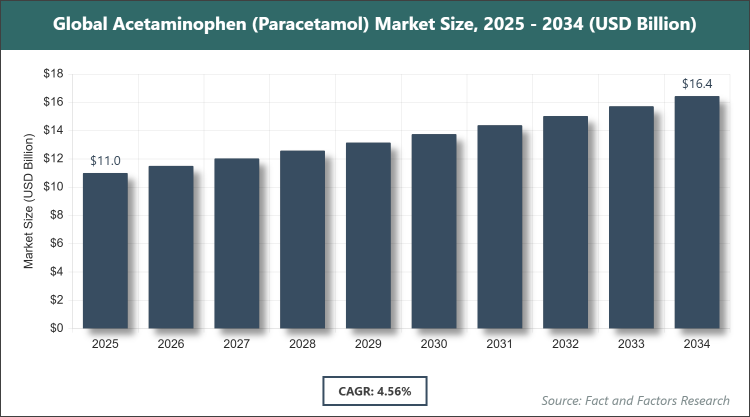
[200+ Pages Report] According to Facts & Factors, the global Acetaminophen (Paracetamol) market size was estimated at USD 11.01 billion in 2025 and is expected to reach USD 16.44 billion by 2034, growing at a CAGR of 4.56% from 2026 to 2034. Acetaminophen (Paracetamol) Market is driven by increasing prevalence of pain and fever-related conditions and rising demand for over-the-counter medications.
 Market Overview
The Acetaminophen (Paracetamol) market involves the production, distribution, and consumption of this widely used analgesic and antipyretic drug, known for its effectiveness in relieving mild to moderate pain and reducing fever without anti-inflammatory properties. It is available in various formulations and is a staple in over-the-counter medications, serving as a key component in household remedies and pharmaceutical combinations for conditions like headaches, muscle aches, and colds. The market supports healthcare needs by providing accessible, affordable pain management solutions, integrating into both prescription and non-prescription products to address everyday health issues and contribute to global wellness strategies.
Key Insights
- The global Acetaminophen (Paracetamol) market size in terms of revenue was estimated to be worth USD 11.01 billion in 2025 and is poised to reach USD 16.44 billion by 2034.
- Growing at a CAGR of 4.56% during the forecasted period from 2026 to 2034.
- The market is driven by rising incidence of chronic diseases, growing self-medication trends, and expanding pharmaceutical manufacturing in emerging economies.
- Based on the Product Type segment, the Tablet subsegment dominated the market with a share of 45% in 2025, due to its convenience, precise dosing, and widespread availability in over-the-counter formats.
- Based on the Application segment, the Headache and Fever subsegment dominated the market with a share of 50% in 2025, owing to acetaminophen's primary use as a first-line treatment for common ailments like headaches and fevers.
- Based on the Distribution Channel segment, the Retail Pharmacies subsegment dominated the market with a share of 55% in 2025, attributed to easy accessibility and consumer preference for purchasing over-the-counter medications locally.
- The North America region dominated the market with a share of 38% in 2025, driven by high per-capita consumption, strong presence of key manufacturers, and advanced healthcare infrastructure.
Growth Drivers
- Rising Prevalence of Pain and Fever-Related Conditions
The increasing incidence of chronic pain disorders, such as arthritis and migraines, along with seasonal illnesses like flu, has heightened demand for acetaminophen as a safe, effective relief option. Its non-addictive nature makes it preferable over opioids, supporting market growth in both developed and developing regions.
Additionally, aging populations worldwide contribute to sustained demand, as elderly individuals often require mild analgesics for daily pain management, further bolstered by healthcare recommendations favoring acetaminophen for its low risk of gastrointestinal side effects.
- Growing Self-Medication and OTC Availability
The trend towards self-medication, fueled by greater health awareness and easy access to over-the-counter drugs, drives acetaminophen sales. Pharmacies and online platforms make it readily available, encouraging consumers to manage minor ailments independently.
This shift is amplified by educational campaigns on safe usage, reducing healthcare visits and costs, while pharmaceutical companies innovate with flavored or fast-dissolving variants to appeal to diverse age groups, enhancing market penetration.
- Expansion in Pharmaceutical Manufacturing and Emerging Markets
Advancements in production technologies and cost-effective manufacturing in countries like India and China lower prices, making acetaminophen more accessible globally. This supports export growth and meets rising demand in emerging economies with improving healthcare access. Government initiatives for affordable medicines and partnerships for generic production further accelerate market expansion, ensuring supply chain stability and addressing global health needs effectively.
Restraints
- Health Risks and Regulatory Scrutiny
Concerns over liver toxicity from overdose lead to strict regulations on dosage and labeling, potentially limiting market growth by increasing compliance costs for manufacturers. Public awareness campaigns on safe usage may also deter excessive consumption. Moreover, recalls or restrictions in certain regions due to contamination issues erode consumer trust, prompting shifts to alternative analgesics and hindering overall market confidence.
- Competition from Alternative Analgesics
The availability of substitutes like ibuprofen and aspirin, which offer anti-inflammatory benefits, poses competition, especially for conditions requiring inflammation reduction. This diverts market share in segments where acetaminophen's limitations are evident. Price sensitivity in low-income regions favors cheaper alternatives, while patent expirations enable generic competition, pressuring branded products and squeezing profit margins.
Opportunities
- Innovation in Formulations and Combination Drugs
Development of extended-release and combination products with other active ingredients opens new avenues, catering to specific needs like cold relief or pediatric use. This innovation can capture niche markets and enhance product differentiation. Collaborations with biotech firms for safer, more effective variants could expand applications, such as in post-surgical pain management, driving revenue through premium pricing.
- Growth in Online Pharmacies and E-Commerce
The surge in digital sales channels provides opportunities to reach underserved areas, with convenient delivery boosting accessibility. Partnerships with e-commerce giants can amplify visibility and sales. Tailored online marketing and subscription models for regular users foster loyalty, while data analytics from digital platforms inform targeted product development.
Challenges
- Supply Chain Disruptions and Raw Material Volatility
Dependency on key raw materials like para-aminophenol, subject to price fluctuations and shortages, challenges production stability. Geopolitical issues can exacerbate supply disruptions. Manufacturers must invest in diversified sourcing, but this increases costs, potentially affecting affordability and market competitiveness.
- Overdose Awareness and Educational Gaps
Despite regulations, lack of awareness on proper dosing leads to health incidents, inviting further scrutiny and potential bans on high-dose products. This requires ongoing education efforts. Balancing promotion with safety messaging is crucial, as negative publicity can impact sales, necessitating proactive strategies from industry players.
Report Scope
Report Attribute |
Details |
Market Size in 2025 |
USD 11.01 Billion |
Projected Market Size in 2034 |
USD 16.44 Billion |
CAGR Growth Rate |
4.56% CAGR |
Base Year |
2025 |
Forecast Years |
2026-2034 |
Key Market Players |
Sanofi, Bayer AG, Teva Pharmaceutical Industries Ltd., Abbott, Novartis AG, and Others. |
Key Segment |
By Product Type, By Application, By Distribution Channel, and By Region |
Major Regions Covered |
North America, Europe, Asia Pacific, Latin America, and the Middle East &, Africa |
Purchase Options |
Request customized purchase options to meet your research needs. Explore purchase options |
Market Segmentation
The Acetaminophen (Paracetamol) market is segmented by product type, application, distribution channel, and region.
Based on Product Type Segment, the Acetaminophen (Paracetamol) market is divided into Tablet, Capsule, Liquid Suspension, Powder, and others. The most dominant subsegment is Tablet, which holds a significant market share due to its ease of administration, long shelf life, and precise dosage control, making it the preferred choice for adults and widely stocked in pharmacies. The second most dominant is Liquid Suspension, favored for pediatric and geriatric use where swallowing pills is challenging. These subsegments drive the market by addressing diverse consumer needs; Tablets enable mass production and global distribution, boosting accessibility and sales volume, while Liquid Suspensions enhance compliance in vulnerable populations, supporting overall growth through inclusive healthcare solutions.
Based on Application Segment, the Acetaminophen (Paracetamol) market is divided into Headache and Fever, Cold and Cough, Muscle Cramps, and others. The most dominant subsegment is Headache and Fever, leading due to acetaminophen's established efficacy as a first-line treatment for these common symptoms, endorsed by health organizations worldwide. The second most dominant is Cold and Cough, where it is often combined with other ingredients for symptomatic relief. Together, these drive market expansion by fulfilling everyday health demands; Headache and Fever applications ensure steady demand through self-medication trends, while Cold and Cough integrations spur innovation in multi-symptom products, increasing market value and penetration.
Based on Distribution Channel Segment, the Acetaminophen (Paracetamol) market is divided into Retail Pharmacies, Hospital Pharmacies, Online Pharmacies, and others. The most dominant subsegment is Retail Pharmacies, commanding the largest share as they provide immediate access to over-the-counter products without prescriptions. The second most dominant is Online Pharmacies, growing with digital convenience. These subsegments propel the market by enhancing distribution efficiency; Retail Pharmacies facilitate impulse purchases and local availability, driving volume sales, while Online Pharmacies expand reach to remote areas, fostering e-commerce growth and overall market accessibility.
Recent Developments
-
In 2023, the FDA approved a new extended-release acetaminophen formulation by a leading pharmaceutical company, aimed at providing longer-lasting pain relief with reduced dosing frequency, enhancing patient compliance.
- In 2024, a major collaboration between Indian generic manufacturers and European distributors expanded acetaminophen supply chains, addressing shortages and stabilizing prices in key markets.
- In 2025, research published in medical journals highlighted safer pediatric dosing guidelines for liquid acetaminophen, influencing global regulatory updates and product reformulations.
Regional Analysis
- North America to dominate the global market
North America leads the Acetaminophen (Paracetamol) market, supported by high healthcare expenditure, widespread OTC availability, and a culture of self-medication. The region's robust pharmaceutical industry and consumer preference for branded products drive demand. The United States, as the dominating country, excels with major manufacturers like Johnson & Johnson and extensive retail networks, where acetaminophen is a household staple for pain management. Advanced R&D focuses on combination therapies, while regulatory frameworks ensure safety, contributing to market stability and growth amid rising chronic conditions.
Europe maintains a strong position, emphasizing regulated access and generic formulations to control costs. Germany dominates, leveraging its pharmaceutical expertise and export capabilities for high-quality acetaminophen products. The region's aging population increases demand for fever and pain relief, with EU-wide standards promoting safe usage. Innovations in eco-friendly packaging and online sales channels further support expansion, addressing seasonal demands like flu seasons effectively.
Asia Pacific emerges as the fastest-growing region, driven by population growth and improving healthcare access. India and China dominate, with India leading in production and exports due to cost-effective manufacturing. Rapid urbanization and rising disposable incomes boost OTC purchases, while government health initiatives promote affordable generics, enhancing market penetration in rural areas.
Latin America shows steady growth, fueled by increasing awareness and pharmacy expansions. Brazil dominates, utilizing acetaminophen in public health programs for fever control in tropical diseases. Economic improvements enable better access, though challenges like counterfeit drugs persist, with international partnerships aiding quality assurance.
The Middle East & Africa region is developing, with demand rising from infectious diseases and pain management needs. South Africa dominates, applying acetaminophen in HIV and malaria treatments. Aid programs and investments in local production improve availability, focusing on affordable solutions for underserved populations.
Competitive Analysis
The global Acetaminophen (Paracetamol) market is dominated by players:
- Sanofi
- Bayer AG
- Teva Pharmaceutical Industries Ltd.
- Abbott
- Novartis AG
- Procter & Gamble
- Sun Pharmaceutical Industries
- Mallinckrodt Pharmaceuticals
- GlaxoSmithKline
- Johnson & Johnson
- And Others.
The global Acetaminophen (Paracetamol) market is segmented as follows:
-
By Product Type
- Tablet
- Capsule
- Liquid Suspension
- Powder
- Others
-
By Application
- Headache and Fever
- Cold and Cough
- Muscle Cramps
- Others
-
By Distribution Channel
- Retail Pharmacies
- Hospital Pharmacies
- Online Pharmacies
- Others
By Region
- North America
- The U.S.
- Canada
- Mexico
- Europe
- France
- The UK
- Spain
- Germany
- Italy
- Rest of Europe
- Asia Pacific
- China
- Japan
- India
- Australia
- Southeast Asia
- Rest of Asia Pacific
- The Middle East & Africa
- Saudi Arabia
- UAE
- Egypt
- Kuwait
- South Africa
- Rest of the Middle East & Africa
- Latin America
- Brazil
- Argentina
- Rest of Latin America
Industry Major Market Players
Frequently Asked Questions



Copyright © 2025 - 2026, All Rights Reserved, Facts and Factors