
Search Market Research Report
Accounts Payable Software Market Size, Share Global Analysis Report, 2026-2034

Accounts Payable Software Market Size, Share, Growth Analysis Report By Deployment Type (Cloud-based, On-premise, and Others), By Organization Size (Small and Medium-sized Enterprises (SMEs), Large Enterprises), By Vertical (Banking, Financial Services, and Insurance (BFSI), Manufacturing, Retail and Consumer Goods, Healthcare, IT and Telecom, and Others), and By Region - Global Industry Insights, Overview, Comprehensive Analysis, Trends, Statistical Research, Market Intelligence, Historical Data and Forecast 2026-2034
Industry Insights
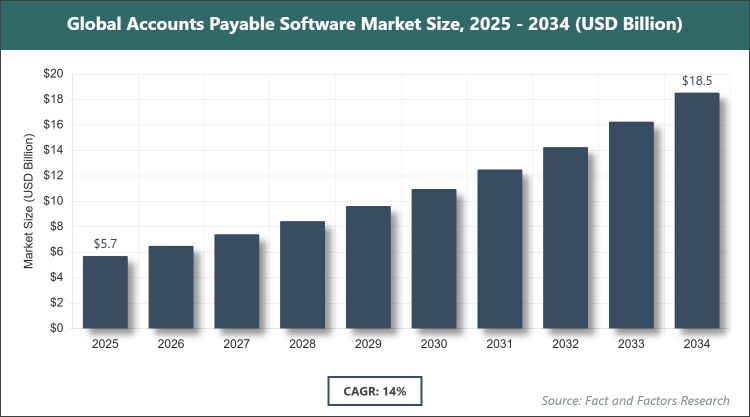
[220+ Pages Report] According to Facts & Factors, the global Accounts Payable Software market size was estimated at USD 5.7 billion in 2025 and is expected to reach USD 18.1 billion by 2034, growing at a CAGR of 14% from 2026 to 2034. Accounts Payable Software Market is driven by increasing adoption of automation to enhance efficiency and reduce errors in financial operations.
 Market Overview
The Accounts Payable Software market refers to the sector encompassing digital solutions designed to automate and streamline the management of vendor invoices, payments, and related financial processes within organizations. This software facilitates the efficient handling of invoice receipt, approval workflows, payment scheduling, and reconciliation, replacing manual methods with integrated systems that enhance accuracy, compliance, and visibility into cash flow. It serves businesses across various scales and industries by integrating with enterprise resource planning systems, enabling seamless data exchange and supporting strategic financial decision-making through real-time analytics and reporting features.
Key Insights
- The global Accounts Payable Software market size in terms of revenue was estimated to be worth USD 5.7 billion in 2025 and is poised to reach USD 18.1 billion by 2034.
- Growing at a CAGR of 14% during the forecasted period from 2026 to 2034.
- The market is driven by rising demand for digital transformation in finance, cost reduction, and regulatory compliance needs.
- Based on the Deployment Type segment, the Cloud-based subsegment dominated the market with a share of 70% in 2025, due to its scalability, lower upfront costs, and ease of integration with existing systems.
- Based on the Organization Size segment, the Large Enterprises subsegment dominated the market with a share of 60% in 2025, owing to their complex financial operations and need for advanced automation features.
- Based on the Vertical segment, the BFSI subsegment dominated the market with a share of 35% in 2025, attributed to high transaction volumes and stringent compliance requirements.
- The North America region dominated the market with a share of 40% in 2025, driven by early technology adoption and presence of key market players.
Growth Drivers
- Digital Transformation in Finance and Accounting
The acceleration of digital transformation initiatives across industries is propelling the adoption of accounts payable software, as businesses seek to automate manual processes for greater efficiency and accuracy. This shift reduces processing times and minimizes human errors, allowing finance teams to focus on strategic activities rather than routine tasks.
Moreover, integration with emerging technologies like AI and machine learning enhances predictive analytics and fraud detection, further driving market growth by providing actionable insights and improving overall financial health.
- Cost Reduction and Operational Efficiency
Organizations are increasingly turning to accounts payable software to cut operational costs associated with paper-based invoicing and manual approvals. Automation streamlines workflows, reduces late payment penalties, and optimizes cash management, leading to significant savings.
In addition, the software's ability to handle high volumes of transactions with minimal resources supports scalability, making it attractive for growing enterprises aiming to maintain competitiveness in cost-sensitive environments.
- Regulatory Compliance and Risk Management
Stringent regulatory requirements for financial reporting and auditing are pushing companies to adopt accounts payable software that ensures compliance through automated tracking and documentation. This mitigates risks associated with non-compliance and enhances audit readiness. Furthermore, features like real-time monitoring and secure data handling address growing concerns over data privacy and cybersecurity, fostering trust and encouraging wider adoption across regulated industries.
Restraints
- High Initial Implementation Costs
The substantial upfront investment required for software deployment, including customization and training, poses a barrier for small and medium-sized enterprises. This financial hurdle can delay adoption, particularly in budget-constrained organizations. Additionally, integration challenges with legacy systems may increase costs and complexity, deterring potential users and limiting market penetration in certain sectors.
- Data Security and Privacy Concerns
Growing cyber threats and data breaches raise concerns about the security of sensitive financial information handled by accounts payable software. Organizations hesitate to migrate to cloud-based solutions due to perceived vulnerabilities. Moreover, varying global data protection regulations complicate compliance efforts, potentially slowing market growth as companies prioritize secure, on-premise alternatives over innovative but riskier options.
Opportunities
- Expansion in Emerging Markets
Rapid economic growth in emerging regions presents opportunities for accounts payable software providers to tap into underserved markets with tailored, affordable solutions. Increasing digitalization in these areas drives demand for efficient financial tools. Partnerships with local firms can facilitate market entry, enabling customization to regional needs and accelerating adoption among growing businesses.
- Integration with AI and Emerging Technologies
Advancements in AI offer opportunities to enhance accounts payable software with predictive capabilities and automated decision-making. This integration can revolutionize invoice processing and payment optimization. As technology evolves, providers can differentiate through innovative features, attracting tech-savvy enterprises seeking competitive advantages in financial management.
Challenges
- Resistance to Change and Skill Gaps
Organizational resistance to adopting new technologies, coupled with a lack of skilled personnel, hinders the effective implementation of accounts payable software. Training requirements can prolong rollout periods. Addressing this through user-friendly interfaces and comprehensive support is essential, but persistent skill gaps in certain regions continue to challenge market expansion.
- Market Fragmentation and Competition
The presence of numerous vendors leads to market fragmentation, making it difficult for buyers to select suitable solutions. Intense competition pressures pricing and innovation. Differentiating through unique value propositions is crucial, yet rapid technological changes require continuous investment, posing challenges for smaller players.
Report Scope
Report Attribute |
Details |
Market Size in 2025 |
USD 5.7 Billion |
Projected Market Size in 2034 |
USD 18.1 Billion |
CAGR Growth Rate |
14% CAGR |
Base Year |
2025 |
Forecast Years |
2026-2034 |
Key Market Players |
SAP Ariba, Sage Software, Tipalti, FreshBooks, Zycus, and Others. |
Key Segment |
By Deployment Type, By Organization Size, By Vertical, and By Region |
Major Regions Covered |
North America, Europe, Asia Pacific, Latin America, and the Middle East &, Africa |
Purchase Options |
Request customized purchase options to meet your research needs. Explore purchase options |
Market Segmentation
The Accounts Payable Software market is segmented by deployment type, organization size, vertical, and region.
Based on Deployment Type Segment, The Accounts Payable Software market is divided into Cloud-based, On-premise, and others. The most dominant subsegment is Cloud-based, which holds a significant market share due to its flexibility, remote accessibility, and subscription-based pricing that lowers entry barriers for businesses. The second most dominant is On-premise, preferred for its control over data security in highly regulated environments. These subsegments drive the market by offering choices that cater to diverse operational needs; Cloud-based solutions enable rapid scalability and integration with other cloud services, boosting efficiency in dynamic markets, while On-premise options ensure compliance and customization, collectively advancing automation and cost savings across industries.
Based on Organization Size Segment, The Accounts Payable Software market is divided into Small and Medium-sized Enterprises (SMEs), Large Enterprises. The most dominant subsegment is Large Enterprises, leading due to their extensive vendor networks and complex financial requirements that necessitate robust automation for handling large transaction volumes. The second most dominant is SMEs, growing rapidly with affordable cloud options. Together, these drive market growth by addressing scale-specific challenges; Large Enterprises leverage advanced features for enterprise-wide integration and analytics, enhancing strategic financial oversight, while SMEs benefit from simplified tools that reduce administrative burdens, promoting broader digital adoption and operational agility.
Based on Vertical Segment, The Accounts Payable Software market is divided into Banking, Financial Services, and Insurance (BFSI), Manufacturing, Retail and Consumer Goods, Healthcare, IT and Telecom, and others. The most dominant subsegment is BFSI, commanding the largest share owing to high regulatory demands and the need for secure, high-volume transaction processing. The second most dominant is Manufacturing, driven by supply chain complexities. These subsegments propel the market by fulfilling industry-specific needs; BFSI utilizes software for compliance and risk management, ensuring seamless operations in a regulated landscape, while Manufacturing optimizes supplier payments and inventory ties, improving efficiency and supporting overall market expansion through tailored automation.
Recent Developments
- In January 2025, AvidXchange was acquired by TPG in partnership with Corpay for USD 2.2 billion, creating a combined entity focused on B2B payments and accounts payable automation to serve a larger merchant base and process higher transaction volumes.
- In December 2025, Basware acquired Redmap, an Australian accounts payable automation provider, to strengthen its AI-driven capabilities and expand its presence in the Asia-Pacific region with enhanced invoice management solutions.
- In July 2025, Tipalti acquired Statement, an AI-native treasury automation firm, integrating real-time cash intelligence into its platform to complement accounts payable functions and improve finance automation for users.
Regional Analysis
- North America to dominate the global market
North America maintains dominance in the Accounts Payable Software market, fueled by its advanced technological infrastructure and high adoption rates of automation solutions. The region's emphasis on efficiency and compliance drives demand, with significant investments in AI-integrated software. The United States, as the dominating country, leads through innovation hubs and major vendors like Coupa and AvidXchange, supported by robust regulatory frameworks that encourage digital financial tools. This position is reinforced by a mature ecosystem of enterprises prioritizing cost optimization and real-time analytics, enabling widespread implementation across sectors like BFSI and manufacturing.
Europe exhibits strong growth, driven by stringent data protection laws like GDPR and a focus on sustainable financial practices. Germany dominates, leveraging its industrial base and tech-savvy firms to adopt cloud-based solutions for efficient cross-border transactions. The region's collaborative initiatives and EU-wide e-invoicing mandates accelerate adoption, particularly in manufacturing and retail, where software enhances supply chain visibility and compliance.
Asia Pacific is experiencing rapid expansion, propelled by digitalization efforts and economic growth. China and India dominate, with China leading due to its massive manufacturing sector and government-backed tech initiatives. The region benefits from increasing SME adoption of affordable cloud software, addressing challenges like diverse payment systems and regulatory variations to improve operational efficiency.
Latin America shows emerging potential, with growth tied to improving digital infrastructure and foreign investments. Brazil dominates, utilizing accounts payable software in its export-driven economy to manage complex tax regimes and supplier relations in sectors like manufacturing. Challenges such as economic volatility persist, but opportunities in cloud adoption are fostering market development.
The Middle East & Africa region is gradually adopting, focused on oil-dependent economies transitioning to diversified sectors. The UAE dominates, applying software in BFSI and retail to enhance transparency and efficiency amid rapid urbanization. International partnerships and investments in tech infrastructure are key, supporting growth in addressing regional challenges like payment delays.
Competitive Analysis
The global Accounts Payable Software market is dominated by players:
- SAP Ariba
- Sage Software
- Tipalti
- FreshBooks
- Zycus
- FIS
- Bottomline Technologies
- Coupa Software
- Comarch
- FinancialForce
- AvidXchange
- Bill.com
- Procurify
- Nvoicepay
- And Others.
The global Accounts Payable Software market is segmented as follows:
-
By Deployment Type
- Cloud-based
- On-premise
- Others
-
By Organization Size
- Small and Medium-sized Enterprises (SMEs)
- Large Enterprises
-
By Vertical
- Banking, Financial Services, and Insurance (BFSI)
- Manufacturing
- Retail and Consumer Goods
- Healthcare
- IT and Telecom
- Others
By Region
- North America
- The U.S.
- Canada
- Mexico
- Europe
- France
- The UK
- Spain
- Germany
- Italy
- Rest of Europe
- Asia Pacific
- China
- Japan
- India
- Australia
- Southeast Asia
- Rest of Asia Pacific
- The Middle East & Africa
- Saudi Arabia
- UAE
- Egypt
- Kuwait
- South Africa
- Rest of the Middle East & Africa
- Latin America
- Brazil
- Argentina
- Rest of Latin America
Industry Major Market Players
Frequently Asked Questions



Copyright © 2025 - 2026, All Rights Reserved, Facts and Factors